
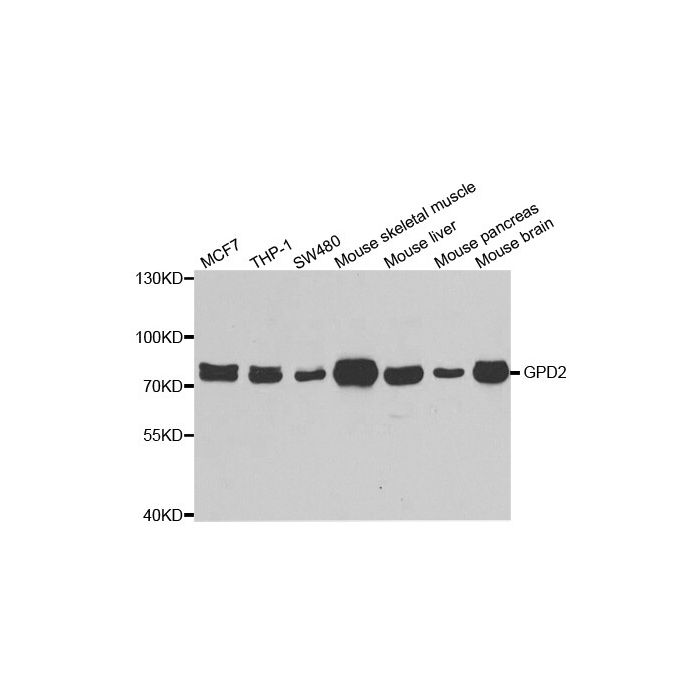
GPD2 polyclonal, anti-human, mouse, rat
€388.00
In stock
SKU
BS8295
Background:
GPD2 (glycerol-3-phosphate dehydrogenase 2, mitochondrial), also known as GDH2 or GPDM, is a 727 amino acid protein belonging to the FAD-dependent glycerol-3-phosphate dehydrogenase family. GPD2 is involved in the conversion of glycerol-3-phosphate (G-3-P) to dihydroxyacetone phosphate (DHAP) while reducing enzyme-bound FAD. Localizing to the outer surface of the inner mitochondrial membrane, GPD2 acts in conjunction with GPD1 (a cytosolic NAD-linked GPD) to form a glycerol phosphate shuttle that ultimately results in the reoxidation of NADH formed during glycolysis. While widely expressed in adult and fetal tissue, GPD2 is found at highest levels in human pancreatic islets where it is essential for pancreatic B-cell glucose-sensory function. Decreased levels of GPD2 leads to impaired glucose-stimulated insulin release in noninsulin-dependent diabetes mellitus. Existing as two alternatively spliced isoforms, GPD2 contains two EF-hand domains and maps to human chromosome 2q24.1.
Alternative Name:
Glycerol-3-phosphate dehydrogenase, mitochondrial, GPD-M, GPDH-M, mtGPD, GPD2
Application Dilution: WB: 1:500~1:2000, IHC: 1:50~1:200
Specificity: GPD2 polyclonal antibody detects endogenous levels of GPD2 protein.
Immunogen:
Recombinant full length Human GPD2.
MW: ~ 81 kDa
Swis Prot.: P43304
Purification & Purity:
The antibody was affinity-purified from rabbit antiserum by affinity-chromatography using epitope-specific immunogen and the purity is > 95% (by SDS-PAGE).
Format:
1mg/ml in PBS with 0.1% Sodium Azide, 50% Glycerol.
Storage:
Store at 4°C short term. Aliquot and store at -20°C long term. Avoid freeze-thaw cycles.
For research use only, not for use in diagnostic procedure.
GPD2 (glycerol-3-phosphate dehydrogenase 2, mitochondrial), also known as GDH2 or GPDM, is a 727 amino acid protein belonging to the FAD-dependent glycerol-3-phosphate dehydrogenase family. GPD2 is involved in the conversion of glycerol-3-phosphate (G-3-P) to dihydroxyacetone phosphate (DHAP) while reducing enzyme-bound FAD. Localizing to the outer surface of the inner mitochondrial membrane, GPD2 acts in conjunction with GPD1 (a cytosolic NAD-linked GPD) to form a glycerol phosphate shuttle that ultimately results in the reoxidation of NADH formed during glycolysis. While widely expressed in adult and fetal tissue, GPD2 is found at highest levels in human pancreatic islets where it is essential for pancreatic B-cell glucose-sensory function. Decreased levels of GPD2 leads to impaired glucose-stimulated insulin release in noninsulin-dependent diabetes mellitus. Existing as two alternatively spliced isoforms, GPD2 contains two EF-hand domains and maps to human chromosome 2q24.1.
Alternative Name:
Glycerol-3-phosphate dehydrogenase, mitochondrial, GPD-M, GPDH-M, mtGPD, GPD2
Application Dilution: WB: 1:500~1:2000, IHC: 1:50~1:200
Specificity: GPD2 polyclonal antibody detects endogenous levels of GPD2 protein.
Immunogen:
Recombinant full length Human GPD2.
MW: ~ 81 kDa
Swis Prot.: P43304
Purification & Purity:
The antibody was affinity-purified from rabbit antiserum by affinity-chromatography using epitope-specific immunogen and the purity is > 95% (by SDS-PAGE).
Format:
1mg/ml in PBS with 0.1% Sodium Azide, 50% Glycerol.
Storage:
Store at 4°C short term. Aliquot and store at -20°C long term. Avoid freeze-thaw cycles.
For research use only, not for use in diagnostic procedure.
| Is Featured? | No |
|---|
Write Your Own Review