
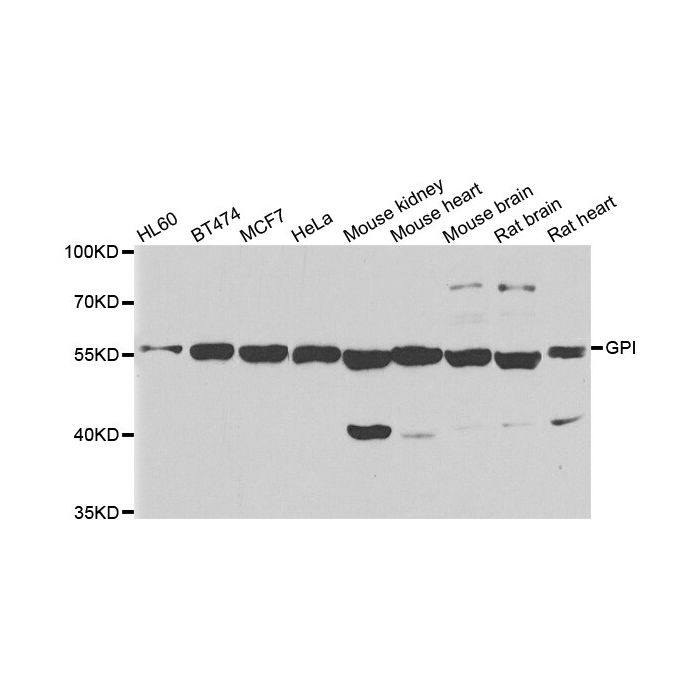
GPI polyclonal, anti-human, mouse, rat
€388.00
In stock
SKU
BS8581
Background:
This gene encodes a member of the glucose phosphate isomerase protein family. The encoded protein has been identified as a moonlighting protein based on its ability to perform mechanistically distinct functions. In the cytoplasm, the gene product functions as a glycolytic enzyme (glucose-6-phosphate isomerase) that interconverts glucose-6-phophsate and fructose-6-phosphate. Extracellularly, the encoded protein (also referred to as neuroleukin) functions as a neurotrophic factor that promotes survival of skeletal motor neurons and sensory neurons, and as a lymphokine that induces immunoglobulin secretion. The encoded protein is also referred to as autocrine motility factor based on an additional function as a tumor-secreted cytokine and angiogenic factor. Defects in this gene are the cause of nonspherocytic hemolytic anemia and a severe enzyme deficiency can be associated with hydrops fetalis, immediate neonatal death and neurological impairment. Alternative splicing results in multiple transcript variants.
Alternative Name:
Glucose-6-phosphate isomerase, GPI, Autocrine motility factor, AMF, Neuroleukin, NLK, Phosphoglucose isomerase, PGI, Phosphohexose isomerase, PHI, Sperm antigen 36, SA-36, GPI
Application Dilution: WB: 1:500~1:2000, IHC: 1:50~1:200, IF: 1:50~1:200
Specificity: GPI polyclonal antibody detects endogenous levels of GPI protein.
Immunogen:
Recombinant full length Human GPI.
MW: ~ 63kDa
Swis Prot.: P06744
Purification & Purity:
The antibody was affinity-purified from rabbit antiserum by affinity-chromatography using epitope-specific immunogen and the purity is > 95% (by SDS-PAGE).
Format:
1mg/ml in PBS with 0.1% Sodium Azide, 50% Glycerol.
Storage:
Store at 4°C short term. Aliquot and store at -20°C long term. Avoid freeze-thaw cycles.
For research use only, not for use in diagnostic procedure.
This gene encodes a member of the glucose phosphate isomerase protein family. The encoded protein has been identified as a moonlighting protein based on its ability to perform mechanistically distinct functions. In the cytoplasm, the gene product functions as a glycolytic enzyme (glucose-6-phosphate isomerase) that interconverts glucose-6-phophsate and fructose-6-phosphate. Extracellularly, the encoded protein (also referred to as neuroleukin) functions as a neurotrophic factor that promotes survival of skeletal motor neurons and sensory neurons, and as a lymphokine that induces immunoglobulin secretion. The encoded protein is also referred to as autocrine motility factor based on an additional function as a tumor-secreted cytokine and angiogenic factor. Defects in this gene are the cause of nonspherocytic hemolytic anemia and a severe enzyme deficiency can be associated with hydrops fetalis, immediate neonatal death and neurological impairment. Alternative splicing results in multiple transcript variants.
Alternative Name:
Glucose-6-phosphate isomerase, GPI, Autocrine motility factor, AMF, Neuroleukin, NLK, Phosphoglucose isomerase, PGI, Phosphohexose isomerase, PHI, Sperm antigen 36, SA-36, GPI
Application Dilution: WB: 1:500~1:2000, IHC: 1:50~1:200, IF: 1:50~1:200
Specificity: GPI polyclonal antibody detects endogenous levels of GPI protein.
Immunogen:
Recombinant full length Human GPI.
MW: ~ 63kDa
Swis Prot.: P06744
Purification & Purity:
The antibody was affinity-purified from rabbit antiserum by affinity-chromatography using epitope-specific immunogen and the purity is > 95% (by SDS-PAGE).
Format:
1mg/ml in PBS with 0.1% Sodium Azide, 50% Glycerol.
Storage:
Store at 4°C short term. Aliquot and store at -20°C long term. Avoid freeze-thaw cycles.
For research use only, not for use in diagnostic procedure.
| Is Featured? | No |
|---|
Write Your Own Review