
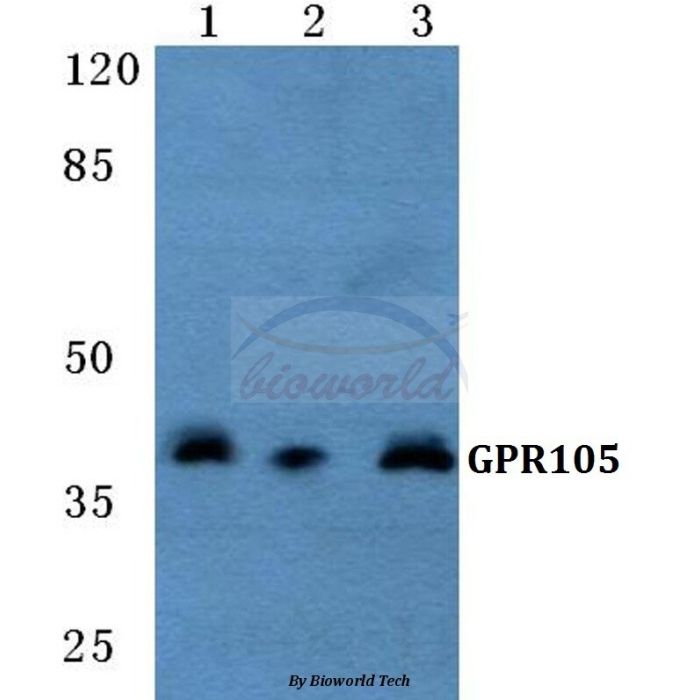
GPR105 polyclonal, anti-human, mouse, rat
€305.00
In stock
SKU
BS5738
Background:
G protein-coupled receptors (GPRs) are a protein family of transmembrane receptors that transmit an extracellular signal (ligand binding) into an intracellular signal (G protein activation). GPR signaling is an evolutionarily ancient mechanism used by all eukaryotes to sense environmental stimuli and mediate cell-cell communication. All of the receptors have seven membrane-spanning domains and the extracellular parts of the receptor can be glycosylated. These extracellular loops also contain two highly conserved cysteine residues which create disulfide bonds to stabilize the receptor structure. GPR105, also designated P2Y14, is widely expressed throughout many brain regions where it localizes to glial cells, and specifically co-localizes with astrocytes. GPR105 is upregulated when a tissue is immunologically challenged with lipopolysaccharide, leading to the theory that GPR105 may play an important role in modulating peripheral and neuroimmune function.
Alternative Name:
P2Y purinoceptor 14, P2Y14, G-protein coupled receptor 105, UDP-glucose receptor, P2RY14, KIAA000
Application Dilution: WB: 1:500~1:1000, ICC: 1:50~1:200
Specificity: GPR105 polyclonal antibody detects endogenous levels of GPR105 protein.
Immunogen:
Synthetic peptide, corresponding to amino acids 197-242 of Human GPR105.
MW: ~ 39 kDa
Swis Prot.: Q15391
Purification & Purity:
The antibody was affinity-purified from rabbit antiserum by affinity-chromatography using epitope-specific immunogen and the purity is > 95% (by SDS-PAGE).
Format:
1 mg/ml in Phosphate buffered saline (PBS) with 15 mM sodium azide, approx. pH 7.2.
Storage:
Store at 4°C short term. Aliquot and store at -20°C long term. Avoid freeze-thaw cycles.
For research use only, not for use in diagnostic procedure.
G protein-coupled receptors (GPRs) are a protein family of transmembrane receptors that transmit an extracellular signal (ligand binding) into an intracellular signal (G protein activation). GPR signaling is an evolutionarily ancient mechanism used by all eukaryotes to sense environmental stimuli and mediate cell-cell communication. All of the receptors have seven membrane-spanning domains and the extracellular parts of the receptor can be glycosylated. These extracellular loops also contain two highly conserved cysteine residues which create disulfide bonds to stabilize the receptor structure. GPR105, also designated P2Y14, is widely expressed throughout many brain regions where it localizes to glial cells, and specifically co-localizes with astrocytes. GPR105 is upregulated when a tissue is immunologically challenged with lipopolysaccharide, leading to the theory that GPR105 may play an important role in modulating peripheral and neuroimmune function.
Alternative Name:
P2Y purinoceptor 14, P2Y14, G-protein coupled receptor 105, UDP-glucose receptor, P2RY14, KIAA000
Application Dilution: WB: 1:500~1:1000, ICC: 1:50~1:200
Specificity: GPR105 polyclonal antibody detects endogenous levels of GPR105 protein.
Immunogen:
Synthetic peptide, corresponding to amino acids 197-242 of Human GPR105.
MW: ~ 39 kDa
Swis Prot.: Q15391
Purification & Purity:
The antibody was affinity-purified from rabbit antiserum by affinity-chromatography using epitope-specific immunogen and the purity is > 95% (by SDS-PAGE).
Format:
1 mg/ml in Phosphate buffered saline (PBS) with 15 mM sodium azide, approx. pH 7.2.
Storage:
Store at 4°C short term. Aliquot and store at -20°C long term. Avoid freeze-thaw cycles.
For research use only, not for use in diagnostic procedure.
| Is Featured? | No |
|---|
Write Your Own Review