
GPR125 polyclonal, anti-human, mouse, rat
€305.00
In stock
SKU
BS60351
Background:
G protein-coupled receptors (GPRs), also known as seven transmembrane receptors, heptahelical receptors or 7TM receptors, comprise a superfamily of proteins that play a role in many different stimulus-response pathways. G protein coupled receptors translate extracellular signals into intracellular signals (G protein activation) and they respond to a variety of signaling molecules, such as hormones and neurotransmitters. GPR125 (G protein-coupled receptor 125), also known as PGR21 or TEM5L, is a 1,321 amino acid multi-pass membrane protein belonging to the G-protein coupled receptor 2 family and the LN-TM7 subfamily. Considered a novel orphan adhesion-type G-protein-coupled receptor, GPR125 has five leucine rich repeats (LRR), an immunoglobulin (Ig) domain and a GPS domain. GPR125 may play a functional role in choroidal and hippocampal response to brain injury. It is also suggested that GPR125 may be a marker for spermatogonial stem cells. Four isoforms of GPR125 exists due to alternative splicing events.
Alternative Name:
Probable G-protein coupled receptor 125, GPR125, UNQ556/PRO1113
Application Dilution: WB: 1:500~1:1000
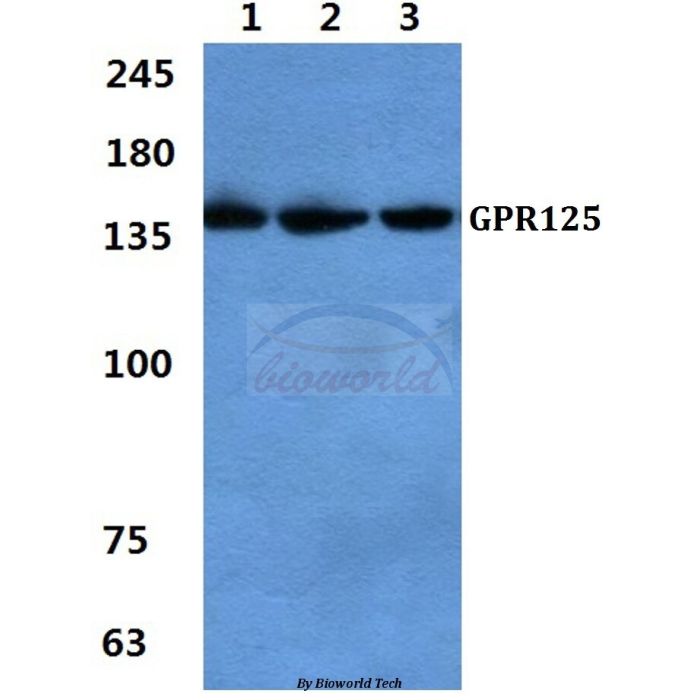
Specificity: GPR125 polyclonal antibody detects endogenous levels of GPR125 protein.
Immunogen:
A synthetic peptide corresponding to residues in Human GPR125.
MW: ~ 140 kDa
Swis Prot.: Q8IWK6
Purification & Purity:
The antibody was affinity-purified from rabbit antiserum by affinity-chromatography using epitope-specific immunogen and the purity is > 95% (by SDS-PAGE).
Format:
1mg/ml in PBS with 0.1% Sodium Azide, 50% Glycerol.
Storage:
Store at 4°C short term. Aliquot and store at -20°C long term. Avoid freeze-thaw cycles.
For research use only, not for use in diagnostic procedure.
G protein-coupled receptors (GPRs), also known as seven transmembrane receptors, heptahelical receptors or 7TM receptors, comprise a superfamily of proteins that play a role in many different stimulus-response pathways. G protein coupled receptors translate extracellular signals into intracellular signals (G protein activation) and they respond to a variety of signaling molecules, such as hormones and neurotransmitters. GPR125 (G protein-coupled receptor 125), also known as PGR21 or TEM5L, is a 1,321 amino acid multi-pass membrane protein belonging to the G-protein coupled receptor 2 family and the LN-TM7 subfamily. Considered a novel orphan adhesion-type G-protein-coupled receptor, GPR125 has five leucine rich repeats (LRR), an immunoglobulin (Ig) domain and a GPS domain. GPR125 may play a functional role in choroidal and hippocampal response to brain injury. It is also suggested that GPR125 may be a marker for spermatogonial stem cells. Four isoforms of GPR125 exists due to alternative splicing events.
Alternative Name:
Probable G-protein coupled receptor 125, GPR125, UNQ556/PRO1113
Application Dilution: WB: 1:500~1:1000
Specificity: GPR125 polyclonal antibody detects endogenous levels of GPR125 protein.
Immunogen:
A synthetic peptide corresponding to residues in Human GPR125.
MW: ~ 140 kDa
Swis Prot.: Q8IWK6
Purification & Purity:
The antibody was affinity-purified from rabbit antiserum by affinity-chromatography using epitope-specific immunogen and the purity is > 95% (by SDS-PAGE).
Format:
1mg/ml in PBS with 0.1% Sodium Azide, 50% Glycerol.
Storage:
Store at 4°C short term. Aliquot and store at -20°C long term. Avoid freeze-thaw cycles.
For research use only, not for use in diagnostic procedure.
| Is Featured? | No |
|---|
Write Your Own Review