
GPR171 polyclonal, anti-human, mouse, rat
€305.00
In stock
SKU
BS5742
Background:
G protein-coupled receptors (GPRs), also known as seven transmembrane receptors, heptahelical receptors or 7TM receptors, comprise a superfamily of proteins that play a role in many different stimulus-response pathways. GPR signaling is an evolutionarily ancient mechanism used by all eukaryotes to sense environmental stimuli and mediate cell-cell communication. G protein-coupled receptors translate extracellular signals into intracellular signals (G protein activation) and they respond to a variety of signaling molecules, such as hormones and neurotransmitters. G protein-coupled receptors provide attractive targets for drug therapy due to the sheer size and diversity of ligands within this receptor family. GPR171, also designated H963, is a 319 amino acid protein that is structurally related to the purinergic receptors P2Y12, P2Y13 and P2Y14.
Alternative Name:
Probable G-protein coupled receptor 171, G-protein coupled receptor H963
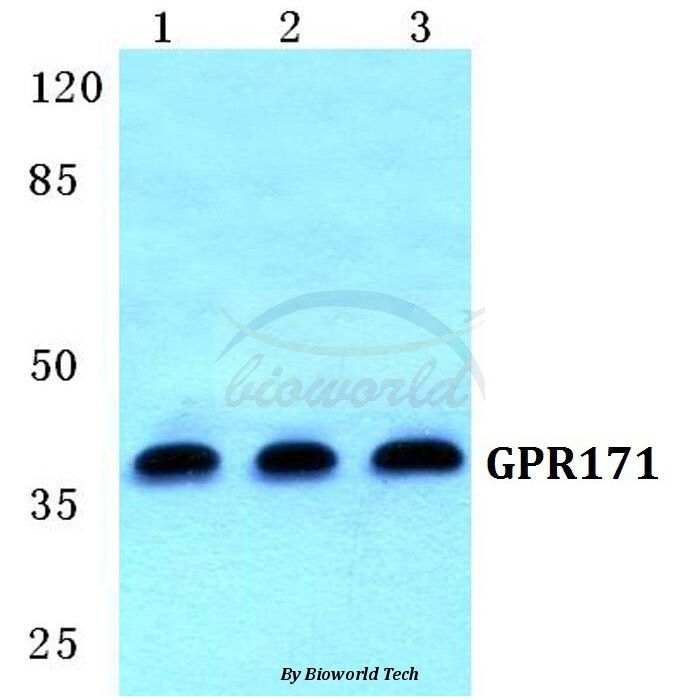
Application Dilution: WB: 1:500~1:1000, IF: 1:200
Specificity: GPR171 polyclonal antibody detects endogenous levels of GPR171 protein.
Immunogen:
Synthetic peptide, corresponding to amino acids 226-271 of Human GPR171.
MW: ~ 37 kDa
Swis Prot.: O14626
Purification & Purity:
The antibody was affinity-purified from rabbit antiserum by affinity-chromatography using epitope-specific immunogen and the purity is > 95% (by SDS-PAGE).
Format:
1 mg/ml in Phosphate buffered saline (PBS) with 0.05% sodium azide, approx. pH 7.2.
Storage:
Store at 4°C short term. Aliquot and store at -20°C long term. Avoid freeze-thaw cycles.
For research use only, not for use in diagnostic procedure.
G protein-coupled receptors (GPRs), also known as seven transmembrane receptors, heptahelical receptors or 7TM receptors, comprise a superfamily of proteins that play a role in many different stimulus-response pathways. GPR signaling is an evolutionarily ancient mechanism used by all eukaryotes to sense environmental stimuli and mediate cell-cell communication. G protein-coupled receptors translate extracellular signals into intracellular signals (G protein activation) and they respond to a variety of signaling molecules, such as hormones and neurotransmitters. G protein-coupled receptors provide attractive targets for drug therapy due to the sheer size and diversity of ligands within this receptor family. GPR171, also designated H963, is a 319 amino acid protein that is structurally related to the purinergic receptors P2Y12, P2Y13 and P2Y14.
Alternative Name:
Probable G-protein coupled receptor 171, G-protein coupled receptor H963
Application Dilution: WB: 1:500~1:1000, IF: 1:200
Specificity: GPR171 polyclonal antibody detects endogenous levels of GPR171 protein.
Immunogen:
Synthetic peptide, corresponding to amino acids 226-271 of Human GPR171.
MW: ~ 37 kDa
Swis Prot.: O14626
Purification & Purity:
The antibody was affinity-purified from rabbit antiserum by affinity-chromatography using epitope-specific immunogen and the purity is > 95% (by SDS-PAGE).
Format:
1 mg/ml in Phosphate buffered saline (PBS) with 0.05% sodium azide, approx. pH 7.2.
Storage:
Store at 4°C short term. Aliquot and store at -20°C long term. Avoid freeze-thaw cycles.
For research use only, not for use in diagnostic procedure.
| Is Featured? | No |
|---|
Write Your Own Review