
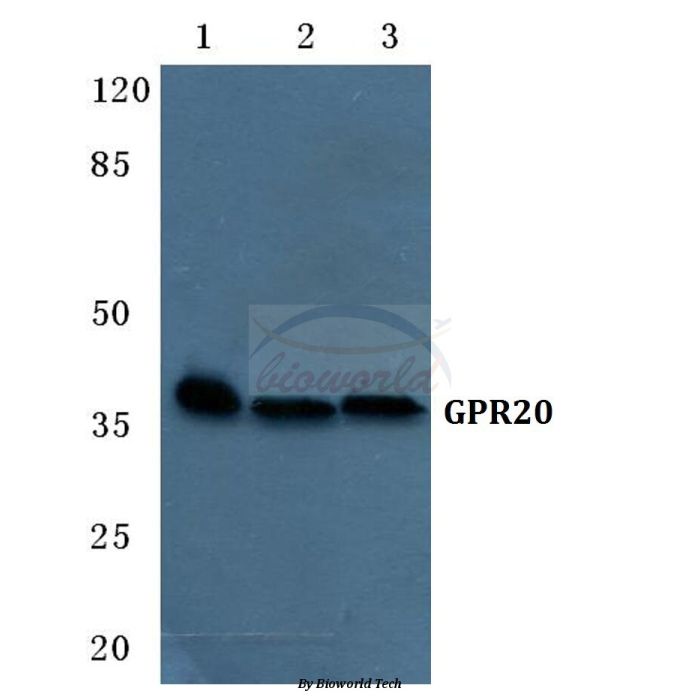
GPR20 polyclonal, anti-human, mouse, rat
€305.00
In stock
SKU
BS5746
Background:
G protein-coupled receptors (GPRs), also known as seven transmembrane receptors, heptahelical receptors or 7TM receptors, comprise a superfamily of proteins that play a role in many different stimulus-response pathways. GPR signaling is an evolutionarily ancient mechanism used by all eukaryotes to sense environmental stimuli and mediate cell-cell communication. G protein-coupled receptors translate extracellular signals into intracellular signals (G protein activation) and they respond to a variety of signaling molecules, such as hormones and neurotransmitters. GPR20 is a 358 amino acid membrane protein that constitutively activates G(i) proteins without ligand stimulation. Also, GPR20 may be involved in the control of intracellular cAMP levels and mitogenic signaling. Interestingly, GPR20 is expressed in liver and certain regions of the brain, including putamen, caudate and thalamus, but is not expressed in hypothalamus, pons and frontal cortex.
Alternative Name:
G-protein coupled receptor 20
Application Dilution: WB: 1:500~1:1000, IF: 1:200
Specificity: GPR20 polyclonal antibody detects endogenous levels of GPR20 protein.
Immunogen:
Synthetic peptide, corresponding to amino acids 313-358 of Human GPR20.
MW: ~ 38 kDa
Swis Prot.: Q99678
Purification & Purity:
The antibody was affinity-purified from rabbit antiserum by affinity-chromatography using epitope-specific immunogen and the purity is > 95% (by SDS-PAGE).
Format:
1 mg/ml in Phosphate buffered saline (PBS) with 0.05% sodium azide, approx. pH 7.2.
Storage:
Store at 4°C short term. Aliquot and store at -20°C long term. Avoid freeze-thaw cycles.
For research use only, not for use in diagnostic procedure.
G protein-coupled receptors (GPRs), also known as seven transmembrane receptors, heptahelical receptors or 7TM receptors, comprise a superfamily of proteins that play a role in many different stimulus-response pathways. GPR signaling is an evolutionarily ancient mechanism used by all eukaryotes to sense environmental stimuli and mediate cell-cell communication. G protein-coupled receptors translate extracellular signals into intracellular signals (G protein activation) and they respond to a variety of signaling molecules, such as hormones and neurotransmitters. GPR20 is a 358 amino acid membrane protein that constitutively activates G(i) proteins without ligand stimulation. Also, GPR20 may be involved in the control of intracellular cAMP levels and mitogenic signaling. Interestingly, GPR20 is expressed in liver and certain regions of the brain, including putamen, caudate and thalamus, but is not expressed in hypothalamus, pons and frontal cortex.
Alternative Name:
G-protein coupled receptor 20
Application Dilution: WB: 1:500~1:1000, IF: 1:200
Specificity: GPR20 polyclonal antibody detects endogenous levels of GPR20 protein.
Immunogen:
Synthetic peptide, corresponding to amino acids 313-358 of Human GPR20.
MW: ~ 38 kDa
Swis Prot.: Q99678
Purification & Purity:
The antibody was affinity-purified from rabbit antiserum by affinity-chromatography using epitope-specific immunogen and the purity is > 95% (by SDS-PAGE).
Format:
1 mg/ml in Phosphate buffered saline (PBS) with 0.05% sodium azide, approx. pH 7.2.
Storage:
Store at 4°C short term. Aliquot and store at -20°C long term. Avoid freeze-thaw cycles.
For research use only, not for use in diagnostic procedure.
| Is Featured? | No |
|---|
Write Your Own Review