
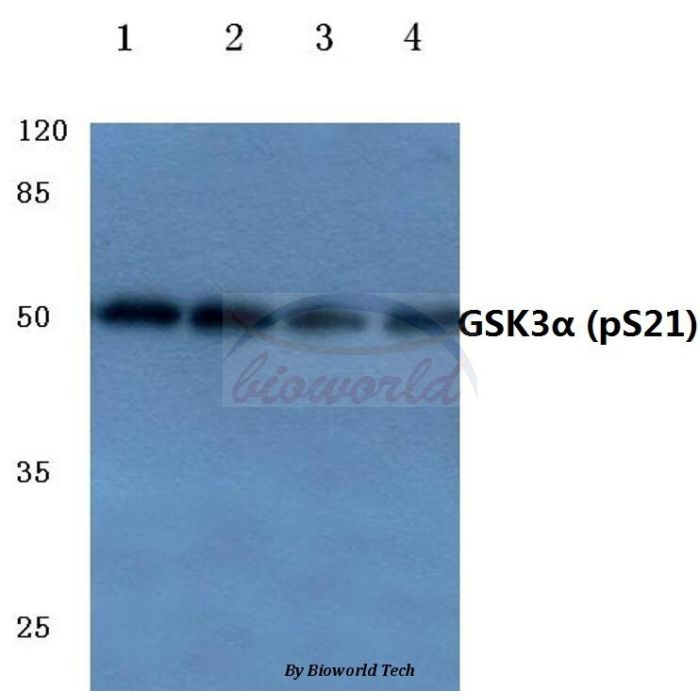
GSK3α (phospho-S21) polyclonal, anti-human, mouse, rat
€328.00
In stock
SKU
BS4082
Background:
Glycogen synthase kinase-3 α and β (GSK-3α, β) are serine/threonine kinases that regulate metabolic enzymes and transcription factors, which are responsible for coordinating processes such as glycogen synthesis and cell adhesion. GSK-3β activity is also required for nuclear activity of Rel dimers, which mediate an anti-apoptotic response to TNFα in mice. GSK-3 catalytic kinase activity is controlled through differential phosphorylation of serine/threonine residues, which have an inhibitory effect, and tyrosine residues, which have an activating effect. Growth factor stimulation of mammalian cells expressing GSK-3α and GSK-3β induces phosphorylation of Ser 21 and Ser 9, respectively through a phosphatidylinositol 3-kinase (PI 3-kinase)-protein kinase B (PKB) dependent pathway, thereby enhancing proliferative signals. Additionally, GSK-3 physically associates with cAMP-dependent protein kinase A (PKA), which phosphorylates Ser 21 of GSK-3α or Ser 9 of GSK-3β and inactivates both forms
Alternative Name:
Glycogen synthase kinase-3 alpha, GSK-3 alpha, Serine/threonine-protein kinase GSK3A, GSK3A
Application Dilution: WB: 1:500~1:1000, IHC: 1:50~1:200, IP: 1:50~1:200
Specificity: p-GSK3α (S21) polyclonal antibody detects endogenous levels of GSK3α protein only when phosphorylated at Ser21 .
Immunogen:
Synthetic phosphopeptide derived from human GSK3α around the phosphorylation site of Serine 21.
MW: ~ 51 kDa
Swis Prot.: P49840
Purification & Purity:
The antibody was affinity-purified from rabbit antiserum by affinity-chromatography using epitope-specific immunogen and the purity is > 95% (by SDS-PAGE).
Format:
1 mg/ml in Phosphate buffered saline (PBS) with 0.05% sodium azide, approx. pH 7.2.
Storage:
Store at 4°C short term. Aliquot and store at -20°C long term. Avoid freeze-thaw cycles.
For research use only, not for use in diagnostic procedure.
Glycogen synthase kinase-3 α and β (GSK-3α, β) are serine/threonine kinases that regulate metabolic enzymes and transcription factors, which are responsible for coordinating processes such as glycogen synthesis and cell adhesion. GSK-3β activity is also required for nuclear activity of Rel dimers, which mediate an anti-apoptotic response to TNFα in mice. GSK-3 catalytic kinase activity is controlled through differential phosphorylation of serine/threonine residues, which have an inhibitory effect, and tyrosine residues, which have an activating effect. Growth factor stimulation of mammalian cells expressing GSK-3α and GSK-3β induces phosphorylation of Ser 21 and Ser 9, respectively through a phosphatidylinositol 3-kinase (PI 3-kinase)-protein kinase B (PKB) dependent pathway, thereby enhancing proliferative signals. Additionally, GSK-3 physically associates with cAMP-dependent protein kinase A (PKA), which phosphorylates Ser 21 of GSK-3α or Ser 9 of GSK-3β and inactivates both forms
Alternative Name:
Glycogen synthase kinase-3 alpha, GSK-3 alpha, Serine/threonine-protein kinase GSK3A, GSK3A
Application Dilution: WB: 1:500~1:1000, IHC: 1:50~1:200, IP: 1:50~1:200
Specificity: p-GSK3α (S21) polyclonal antibody detects endogenous levels of GSK3α protein only when phosphorylated at Ser21 .
Immunogen:
Synthetic phosphopeptide derived from human GSK3α around the phosphorylation site of Serine 21.
MW: ~ 51 kDa
Swis Prot.: P49840
Purification & Purity:
The antibody was affinity-purified from rabbit antiserum by affinity-chromatography using epitope-specific immunogen and the purity is > 95% (by SDS-PAGE).
Format:
1 mg/ml in Phosphate buffered saline (PBS) with 0.05% sodium azide, approx. pH 7.2.
Storage:
Store at 4°C short term. Aliquot and store at -20°C long term. Avoid freeze-thaw cycles.
For research use only, not for use in diagnostic procedure.
| Is Featured? | No |
|---|
Write Your Own Review