
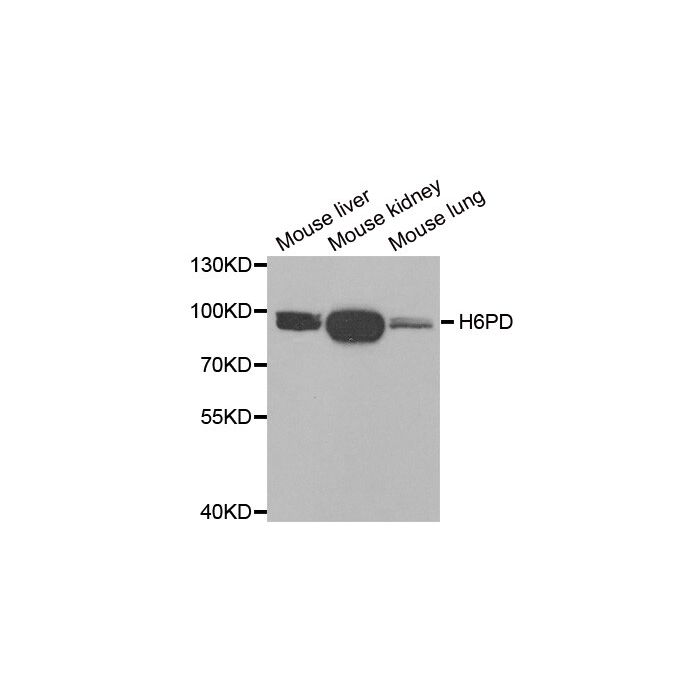
H6PD polyclonal, anti-human, mouse, rat
€388.00
In stock
SKU
BS8218
Background:
H6PD (hexose-6-phosphate dehydrogenase, GDH/6PGL endoplasmic bifunctional protein) is a 789 amino acid protein encoded by the human gene H6PD. The N-terminal section of H6PD belongs to the glucose-6-phosphate dehydrogenase family, while the C-terminal section belongs to the glucosamine/galactosamine-6-phosphate isomerase family, 6-phosphogluconolactonase subfamily. H6PD is responsible primarily for the oxidation of glucose-6-phosphate and glucose. It also oxidizes other hexose-6-phosphates. H6PD catalyzes the conversion of glucose 6-phosphate to 6-phosphogluconolactone within the lumen of the endoplasmic reticulum, thereby generating reduced nicotinamide adenine dinucleotide phosphate. Reduced nicotinamide adenine dinucleotide phosphate is a necessary cofactor for the reductase activity of 11β-hydroxysteroid dehydrogenase type 1, which converts hormonally inactive cortisone to active cortisol (in rodents, 11-dehydrocorticosterone to corticosterone).
Alternative Name:
GDH/6PGL endoplasmic bifunctional protein, H6PD, GDH
Application Dilution: WB: 1:500 - 1:2000, IHC: 1:50 - 1:200, IF: 1:10 - 1:100
Specificity: H6PD polyclonal antibody detects endogenous levels of H6PD protein.
Immunogen:
Recombinant full length Human H6PD.
MW: ~ 89 kDa
Swis Prot.: O95479
Purification & Purity:
The antibody was affinity-purified from rabbit antiserum by affinity-chromatography using epitope-specific immunogen and the purity is > 95% (by SDS-PAGE).
Format:
1mg/ml in PBS with 0.1% Sodium Azide, 50% Glycerol.
Storage:
Store at 4°C short term. Aliquot and store at -20°C long term. Avoid freeze-thaw cycles.
For research use only, not for use in diagnostic procedure.
H6PD (hexose-6-phosphate dehydrogenase, GDH/6PGL endoplasmic bifunctional protein) is a 789 amino acid protein encoded by the human gene H6PD. The N-terminal section of H6PD belongs to the glucose-6-phosphate dehydrogenase family, while the C-terminal section belongs to the glucosamine/galactosamine-6-phosphate isomerase family, 6-phosphogluconolactonase subfamily. H6PD is responsible primarily for the oxidation of glucose-6-phosphate and glucose. It also oxidizes other hexose-6-phosphates. H6PD catalyzes the conversion of glucose 6-phosphate to 6-phosphogluconolactone within the lumen of the endoplasmic reticulum, thereby generating reduced nicotinamide adenine dinucleotide phosphate. Reduced nicotinamide adenine dinucleotide phosphate is a necessary cofactor for the reductase activity of 11β-hydroxysteroid dehydrogenase type 1, which converts hormonally inactive cortisone to active cortisol (in rodents, 11-dehydrocorticosterone to corticosterone).
Alternative Name:
GDH/6PGL endoplasmic bifunctional protein, H6PD, GDH
Application Dilution: WB: 1:500 - 1:2000, IHC: 1:50 - 1:200, IF: 1:10 - 1:100
Specificity: H6PD polyclonal antibody detects endogenous levels of H6PD protein.
Immunogen:
Recombinant full length Human H6PD.
MW: ~ 89 kDa
Swis Prot.: O95479
Purification & Purity:
The antibody was affinity-purified from rabbit antiserum by affinity-chromatography using epitope-specific immunogen and the purity is > 95% (by SDS-PAGE).
Format:
1mg/ml in PBS with 0.1% Sodium Azide, 50% Glycerol.
Storage:
Store at 4°C short term. Aliquot and store at -20°C long term. Avoid freeze-thaw cycles.
For research use only, not for use in diagnostic procedure.
| Is Featured? | No |
|---|
Write Your Own Review