
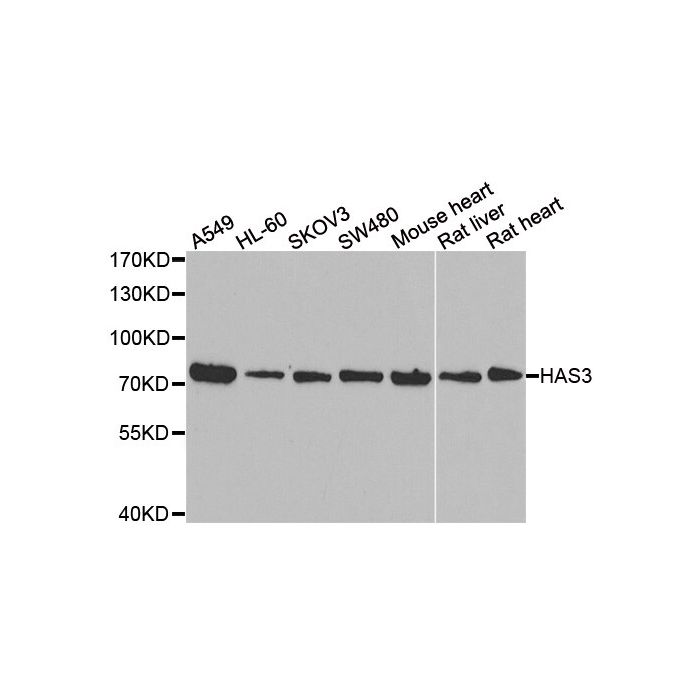
HAS3 polyclonal, anti-human, mouse, rat
€388.00
In stock
SKU
BS8298
Background:
HAS1, HAS2 and HAS3 are HA (hyaluronan or hyaluronic acid) synthase proteins. The extracellular matrix in most vertebrates express HA, which is a high molecular weight linear polysaccharide composed of alternating glucuronic acid and N-acetylglucosamine residues linked by b-1,3 and b-1,4 glycosidic bonds. The three HAS genes show distinct patterns of expression during development and their protein products play significantly different roles in the formation of the HA matrix. Both HAS1 and HAS2 synthesize high molecular-weight HA, whereas HAS3 produces lower molecular weight HA. The expression of the three HAS isoforms is more prominent in growing cells than in resting cells and is differentially regulated by various stimuli, suggesting distinct functional roles of the three proteins. HAS3 produces both secreted and cell-associated forms of hyaluronan and is the most active of the three isoforms of this enzyme in adults. HAS3 gene expression plays a crucial role in the regulation of hyaluronan synthesis in the epidermis. Specifically, IFN-g markedly upregulates HAS3 mRNA, whereas TGFβ downregulates HAS3 transcript levels. The human HAS3 gene maps to chromosome 16q22.1.
Alternative Name:
Hyaluronan synthase 3, Hyaluronate synthase 3, Hyaluronic acid synthase 3, HA synthase 3, HAS3
Application Dilution: WB: 1:500 - 1:2000, IHC: 1:50 - 1:200, IF: 1:50 - 1:200
Specificity: HAS3 polyclonal antibody detects endogenous levels of HAS3 protein.
Immunogen:
Recombinant full length Human HAS3.
MW: ~ 63 kDa
Swis Prot.: O00219
Purification & Purity:
The antibody was affinity-purified from rabbit antiserum by affinity-chromatography using epitope-specific immunogen and the purity is > 95% (by SDS-PAGE).
Format:
1mg/ml in PBS with 0.1% Sodium Azide, 50% Glycerol.
Storage:
Store at 4°C short term. Aliquot and store at -20°C long term. Avoid freeze-thaw cycles.
For research use only, not for use in diagnostic procedure.
HAS1, HAS2 and HAS3 are HA (hyaluronan or hyaluronic acid) synthase proteins. The extracellular matrix in most vertebrates express HA, which is a high molecular weight linear polysaccharide composed of alternating glucuronic acid and N-acetylglucosamine residues linked by b-1,3 and b-1,4 glycosidic bonds. The three HAS genes show distinct patterns of expression during development and their protein products play significantly different roles in the formation of the HA matrix. Both HAS1 and HAS2 synthesize high molecular-weight HA, whereas HAS3 produces lower molecular weight HA. The expression of the three HAS isoforms is more prominent in growing cells than in resting cells and is differentially regulated by various stimuli, suggesting distinct functional roles of the three proteins. HAS3 produces both secreted and cell-associated forms of hyaluronan and is the most active of the three isoforms of this enzyme in adults. HAS3 gene expression plays a crucial role in the regulation of hyaluronan synthesis in the epidermis. Specifically, IFN-g markedly upregulates HAS3 mRNA, whereas TGFβ downregulates HAS3 transcript levels. The human HAS3 gene maps to chromosome 16q22.1.
Alternative Name:
Hyaluronan synthase 3, Hyaluronate synthase 3, Hyaluronic acid synthase 3, HA synthase 3, HAS3
Application Dilution: WB: 1:500 - 1:2000, IHC: 1:50 - 1:200, IF: 1:50 - 1:200
Specificity: HAS3 polyclonal antibody detects endogenous levels of HAS3 protein.
Immunogen:
Recombinant full length Human HAS3.
MW: ~ 63 kDa
Swis Prot.: O00219
Purification & Purity:
The antibody was affinity-purified from rabbit antiserum by affinity-chromatography using epitope-specific immunogen and the purity is > 95% (by SDS-PAGE).
Format:
1mg/ml in PBS with 0.1% Sodium Azide, 50% Glycerol.
Storage:
Store at 4°C short term. Aliquot and store at -20°C long term. Avoid freeze-thaw cycles.
For research use only, not for use in diagnostic procedure.
| Is Featured? | No |
|---|
Write Your Own Review