
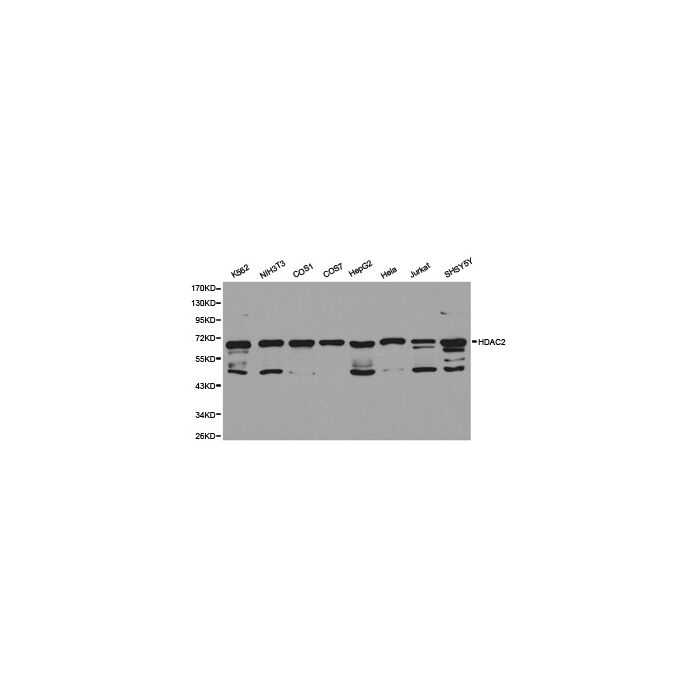
HDAC2 polyclonal, anti-human, mouse, rat, monkey
€388.00
In stock
SKU
BS6887
Background:
The identification of histone acetyltransferases (HATs) and their large multiprotein complexes has yielded important insights into how these enzymes regulate transcription. HAT complexes interact with sequence-specific activator proteins to target specific genes. In addition to histones, HATs can acetylate nonhistone proteins, suggesting multiple roles for these enzymes. In contrast, histone deacetylation promotes a "closed" chromatin conformation and typically leads to repression of gene activity. Mammalian histone deacetylases can be divided into three classes on the basis of their similarity to various yeast deacetylases. Class I proteins (HDACs 1, 2, 3, and 8) are related to the yeast Rpd3-like proteins, those in class II (HDACs 4, 5, 6, 7, 9, and 10) are related to yeast Hda1-like proteins, and class III proteins are related to the yeast protein Sir2. Inhibitors of HDAC activity are now being explored as potential therapeutic cancer agents.
Alternative Name:
Histone deacetylase 2, HD2, Name: HDAC 2
Application Dilution: WB: 1:500 - 1:2000, IHC: 1:50 - 1:200, IF: 1:50 - 1:100, IP: 1:50 - 1:200
Specificity: HDAC2 polyclonal antibody detects endogenous levels of HDAC2 protein.
Immunogen:
Recombinant full length Human HDAC2.
MW: ~ 60 kDa
Swis Prot.: Q92769
Purification & Purity:
The antibody was affinity-purified from rabbit antiserum by affinity-chromatography using epitope-specific immunogen and the purity is > 95% (by SDS-PAGE).
Format:
1 mg/ml in Phosphate buffered saline (PBS) with 0.05% sodium azide, approx. pH 7.2.
Storage:
Store at 4°C short term. Aliquot and store at -20°C long term. Avoid freeze-thaw cycles.
For research use only, not for use in diagnostic procedure.
The identification of histone acetyltransferases (HATs) and their large multiprotein complexes has yielded important insights into how these enzymes regulate transcription. HAT complexes interact with sequence-specific activator proteins to target specific genes. In addition to histones, HATs can acetylate nonhistone proteins, suggesting multiple roles for these enzymes. In contrast, histone deacetylation promotes a "closed" chromatin conformation and typically leads to repression of gene activity. Mammalian histone deacetylases can be divided into three classes on the basis of their similarity to various yeast deacetylases. Class I proteins (HDACs 1, 2, 3, and 8) are related to the yeast Rpd3-like proteins, those in class II (HDACs 4, 5, 6, 7, 9, and 10) are related to yeast Hda1-like proteins, and class III proteins are related to the yeast protein Sir2. Inhibitors of HDAC activity are now being explored as potential therapeutic cancer agents.
Alternative Name:
Histone deacetylase 2, HD2, Name: HDAC 2
Application Dilution: WB: 1:500 - 1:2000, IHC: 1:50 - 1:200, IF: 1:50 - 1:100, IP: 1:50 - 1:200
Specificity: HDAC2 polyclonal antibody detects endogenous levels of HDAC2 protein.
Immunogen:
Recombinant full length Human HDAC2.
MW: ~ 60 kDa
Swis Prot.: Q92769
Purification & Purity:
The antibody was affinity-purified from rabbit antiserum by affinity-chromatography using epitope-specific immunogen and the purity is > 95% (by SDS-PAGE).
Format:
1 mg/ml in Phosphate buffered saline (PBS) with 0.05% sodium azide, approx. pH 7.2.
Storage:
Store at 4°C short term. Aliquot and store at -20°C long term. Avoid freeze-thaw cycles.
For research use only, not for use in diagnostic procedure.
| Is Featured? | No |
|---|
Write Your Own Review