
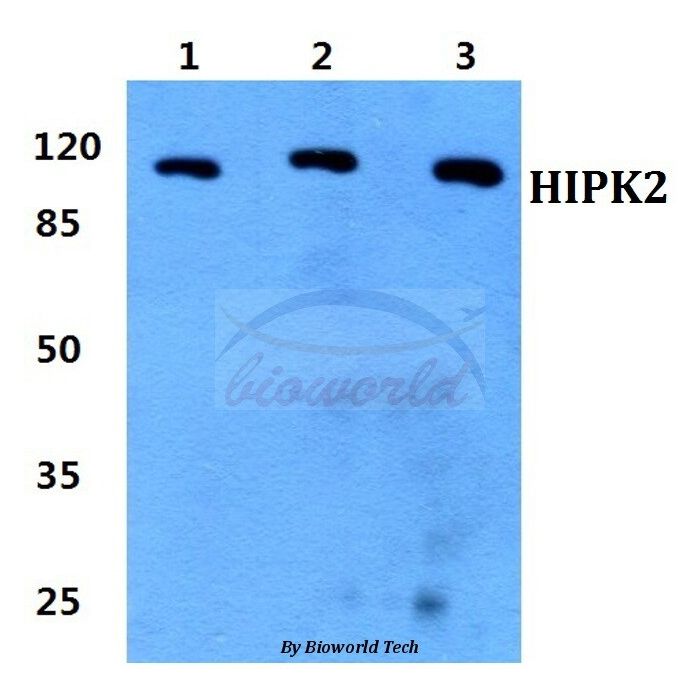
HIPK2 polyclonal, anti-human, mouse, rat
€305.00
In stock
SKU
BS60320
Background:
The Homeodomain-Interacting Protein Kinase (HIPK) family, which includes HIPK1, HIPK2, HIPK3, contains a conserved protein kinase domain as well as a separate domain that interacts with homeoproteins. HIPK2, the most highly characterized family member, is thought to act as a co-repressor of homeodomain transcription factors as HIPK2 has been shown to enhance the DNA binding of the NK-3 homeoprotein in vitro. It is regulated by a posttranslational modification of a ubiquitin-like protein, SUMO-1, via covalent bonding to a lysine residue on HIPK2. This is similar to the binding of SUMO-1 to PML and Sp100. The conjugation of SUMO-1 is thought to direct each of these proteins to nuclear bodies (NBs), which appear to play a role in autoimmunity and viral protection. HIPK2 is the first protein kinase to be directed to nuclear bodies in response to ubiquitin-like modification.
Alternative Name:
Homeodomain-interacting protein kinase 2, hHIPk2
Application Dilution: WB: 1:500~1:1000
Specificity: HIPK2 polyclonal antibody detects endogenous levels of HIPK2 protein.
Immunogen:
A synthetic peptide corresponding to residues in Human HIPK2.
MW: ~ 110 kDa
Swis Prot.: Q9H2X6
Purification & Purity:
The antibody was affinity-purified from rabbit antiserum by affinity-chromatography using epitope-specific immunogen and the purity is > 95% (by SDS-PAGE).
Format:
1mg/ml in PBS with 0.1% Sodium Azide, 50% Glycerol.
Storage:
Store at 4°C short term. Aliquot and store at -20°C long term. Avoid freeze-thaw cycles.
For research use only, not for use in diagnostic procedure.
The Homeodomain-Interacting Protein Kinase (HIPK) family, which includes HIPK1, HIPK2, HIPK3, contains a conserved protein kinase domain as well as a separate domain that interacts with homeoproteins. HIPK2, the most highly characterized family member, is thought to act as a co-repressor of homeodomain transcription factors as HIPK2 has been shown to enhance the DNA binding of the NK-3 homeoprotein in vitro. It is regulated by a posttranslational modification of a ubiquitin-like protein, SUMO-1, via covalent bonding to a lysine residue on HIPK2. This is similar to the binding of SUMO-1 to PML and Sp100. The conjugation of SUMO-1 is thought to direct each of these proteins to nuclear bodies (NBs), which appear to play a role in autoimmunity and viral protection. HIPK2 is the first protein kinase to be directed to nuclear bodies in response to ubiquitin-like modification.
Alternative Name:
Homeodomain-interacting protein kinase 2, hHIPk2
Application Dilution: WB: 1:500~1:1000
Specificity: HIPK2 polyclonal antibody detects endogenous levels of HIPK2 protein.
Immunogen:
A synthetic peptide corresponding to residues in Human HIPK2.
MW: ~ 110 kDa
Swis Prot.: Q9H2X6
Purification & Purity:
The antibody was affinity-purified from rabbit antiserum by affinity-chromatography using epitope-specific immunogen and the purity is > 95% (by SDS-PAGE).
Format:
1mg/ml in PBS with 0.1% Sodium Azide, 50% Glycerol.
Storage:
Store at 4°C short term. Aliquot and store at -20°C long term. Avoid freeze-thaw cycles.
For research use only, not for use in diagnostic procedure.
| Is Featured? | No |
|---|
Write Your Own Review