
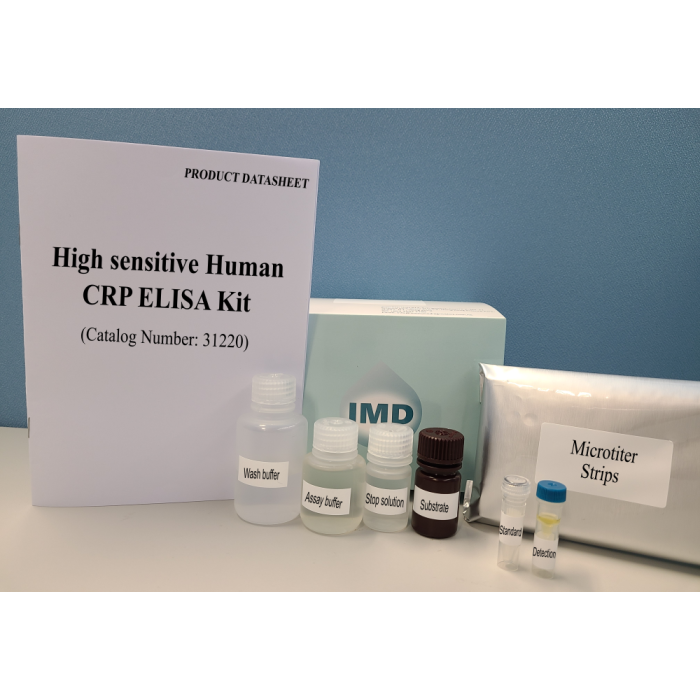
Human high sensitive C-reactive protein ELISA Kit
€360.00
In stock
SKU
IMD-31220
Catalog Number: IMD-31220
Size: 96 tests/kit
Assay range: 0.312-20 ng/mL
Datasheet
Questions? Contact us!
Size: 96 tests/kit
Assay range: 0.312-20 ng/mL
Datasheet
Questions? Contact us!
INTENDED USE:
For the quantitative determination of human C-reactive protein concentrations in serum or plasma
INTRODUCTION:
C-reactive protein (CRP) is a circulating protein mainly secreted from the liver. This acute phase protein consists of five identical non-glycosylated subunits of 23 kDa, that give rise to a symmetrically arranged globular protein with molecular weight of approximately 120 kDa.1 It has long been recognized that CRP is closely related to immunology, inflammation and host defence; as a result it has been used as an inflammatory marker. However, the development of high-sensitivity CRP (hsCRP) ELISA had addressed its role in other clinical issues. There is accumulating evidence suggesting the important role that CRP plays in mediating cardiovascular diseases (CVD) and type 2 diabetes.2-4 Normally CRP is presenting only in a trace amount in circulation (<1 µg/ml)5,6 but can increase over 1,000-fold under acute inflammatory state. Individual with blood CRP levels <1 µg/ml, 1-3 µg/ml and >3 µg/ml is considered to have low, moderate and high risk, respectively, of CVD and myocardial infraction.7 Therefore, blood CRP level has become a promising measure of CVD risk.8,9
PRINCIPLE OF THE ASSAY:
This assay is a quantitative sandwich ELISA using monoclonal antibodies against human CRP. The immunoplate is pre-coated with a monoclonal antibody specific for human CRP. Standards and samples are pipetted into the wells and any human CRP present is bound by the immobilized antibody. After washing away any unbound substances, a horseradish peroxidase (HRP)-linked monoclonal antibody specific for human CRP is added to the wells. After wash step to remove any unbound reagents, an HRP substrate solution is added and colour develops in proportion to the amount of human CRP bound initially. The assay is stopped and the optical density of the wells determined using a micro-plate reader. Since the increases in absorbance are directly proportional to the amount of captured human CRP, the unknown sample concentration can be interpolated from a reference curve included in each assay.
SENSITIVITY: The lowest level of CRP that can be detected by this assay is 0.312 ng/mL.
PUBLICATIONS CITING THIS PRODUCT
Wu G, Li H, Fang Q, Jiang S, Zhang L, Zhang J, Hou X, Lu J, Bao Y, Xu A, Jia W. Elevated circulating lipocalin-2 levels independently predict incident cardiovascular events in men in a population-based cohort. Arteriosclerosis, thrombosis, and vascular biology. 2014 Nov;34(11):2457-64.
Chen DL, Liess C, Poljak A, Xu A, Zhang J, Thoma C, Trenell M, Milner B, Jenkins AB, Chisholm DJ, Samocha-Bonet D. Phenotypic characterization of insulin-resistant and insulin-sensitive obesity. The Journal of Clinical Endocrinology & Metabolism. 2015 Nov 1;100(11):4082-91.
Chen DL, Brown R, Liess C, Poljak A, Xu A, Zhang J, Trenell M, Jenkins A, Chisholm D, Samocha-Bonet D, Macefield VG. Muscle sympathetic nerve activity is associated with liver insulin sensitivity in obese non-diabetic men. Frontiers in physiology. 2017 Feb 28;8:101.
Yang K, Deng HB, Man AW, Song E, Zhang J, Luo C, Cheung BM, Yuen KY, Jensen PS, Irmukhamedov A, Elie AG. Measuring non‐polyaminated lipocalin‐2 for cardiometabolic risk assessment. ESC heart failure. 2017 Nov;4(4):563-75.
Elie AG, Bloksgaard M, Sun WY, Yang K, Man AW, Xu A, Irmukhamedov A, Riber LP, Wang Y, De Mey JG. Local enrichment of fatty acid-binding protein 4 in the pericardial cavity of cardiovascular disease patients. PloS one. 2018 Nov 5;13(11):e0206802.
Harari A, Coster AC, Jenkins A, Xu A, Greenfield JR, Harats D, Shaish A, Samocha-Bonet D. Obesity and insulin resistance are inversely associated with serum and adipose tissue carotenoid concentrations in adults. The Journal of nutrition. 2020 Jan 1;150(1):38-46.
Liu Y, Wang Y, Ni Y, Cheung CK, Lam KS, Wang Y, Xia Z, Ye D, Guo J, Tse MA, Panagiotou G. Gut microbiome fermentation determines the efficacy of exercise for diabetes prevention. Cell metabolism. 2020 Jan 7;31(1):77-91.
For the quantitative determination of human C-reactive protein concentrations in serum or plasma
INTRODUCTION:
C-reactive protein (CRP) is a circulating protein mainly secreted from the liver. This acute phase protein consists of five identical non-glycosylated subunits of 23 kDa, that give rise to a symmetrically arranged globular protein with molecular weight of approximately 120 kDa.1 It has long been recognized that CRP is closely related to immunology, inflammation and host defence; as a result it has been used as an inflammatory marker. However, the development of high-sensitivity CRP (hsCRP) ELISA had addressed its role in other clinical issues. There is accumulating evidence suggesting the important role that CRP plays in mediating cardiovascular diseases (CVD) and type 2 diabetes.2-4 Normally CRP is presenting only in a trace amount in circulation (<1 µg/ml)5,6 but can increase over 1,000-fold under acute inflammatory state. Individual with blood CRP levels <1 µg/ml, 1-3 µg/ml and >3 µg/ml is considered to have low, moderate and high risk, respectively, of CVD and myocardial infraction.7 Therefore, blood CRP level has become a promising measure of CVD risk.8,9
PRINCIPLE OF THE ASSAY:
This assay is a quantitative sandwich ELISA using monoclonal antibodies against human CRP. The immunoplate is pre-coated with a monoclonal antibody specific for human CRP. Standards and samples are pipetted into the wells and any human CRP present is bound by the immobilized antibody. After washing away any unbound substances, a horseradish peroxidase (HRP)-linked monoclonal antibody specific for human CRP is added to the wells. After wash step to remove any unbound reagents, an HRP substrate solution is added and colour develops in proportion to the amount of human CRP bound initially. The assay is stopped and the optical density of the wells determined using a micro-plate reader. Since the increases in absorbance are directly proportional to the amount of captured human CRP, the unknown sample concentration can be interpolated from a reference curve included in each assay.
SENSITIVITY: The lowest level of CRP that can be detected by this assay is 0.312 ng/mL.
PUBLICATIONS CITING THIS PRODUCT
Wu G, Li H, Fang Q, Jiang S, Zhang L, Zhang J, Hou X, Lu J, Bao Y, Xu A, Jia W. Elevated circulating lipocalin-2 levels independently predict incident cardiovascular events in men in a population-based cohort. Arteriosclerosis, thrombosis, and vascular biology. 2014 Nov;34(11):2457-64.
Chen DL, Liess C, Poljak A, Xu A, Zhang J, Thoma C, Trenell M, Milner B, Jenkins AB, Chisholm DJ, Samocha-Bonet D. Phenotypic characterization of insulin-resistant and insulin-sensitive obesity. The Journal of Clinical Endocrinology & Metabolism. 2015 Nov 1;100(11):4082-91.
Chen DL, Brown R, Liess C, Poljak A, Xu A, Zhang J, Trenell M, Jenkins A, Chisholm D, Samocha-Bonet D, Macefield VG. Muscle sympathetic nerve activity is associated with liver insulin sensitivity in obese non-diabetic men. Frontiers in physiology. 2017 Feb 28;8:101.
Yang K, Deng HB, Man AW, Song E, Zhang J, Luo C, Cheung BM, Yuen KY, Jensen PS, Irmukhamedov A, Elie AG. Measuring non‐polyaminated lipocalin‐2 for cardiometabolic risk assessment. ESC heart failure. 2017 Nov;4(4):563-75.
Elie AG, Bloksgaard M, Sun WY, Yang K, Man AW, Xu A, Irmukhamedov A, Riber LP, Wang Y, De Mey JG. Local enrichment of fatty acid-binding protein 4 in the pericardial cavity of cardiovascular disease patients. PloS one. 2018 Nov 5;13(11):e0206802.
Harari A, Coster AC, Jenkins A, Xu A, Greenfield JR, Harats D, Shaish A, Samocha-Bonet D. Obesity and insulin resistance are inversely associated with serum and adipose tissue carotenoid concentrations in adults. The Journal of nutrition. 2020 Jan 1;150(1):38-46.
Liu Y, Wang Y, Ni Y, Cheung CK, Lam KS, Wang Y, Xia Z, Ye D, Guo J, Tse MA, Panagiotou G. Gut microbiome fermentation determines the efficacy of exercise for diabetes prevention. Cell metabolism. 2020 Jan 7;31(1):77-91.
| Is Featured? | No |
|---|
Write Your Own Review