
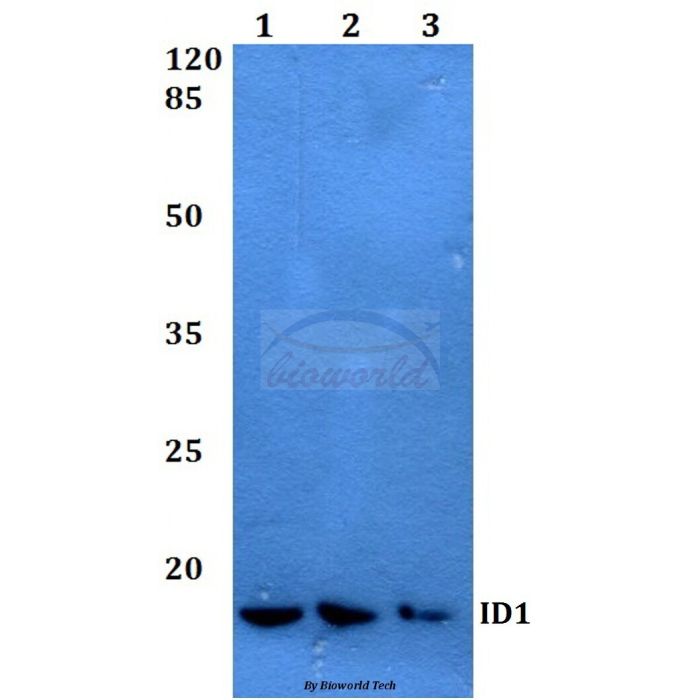
ID1 polyclonal, anti-human, mouse, rat
€305.00
In stock
SKU
BS60047
Background:
Members of the Id family of basic helix-loop-helix (bHLH) proteins include Id1, Id2, Id3 and Id4. They are ubiquitously expressed and dimerize with members of the class A and B HLH proteins. Due to the absence of the basic region, the resulting heterodimers cannot bind DNA. The Id-type proteins thus appear to negatively regulate DNA binding of bHLH proteins. Since Id1 inhibits DNA binding of E12 and Myo D, it apparently functions to inhibit muscle-specific gene expression. Under conditions that facilitate muscle cell differentiation, the Id protein levels fall, allowing E12 and/or E47 to form heterodimers with Myo D and myogenin, which in turn activate myogenic differentiation. It has been shown that expression of each of the Id proteins is strongly dependent on growth factor activation and that reduction of Id mRNA levels by antisense oligonucleotides leads to a delayed reentry of arrested cells into the cell cycle following growth factor stimulation.
Alternative Name:
DNA-binding protein inhibitor ID-1, Class B basic helix-loop-helix protein 24, bHLHb24, Inhibitor of DNA binding 1, ID1, BHLHB24, ID
Application Dilution: WB: 1:500~1:1000
Specificity: ID1 polyclonal antibody detects endogenous levels of ID1 protein.
Immunogen:
A synthetic peptide corresponding to residues in Human ID1.
MW: ~ 16 kDa
Swis Prot.: P41134
Purification & Purity:
The antibody was affinity-purified from rabbit antiserum by affinity-chromatography using epitope-specific immunogen and the purity is > 95% (by SDS-PAGE).
Format:
1 mg/ml in Phosphate buffered saline (PBS) with 0.05% sodium azide, approx. pH 7.2.
Storage:
Store at 4°C short term. Aliquot and store at -20°C long term. Avoid freeze-thaw cycles.
For research use only, not for use in diagnostic procedure.
Members of the Id family of basic helix-loop-helix (bHLH) proteins include Id1, Id2, Id3 and Id4. They are ubiquitously expressed and dimerize with members of the class A and B HLH proteins. Due to the absence of the basic region, the resulting heterodimers cannot bind DNA. The Id-type proteins thus appear to negatively regulate DNA binding of bHLH proteins. Since Id1 inhibits DNA binding of E12 and Myo D, it apparently functions to inhibit muscle-specific gene expression. Under conditions that facilitate muscle cell differentiation, the Id protein levels fall, allowing E12 and/or E47 to form heterodimers with Myo D and myogenin, which in turn activate myogenic differentiation. It has been shown that expression of each of the Id proteins is strongly dependent on growth factor activation and that reduction of Id mRNA levels by antisense oligonucleotides leads to a delayed reentry of arrested cells into the cell cycle following growth factor stimulation.
Alternative Name:
DNA-binding protein inhibitor ID-1, Class B basic helix-loop-helix protein 24, bHLHb24, Inhibitor of DNA binding 1, ID1, BHLHB24, ID
Application Dilution: WB: 1:500~1:1000
Specificity: ID1 polyclonal antibody detects endogenous levels of ID1 protein.
Immunogen:
A synthetic peptide corresponding to residues in Human ID1.
MW: ~ 16 kDa
Swis Prot.: P41134
Purification & Purity:
The antibody was affinity-purified from rabbit antiserum by affinity-chromatography using epitope-specific immunogen and the purity is > 95% (by SDS-PAGE).
Format:
1 mg/ml in Phosphate buffered saline (PBS) with 0.05% sodium azide, approx. pH 7.2.
Storage:
Store at 4°C short term. Aliquot and store at -20°C long term. Avoid freeze-thaw cycles.
For research use only, not for use in diagnostic procedure.
| Is Featured? | No |
|---|
Write Your Own Review