
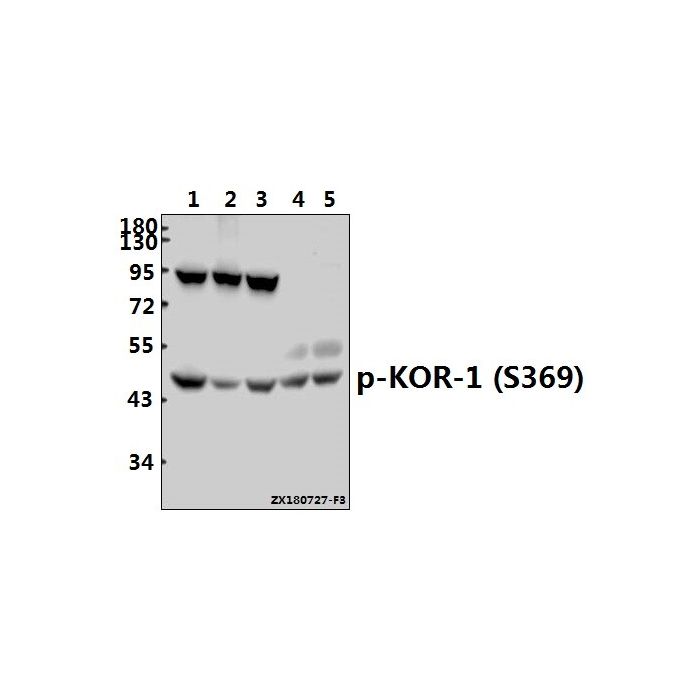
KOR-1 (phospho-S369) polyclonal, anti-human, mouse, rat
€328.00
In stock
SKU
BS4577
Background:
Endogenous opioid peptides and opiates, like morphine, transmit their pharmacological effects through membrane bound opioid receptors. Pharmacological studies and molecular cloning have led to the identification of three different types of opioid receptor, mu-type, delta-type and kappa-type, also designated MOR-1, DOR-1 and KOR-1, respectively. MOR-1 is a receptor for beta-endorphin, DOR-1 is a receptor for enkephalins, and KOR-1 is a receptor for dynorphins. The three opioid receptor types are highly homologous and belong to the superfamily of G-protein-coupled receptors. Opioid receptors have been shown to modulate a range of brain functions, including instinctive behavior and emotions. This regulation is thought to involve the inhibition of neurotransmitter release by reducing calcium ion currents and increasing potassium ion conductance.
Alternative Name:
Kappa-type opioid receptor, K-OR-1, KOR-1, OPRK1, OPRK
Application Dilution: WB: 1:500~1:1000
Specificity: KOR-1 (phospho-S369) polyclonal antibody detects endogenous levels of KOR-1 protein when phosphorylated at Ser369.
Immunogen:
Synthetic phosphopeptide derived from human KOR-1 around the phosphorylation site of Ser369.
MW: ~ 42 kDa
Swis Prot.: P41145
Purification & Purity:
The antibody was affinity-purified from rabbit antiserum by affinity-chromatography using epitope-specific immunogen and the purity is > 95% (by SDS-PAGE).
Format:
1 mg/ml in Phosphate buffered saline (PBS) with 0.05% sodium azide, approx. pH 7.2.
Storage:
Store at 4°C short term. Aliquot and store at -20°C long term. Avoid freeze-thaw cycles.
For research use only, not for use in diagnostic procedure.
Endogenous opioid peptides and opiates, like morphine, transmit their pharmacological effects through membrane bound opioid receptors. Pharmacological studies and molecular cloning have led to the identification of three different types of opioid receptor, mu-type, delta-type and kappa-type, also designated MOR-1, DOR-1 and KOR-1, respectively. MOR-1 is a receptor for beta-endorphin, DOR-1 is a receptor for enkephalins, and KOR-1 is a receptor for dynorphins. The three opioid receptor types are highly homologous and belong to the superfamily of G-protein-coupled receptors. Opioid receptors have been shown to modulate a range of brain functions, including instinctive behavior and emotions. This regulation is thought to involve the inhibition of neurotransmitter release by reducing calcium ion currents and increasing potassium ion conductance.
Alternative Name:
Kappa-type opioid receptor, K-OR-1, KOR-1, OPRK1, OPRK
Application Dilution: WB: 1:500~1:1000
Specificity: KOR-1 (phospho-S369) polyclonal antibody detects endogenous levels of KOR-1 protein when phosphorylated at Ser369.
Immunogen:
Synthetic phosphopeptide derived from human KOR-1 around the phosphorylation site of Ser369.
MW: ~ 42 kDa
Swis Prot.: P41145
Purification & Purity:
The antibody was affinity-purified from rabbit antiserum by affinity-chromatography using epitope-specific immunogen and the purity is > 95% (by SDS-PAGE).
Format:
1 mg/ml in Phosphate buffered saline (PBS) with 0.05% sodium azide, approx. pH 7.2.
Storage:
Store at 4°C short term. Aliquot and store at -20°C long term. Avoid freeze-thaw cycles.
For research use only, not for use in diagnostic procedure.
| Is Featured? | No |
|---|
Write Your Own Review