
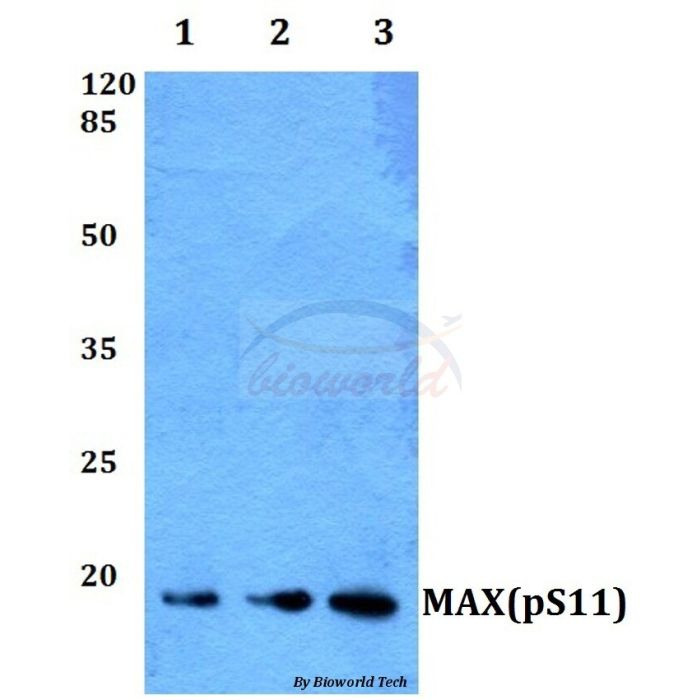
MAX (phospho-S11) polyclonal, anti-human, mouse, rat
€328.00
In stock
SKU
BS64009
Background:
It is now well established that the nature and relative abundance of individual subunits of different classes of transcription factors can positively or negatively regulate levels of gene expression. Myc proteins homodimerize and bind DNA poorly, if at all, at physiological levels. Max is a nuclear localized bHLH-Zip protein initially identified by screening a B cell expression library with the bHLH-Zip region of c-Myc. Max homodimers and the Myc-Max heterodimers bind the sequence CACGTG; however the binding of the hetero-dimeric complex is stronger than the Max homodimer. The Max gene products have been identified as Max and Max 9 proteins that differ by a 9 amino acid insertion N-terminal to the basic region. In contrast to Myc, which is highly regulated during progression through the cell cycle, Max is highly stable and is much more abundant than Myc. Two members of the bHLH-Zip protein family, designated Mad and Mxi1, homodimerize poorly but form heterodimeric complexes with Max that have opposing functions to Myc-Max heterodimers with respect to regulation of gene expression.
Alternative Name:
Protein max, Class D basic helix-loop-helix protein 4, bHLHd4, Myc-associated factor X, BHLHD4
Application Dilution: WB: 1:500~1:1000
Specificity: p-MAX(S11) polyclonal antibody detects endogenous levels of MAX protein only when phosphorylated at Ser11.
Immunogen:
Synthetic phosphopeptide derived from human MAX around the phosphorylation site of Serine 11.
MW: ~ 18 kDa
Swis Prot.: P61244
Purification & Purity:
The antibody was affinity-purified from rabbit antiserum by affinity-chromatography using epitope-specific immunogen and the purity is > 95% (by SDS-PAGE).
Format:
1mg/ml in PBS with 0.1% Sodium Azide, 50% Glycerol.
Storage:
Store at 4°C short term. Aliquot and store at -20°C long term. Avoid freeze-thaw cycles.
For research use only, not for use in diagnostic procedure.
It is now well established that the nature and relative abundance of individual subunits of different classes of transcription factors can positively or negatively regulate levels of gene expression. Myc proteins homodimerize and bind DNA poorly, if at all, at physiological levels. Max is a nuclear localized bHLH-Zip protein initially identified by screening a B cell expression library with the bHLH-Zip region of c-Myc. Max homodimers and the Myc-Max heterodimers bind the sequence CACGTG; however the binding of the hetero-dimeric complex is stronger than the Max homodimer. The Max gene products have been identified as Max and Max 9 proteins that differ by a 9 amino acid insertion N-terminal to the basic region. In contrast to Myc, which is highly regulated during progression through the cell cycle, Max is highly stable and is much more abundant than Myc. Two members of the bHLH-Zip protein family, designated Mad and Mxi1, homodimerize poorly but form heterodimeric complexes with Max that have opposing functions to Myc-Max heterodimers with respect to regulation of gene expression.
Alternative Name:
Protein max, Class D basic helix-loop-helix protein 4, bHLHd4, Myc-associated factor X, BHLHD4
Application Dilution: WB: 1:500~1:1000
Specificity: p-MAX(S11) polyclonal antibody detects endogenous levels of MAX protein only when phosphorylated at Ser11.
Immunogen:
Synthetic phosphopeptide derived from human MAX around the phosphorylation site of Serine 11.
MW: ~ 18 kDa
Swis Prot.: P61244
Purification & Purity:
The antibody was affinity-purified from rabbit antiserum by affinity-chromatography using epitope-specific immunogen and the purity is > 95% (by SDS-PAGE).
Format:
1mg/ml in PBS with 0.1% Sodium Azide, 50% Glycerol.
Storage:
Store at 4°C short term. Aliquot and store at -20°C long term. Avoid freeze-thaw cycles.
For research use only, not for use in diagnostic procedure.
| Is Featured? | No |
|---|
Write Your Own Review