
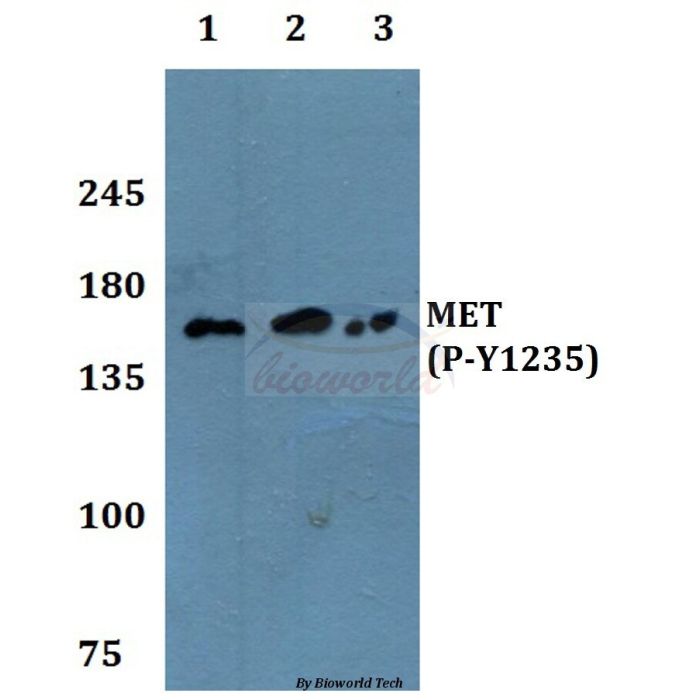
MET (phospho-Y1235) polyclonal, anti-human, mouse, rat
€328.00
In stock
SKU
BS64017
Background:
The c-Met oncogene was originally isolated from a chemical carcinogen-treated human osteogenic sarcoma cell line by transfection analysis in NIH/3T3 cells. The Met proto-oncogene product was identified as a transmembrane receptor-like protein with tyrosine kinase activity that is expressed in many tissues. A high proportion of spontaneous NIH/3T3 transformants overexpress c-Met and by transfection analysis the c-Met proto-oncogene has been shown to exhibit transforming activity. Tyrosine phosphorylation of apparently normal Met protein has also been observed in certain human gastric carcinoma cell lines . The c-Met gene product has been identified as the cell-surface receptor for hepatocyte growth factor, a plasminogen-like protein thought to be a humoral mediator of liver regeneration.
Alternative Name:
Hepatocyte growth factor receptor, HGF receptor, HGF/SF receptor, Proto-oncogene c-Met, Scatter factor receptor, SF receptor, Tyrosine-protein kinase Met, MET
Application Dilution: WB: 1:500~1:1000
Specificity: p-MET (Y1009) polyclonal antibody detects endogenous levels of MET protein only when phosphorylated at Tyr1235.
Immunogen:
A synthetic peptide corresponding to residues in Human MET around the phosphorylation site of Tyrosine 1235.
MW: ~ 156 kDa
Swis Prot.: P08581
Purification & Purity:
The antibody was affinity-purified from rabbit antiserum by affinity-chromatography using epitope-specific immunogen and the purity is > 95% (by SDS-PAGE).
Format:
1 mg/ml in Phosphate buffered saline (PBS) with 0.05% sodium azide, approx. pH 7.2.
Storage:
Store at 4°C short term. Aliquot and store at -20°C long term. Avoid freeze-thaw cycles.
For research use only, not for use in diagnostic procedure.
The c-Met oncogene was originally isolated from a chemical carcinogen-treated human osteogenic sarcoma cell line by transfection analysis in NIH/3T3 cells. The Met proto-oncogene product was identified as a transmembrane receptor-like protein with tyrosine kinase activity that is expressed in many tissues. A high proportion of spontaneous NIH/3T3 transformants overexpress c-Met and by transfection analysis the c-Met proto-oncogene has been shown to exhibit transforming activity. Tyrosine phosphorylation of apparently normal Met protein has also been observed in certain human gastric carcinoma cell lines . The c-Met gene product has been identified as the cell-surface receptor for hepatocyte growth factor, a plasminogen-like protein thought to be a humoral mediator of liver regeneration.
Alternative Name:
Hepatocyte growth factor receptor, HGF receptor, HGF/SF receptor, Proto-oncogene c-Met, Scatter factor receptor, SF receptor, Tyrosine-protein kinase Met, MET
Application Dilution: WB: 1:500~1:1000
Specificity: p-MET (Y1009) polyclonal antibody detects endogenous levels of MET protein only when phosphorylated at Tyr1235.
Immunogen:
A synthetic peptide corresponding to residues in Human MET around the phosphorylation site of Tyrosine 1235.
MW: ~ 156 kDa
Swis Prot.: P08581
Purification & Purity:
The antibody was affinity-purified from rabbit antiserum by affinity-chromatography using epitope-specific immunogen and the purity is > 95% (by SDS-PAGE).
Format:
1 mg/ml in Phosphate buffered saline (PBS) with 0.05% sodium azide, approx. pH 7.2.
Storage:
Store at 4°C short term. Aliquot and store at -20°C long term. Avoid freeze-thaw cycles.
For research use only, not for use in diagnostic procedure.
| Is Featured? | No |
|---|
Write Your Own Review