
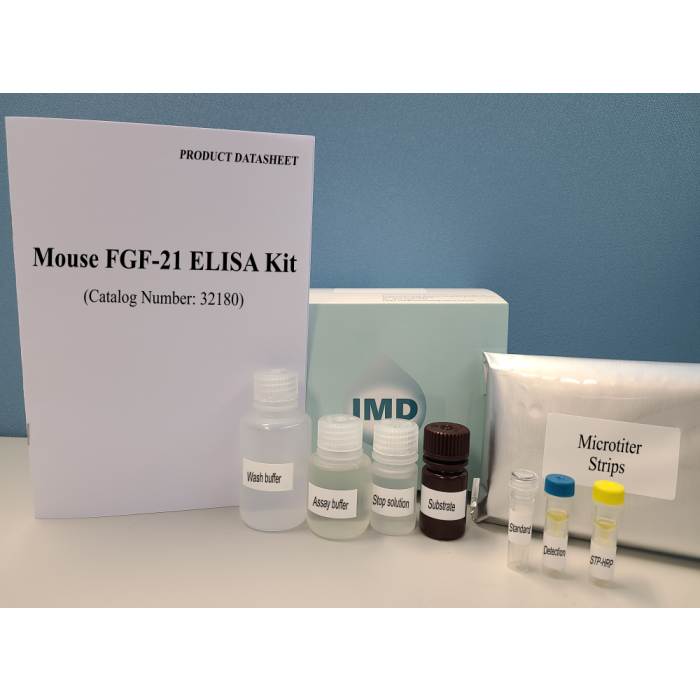
Mouse FGF-21 ELISA Kit
€400.00
In stock
SKU
IMD-32180
Catalog Number: IMD-32180
Size: 96 tests/kit
Assay range: 31.2-2000 pg/mL
Datasheet
Questions? Contact us!
Size: 96 tests/kit
Assay range: 31.2-2000 pg/mL
Datasheet
Questions? Contact us!
INTENDED USE:
For the quantitative determination of mouse FGF-21 concentrations in serum, plasma or cell culture supernate samples
INTRODUCTION:
FGF21 is a metabolic hormone mainly produced in liver. It regulates glucose and lipid metabolism through pleiotropic actions in multiple tissues, and protects against metabolic damages under various stresses.
In humans, high circulating FGF21 levels are found in obesity and multiple cardiometabolic disorders, including metabolic syndrome, type 2 diabetes, non-alcoholic fatty liver disease and coronary artery disease. Serum FGF21 is a potential biomarker for the early detection and risk prediction of these diseases.
PRINCIPLE OF THE ASSAY:
This assay is a quantitative sandwich ELISA. The immunoplate is precoated with a rabbit polyclonal antibody specific for mouse FGF-21. Standards and samples are pipetted into the wells and any mouse FGF-21 present is bound by the immobilized antibody. After washing away any unbound substances, a biotin labelled polyclonal antibody specific for mouse FGF-21 is added to the wells. After wash step to remove any unbound reagents, streptavidin-HRP conjugate (STP-HRP) is added. After the last wash step, an HRP substrate solution is added and colour develops in proportion to the amount of mouse FGF-21 bound initially. The assay is stopped and the optical density of the wells determined using a microplate reader. Since the increases in absorbance are directly proportional to the amount of captured mouse FGF-21, the unknown sample concentration can be interpolated from a reference curve included in each assay.
SENSITIVITY: The lowest level of mouse FGF-21 that can be detected by this assay is 31.2 pg/mL.
PUBLICATIONS CITING THIS PRODUCT
Li H, Gao Z, Zhang J, Ye X, Xu A, Ye J, Jia W. Sodium butyrate stimulates expression of fibroblast growth factor 21 in liver by inhibition of histone deacetylase 3. Diabetes. 2012 Apr 1;61(4):797-806.
Lin Z, Tian H, Lam KS, Lin S, Hoo RC, Konishi M, Itoh N, Wang Y, Bornstein SR, Xu A, Li X. Adiponectin mediates the metabolic effects of FGF21 on glucose homeostasis and insulin sensitivity in mice. Cell metabolism. 2013 May 7;17(5):779-89.
Huang Z, Zhong L, Lee JT, Zhang J, Wu D, Geng L, Wang Y, Wong CM, Xu A. The FGF21-CCL11 axis mediates beiging of white adipose tissues by coupling sympathetic nervous system to type 2 immunity. Cell metabolism. 2017 Sep 5;26(3):493-508.
Li H, Wu G, Fang Q, Zhang M, Hui X, Sheng B, Wu L, Bao Y, Li P, Xu A, Jia W. Fibroblast growth factor 21 increases insulin sensitivity through specific expansion of subcutaneous fat. Nature communications. 2018 Jan 18;9(1):1-6.
Pan X, Shao Y, Wu F, Wang Y, Xiong R, Zheng J, Tian H, Wang B, Wang Y, Zhang Y, Han Z. Fgf21 prevents angiotensin ii-induced hypertension and vascular dysfunction by activation of ace2/angiotensin-(1–7) axis in mice. Cell metabolism. 2018 Jun 5;27(6):1323-37.
Pan Y, Wang B, Zheng J, Xiong R, Fan Z, Ye Y, Zhang S, Li Q, Gong F, Wu C, Lin Z. Pancreatic fibroblast growth factor 21 protects against type 2 diabetes in mice by promoting insulin expression and secretion in a PI3K/Akt signaling‐dependent manner. Journal of cellular and molecular medicine. 2019 Feb;23(2):1059-71.
Pan Y, Hui X, Hoo RL, Ye D, Chan CY, Feng T, Wang Y, Lam KS, Xu A. Adipocyte-secreted exosomal microRNA-34a inhibits M2 macrophage polarization to promote obesity-induced adipose inflammation. The Journal of clinical investigation. 2019 Feb 1;129(2):834-49.
Geng L, Liao B, Jin L, Huang Z, Triggle CR, Ding H, Zhang J, Huang Y, Lin Z, Xu A. Exercise alleviates obesity-induced metabolic dysfunction via enhancing FGF21 sensitivity in adipose tissues. Cell reports. 2019 Mar 5;26(10):2738-52.
Yang BC, Wu SY, Leung PS. Alcohol ingestion induces pancreatic islet dysfunction and apoptosis via mediation of FGF21 resistance. Annals of translational medicine. 2020 Mar;8(6).
Zhang Y, Cao X, Chen L, Qin Y, Xu Y, Tian Y, Chen L. Exposure of female mice to perfluorooctanoic acid suppresses hypothalamic kisspeptin‐reproductive endocrine system through enhanced hepatic fibroblast growth factor 21 synthesis, leading to ovulation failure and prolonged dioestrus. Journal of neuroendocrinology. 2020 May;32(5):e12848.
For the quantitative determination of mouse FGF-21 concentrations in serum, plasma or cell culture supernate samples
INTRODUCTION:
FGF21 is a metabolic hormone mainly produced in liver. It regulates glucose and lipid metabolism through pleiotropic actions in multiple tissues, and protects against metabolic damages under various stresses.
In humans, high circulating FGF21 levels are found in obesity and multiple cardiometabolic disorders, including metabolic syndrome, type 2 diabetes, non-alcoholic fatty liver disease and coronary artery disease. Serum FGF21 is a potential biomarker for the early detection and risk prediction of these diseases.
PRINCIPLE OF THE ASSAY:
This assay is a quantitative sandwich ELISA. The immunoplate is precoated with a rabbit polyclonal antibody specific for mouse FGF-21. Standards and samples are pipetted into the wells and any mouse FGF-21 present is bound by the immobilized antibody. After washing away any unbound substances, a biotin labelled polyclonal antibody specific for mouse FGF-21 is added to the wells. After wash step to remove any unbound reagents, streptavidin-HRP conjugate (STP-HRP) is added. After the last wash step, an HRP substrate solution is added and colour develops in proportion to the amount of mouse FGF-21 bound initially. The assay is stopped and the optical density of the wells determined using a microplate reader. Since the increases in absorbance are directly proportional to the amount of captured mouse FGF-21, the unknown sample concentration can be interpolated from a reference curve included in each assay.
SENSITIVITY: The lowest level of mouse FGF-21 that can be detected by this assay is 31.2 pg/mL.
PUBLICATIONS CITING THIS PRODUCT
Li H, Gao Z, Zhang J, Ye X, Xu A, Ye J, Jia W. Sodium butyrate stimulates expression of fibroblast growth factor 21 in liver by inhibition of histone deacetylase 3. Diabetes. 2012 Apr 1;61(4):797-806.
Lin Z, Tian H, Lam KS, Lin S, Hoo RC, Konishi M, Itoh N, Wang Y, Bornstein SR, Xu A, Li X. Adiponectin mediates the metabolic effects of FGF21 on glucose homeostasis and insulin sensitivity in mice. Cell metabolism. 2013 May 7;17(5):779-89.
Huang Z, Zhong L, Lee JT, Zhang J, Wu D, Geng L, Wang Y, Wong CM, Xu A. The FGF21-CCL11 axis mediates beiging of white adipose tissues by coupling sympathetic nervous system to type 2 immunity. Cell metabolism. 2017 Sep 5;26(3):493-508.
Li H, Wu G, Fang Q, Zhang M, Hui X, Sheng B, Wu L, Bao Y, Li P, Xu A, Jia W. Fibroblast growth factor 21 increases insulin sensitivity through specific expansion of subcutaneous fat. Nature communications. 2018 Jan 18;9(1):1-6.
Pan X, Shao Y, Wu F, Wang Y, Xiong R, Zheng J, Tian H, Wang B, Wang Y, Zhang Y, Han Z. Fgf21 prevents angiotensin ii-induced hypertension and vascular dysfunction by activation of ace2/angiotensin-(1–7) axis in mice. Cell metabolism. 2018 Jun 5;27(6):1323-37.
Pan Y, Wang B, Zheng J, Xiong R, Fan Z, Ye Y, Zhang S, Li Q, Gong F, Wu C, Lin Z. Pancreatic fibroblast growth factor 21 protects against type 2 diabetes in mice by promoting insulin expression and secretion in a PI3K/Akt signaling‐dependent manner. Journal of cellular and molecular medicine. 2019 Feb;23(2):1059-71.
Pan Y, Hui X, Hoo RL, Ye D, Chan CY, Feng T, Wang Y, Lam KS, Xu A. Adipocyte-secreted exosomal microRNA-34a inhibits M2 macrophage polarization to promote obesity-induced adipose inflammation. The Journal of clinical investigation. 2019 Feb 1;129(2):834-49.
Geng L, Liao B, Jin L, Huang Z, Triggle CR, Ding H, Zhang J, Huang Y, Lin Z, Xu A. Exercise alleviates obesity-induced metabolic dysfunction via enhancing FGF21 sensitivity in adipose tissues. Cell reports. 2019 Mar 5;26(10):2738-52.
Yang BC, Wu SY, Leung PS. Alcohol ingestion induces pancreatic islet dysfunction and apoptosis via mediation of FGF21 resistance. Annals of translational medicine. 2020 Mar;8(6).
Zhang Y, Cao X, Chen L, Qin Y, Xu Y, Tian Y, Chen L. Exposure of female mice to perfluorooctanoic acid suppresses hypothalamic kisspeptin‐reproductive endocrine system through enhanced hepatic fibroblast growth factor 21 synthesis, leading to ovulation failure and prolonged dioestrus. Journal of neuroendocrinology. 2020 May;32(5):e12848.
| Is Featured? | No |
|---|
Write Your Own Review