
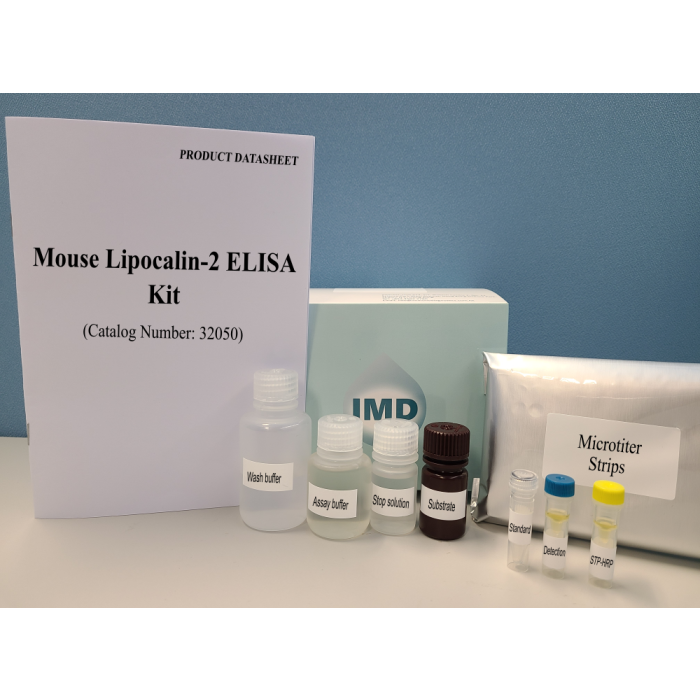
Mouse lipocalin 2 (NGAL) ELISA Kit
€460.00
In stock
SKU
IMD-32050
Catalog Number: IMD-32050
Size: 96 tests/kit
Assay range: 0.156-10 ng/mL
Datasheet
Questions? Contact us!
Size: 96 tests/kit
Assay range: 0.156-10 ng/mL
Datasheet
Questions? Contact us!
INTENDED USE:
For the quantitative determination of mouse lipocalin-2 concentrations in serum, plasma or cell culture supernate samples
INTRODUCTION:
Lipocalin-2, also known as neutrophil gelatinase-associated lipocalin (NGAL), 24p3, siderocalin, or neutrophil lipocalin (NL), is a secretory glycoprotein expressed in liver, lung, kidney, adipocytes, activated neutrophils and macrophages.
Lipocalin-2 is upregulated under various inflammation and infection conditions and can be served as a sensitive biomarker for various renal injuries. Serum levels of lipocalin-2 are positively correlated with obesity, insulin resistance, hyperglycemia, coronary heart disease and fatty liver disease in humans.
PRINCIPLE OF THE ASSAY:
This assay is a sandwich ELISA using antigen-affinity-purified polyclonal antibodies against mouse LCN2. The immunoplate is pre-coated with anti-mouse LCN2 capture antibody. Standards and samples are added to the wells and any mouse LCN2 present is captured by the immobilized antibody. After wash step to remove any unbound substances, a biotin labelled anti-mouse LCN2 detection antibody is added. After washing procedure, streptavidin-HRP conjugate (STP-HRP) is added. After the last wash step, an HRP substrate solution is added and colour develops in proportion to the amount of mouse LCN2 bound initially. The assay is stopped and the optical density of the wells determined using a microplate reader. Since the increases in absorbance are directly proportional to the amount of captured mouse LCN2, the unknown sample concentration can be interpolated from a reference curve included in each assay.
SENSITIVITY: The lowest level of lipocalin-2 that can be detected by this assay is 0.156 ng/mL.
PUBLICATIONS CITING THIS PRODUCT
Sun WY, Bai B, Luo C, Yang K, Li D, Wu D, Félétou M, Villeneuve N, Zhou Y, Yang J, Xu A. Lipocalin-2 derived from adipose tissue mediates aldosterone-induced renal injury. JCI insight. 2018 Sep 6;3(17).
For the quantitative determination of mouse lipocalin-2 concentrations in serum, plasma or cell culture supernate samples
INTRODUCTION:
Lipocalin-2, also known as neutrophil gelatinase-associated lipocalin (NGAL), 24p3, siderocalin, or neutrophil lipocalin (NL), is a secretory glycoprotein expressed in liver, lung, kidney, adipocytes, activated neutrophils and macrophages.
Lipocalin-2 is upregulated under various inflammation and infection conditions and can be served as a sensitive biomarker for various renal injuries. Serum levels of lipocalin-2 are positively correlated with obesity, insulin resistance, hyperglycemia, coronary heart disease and fatty liver disease in humans.
PRINCIPLE OF THE ASSAY:
This assay is a sandwich ELISA using antigen-affinity-purified polyclonal antibodies against mouse LCN2. The immunoplate is pre-coated with anti-mouse LCN2 capture antibody. Standards and samples are added to the wells and any mouse LCN2 present is captured by the immobilized antibody. After wash step to remove any unbound substances, a biotin labelled anti-mouse LCN2 detection antibody is added. After washing procedure, streptavidin-HRP conjugate (STP-HRP) is added. After the last wash step, an HRP substrate solution is added and colour develops in proportion to the amount of mouse LCN2 bound initially. The assay is stopped and the optical density of the wells determined using a microplate reader. Since the increases in absorbance are directly proportional to the amount of captured mouse LCN2, the unknown sample concentration can be interpolated from a reference curve included in each assay.
SENSITIVITY: The lowest level of lipocalin-2 that can be detected by this assay is 0.156 ng/mL.
PUBLICATIONS CITING THIS PRODUCT
Sun WY, Bai B, Luo C, Yang K, Li D, Wu D, Félétou M, Villeneuve N, Zhou Y, Yang J, Xu A. Lipocalin-2 derived from adipose tissue mediates aldosterone-induced renal injury. JCI insight. 2018 Sep 6;3(17).
| Is Featured? | No |
|---|
Write Your Own Review