
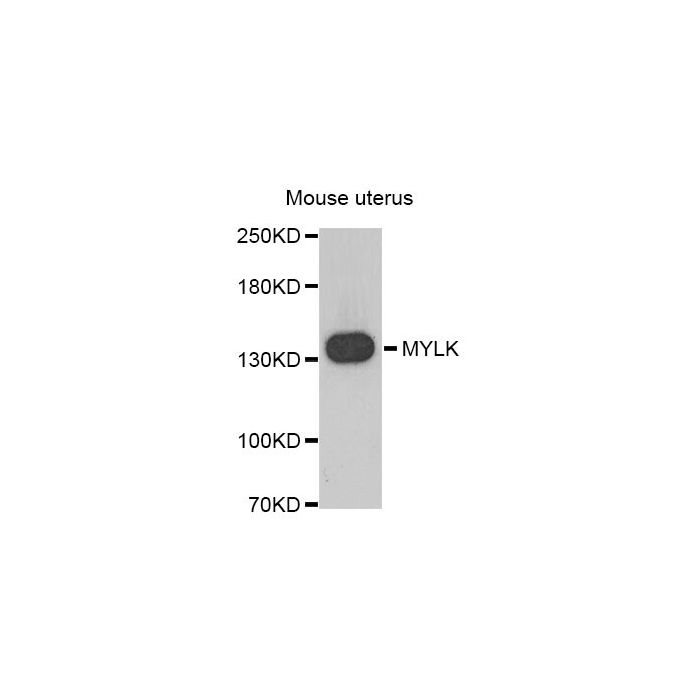
MYLK polyclonal, anti-human, mouse, rat
€388.00
In stock
SKU
BS71057
Background:
The Ca2+/calmodulin-dependent protein kinases (CaM kinases) are a structurally related subfamily of serine/threonine kinases that includes CaMKI, CaMKII, CaMKIV and myosin light chain kinases (MYLK, also designated MLCK). The MYLK kinases phosphorylate myosin regulatory light chains to catalyze myosin interaction with actin filaments resulting in contractile activity. Non-muscle, smooth muscle and skeletal/cardiac muscle MYLK isoforms exist. The MYLK gene (also designated MYLK1) encodes both smooth muscle and non-muscle isoforms as well as telokin, a small C-terminal isoform expressed only in smooth muscle with the capacity to stabilize unphosphorylated myosin filaments. Multiple transcript variants are described for the MYLK gene. Smooth-muscle and non-muscle MYLK isoforms are expressed in a wide variety of adult and fetal tissues. The skeletal/cardiac muscle isoforms of MYLK are encoded by a separate gene, MYLK2 (also designated skMLCK). MYLK appears to be a target for PAKs (p21-activated kinases). PAK1 interaction with MYLK results in a decrease in MYLK activity and myosin light chain phosphorylation.
Alternative Name:
KRP, AAT7, MLCK, MLCK1, MYLK1, smMLCK, MLCK108, MLCK210, MSTP083,
Application Dilution: WB: 1:500 - 1:2000, IHC: 1:50 - 1:200
Specificity: MYLK polyclonal antibody detects endogenous levels of MYLK protein.
Immunogen:
Recombinant protein of human MYLK.
MW: ~ 211 kDa
Swis Prot.: Q15746
Purification & Purity:
The antibody was affinity-purified from rabbit antiserum by affinity-chromatography using epitope-specific immunogen and the purity is > 95% (by SDS-PAGE).
Format:
1mg/ml in PBS with 0.02% sodium azide, 50% glycerol, pH7.3.
Storage:
Store at 4°C short term. Aliquot and store at -20°C long term. Avoid freeze-thaw cycles.
For research use only, not for use in diagnostic procedure.
The Ca2+/calmodulin-dependent protein kinases (CaM kinases) are a structurally related subfamily of serine/threonine kinases that includes CaMKI, CaMKII, CaMKIV and myosin light chain kinases (MYLK, also designated MLCK). The MYLK kinases phosphorylate myosin regulatory light chains to catalyze myosin interaction with actin filaments resulting in contractile activity. Non-muscle, smooth muscle and skeletal/cardiac muscle MYLK isoforms exist. The MYLK gene (also designated MYLK1) encodes both smooth muscle and non-muscle isoforms as well as telokin, a small C-terminal isoform expressed only in smooth muscle with the capacity to stabilize unphosphorylated myosin filaments. Multiple transcript variants are described for the MYLK gene. Smooth-muscle and non-muscle MYLK isoforms are expressed in a wide variety of adult and fetal tissues. The skeletal/cardiac muscle isoforms of MYLK are encoded by a separate gene, MYLK2 (also designated skMLCK). MYLK appears to be a target for PAKs (p21-activated kinases). PAK1 interaction with MYLK results in a decrease in MYLK activity and myosin light chain phosphorylation.
Alternative Name:
KRP, AAT7, MLCK, MLCK1, MYLK1, smMLCK, MLCK108, MLCK210, MSTP083,
Application Dilution: WB: 1:500 - 1:2000, IHC: 1:50 - 1:200
Specificity: MYLK polyclonal antibody detects endogenous levels of MYLK protein.
Immunogen:
Recombinant protein of human MYLK.
MW: ~ 211 kDa
Swis Prot.: Q15746
Purification & Purity:
The antibody was affinity-purified from rabbit antiserum by affinity-chromatography using epitope-specific immunogen and the purity is > 95% (by SDS-PAGE).
Format:
1mg/ml in PBS with 0.02% sodium azide, 50% glycerol, pH7.3.
Storage:
Store at 4°C short term. Aliquot and store at -20°C long term. Avoid freeze-thaw cycles.
For research use only, not for use in diagnostic procedure.
| Is Featured? | No |
|---|
Write Your Own Review