
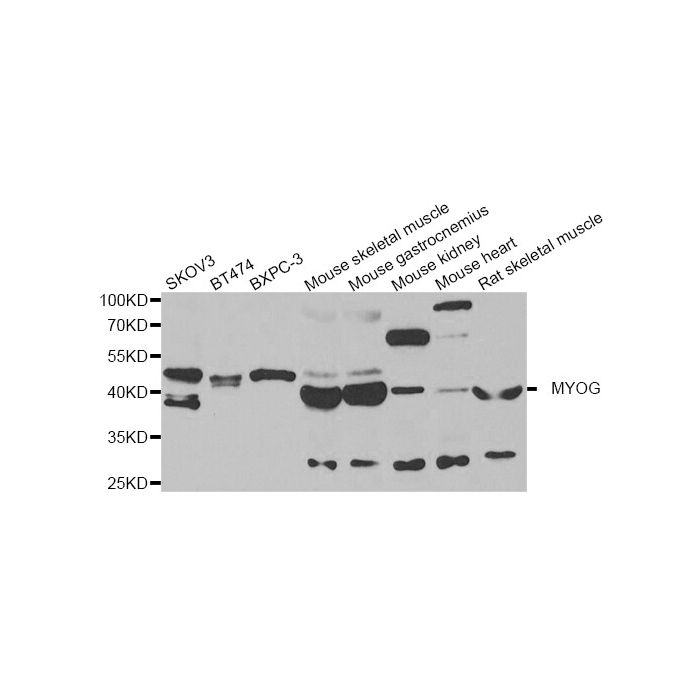
MYOG polyclonal, anti-human, mouse, rat
€388.00
In stock
SKU
BS8337
Background:
Differentiation of myogenic cells is regulated by multiple positively and negatively acting factors. One well characterized family of helix-loop-helix (HLH) proteins known to play an important role in the regulation of muscle cell development includes Myo D, myogenin, Myf-5 and Myf-6 (also designated MRF-4 or herculin). Of interest, most muscle cells express either Myo D or Myf-5 in the committed state, but when induced to differentiate, all turn on expression of myogenin. Myo D transcription factors form heterodimers with products of a more widely expressed family of bHLH genes, the E family, which consists of at least three distinct genes: E2A, IF2 and HEB. Myo D-E heterodimers bind avidly to consensus (CANNTG) E box target sites that are functionally important elements in the upstream regulatory sequences of many muscle-specific terminal differentiation genes.
Alternative Name:
Myogenin, Class C basic helix-loop-helix protein 3, bHLHc3, Myogenic factor 4, Myf-4, MYOG, BHLHC3, MYF4
Application Dilution: WB: 1:500~1:2000, IHC: 1:50~1:200
Specificity: MYOG polyclonal antibody detects endogenous levels of MYOG protein.
Immunogen:
Recombinant full length Human MYOG.
MW: ~ 25 kDa
Swis Prot.: P15173
Purification & Purity:
The antibody was affinity-purified from rabbit antiserum by affinity-chromatography using epitope-specific immunogen and the purity is > 95% (by SDS-PAGE).
Format:
1mg/ml in PBS with 0.1% Sodium Azide, 50% Glycerol.
Storage:
Store at 4°C short term. Aliquot and store at -20°C long term. Avoid freeze-thaw cycles.
For research use only, not for use in diagnostic procedure.
Differentiation of myogenic cells is regulated by multiple positively and negatively acting factors. One well characterized family of helix-loop-helix (HLH) proteins known to play an important role in the regulation of muscle cell development includes Myo D, myogenin, Myf-5 and Myf-6 (also designated MRF-4 or herculin). Of interest, most muscle cells express either Myo D or Myf-5 in the committed state, but when induced to differentiate, all turn on expression of myogenin. Myo D transcription factors form heterodimers with products of a more widely expressed family of bHLH genes, the E family, which consists of at least three distinct genes: E2A, IF2 and HEB. Myo D-E heterodimers bind avidly to consensus (CANNTG) E box target sites that are functionally important elements in the upstream regulatory sequences of many muscle-specific terminal differentiation genes.
Alternative Name:
Myogenin, Class C basic helix-loop-helix protein 3, bHLHc3, Myogenic factor 4, Myf-4, MYOG, BHLHC3, MYF4
Application Dilution: WB: 1:500~1:2000, IHC: 1:50~1:200
Specificity: MYOG polyclonal antibody detects endogenous levels of MYOG protein.
Immunogen:
Recombinant full length Human MYOG.
MW: ~ 25 kDa
Swis Prot.: P15173
Purification & Purity:
The antibody was affinity-purified from rabbit antiserum by affinity-chromatography using epitope-specific immunogen and the purity is > 95% (by SDS-PAGE).
Format:
1mg/ml in PBS with 0.1% Sodium Azide, 50% Glycerol.
Storage:
Store at 4°C short term. Aliquot and store at -20°C long term. Avoid freeze-thaw cycles.
For research use only, not for use in diagnostic procedure.
| Is Featured? | No |
|---|
Write Your Own Review