
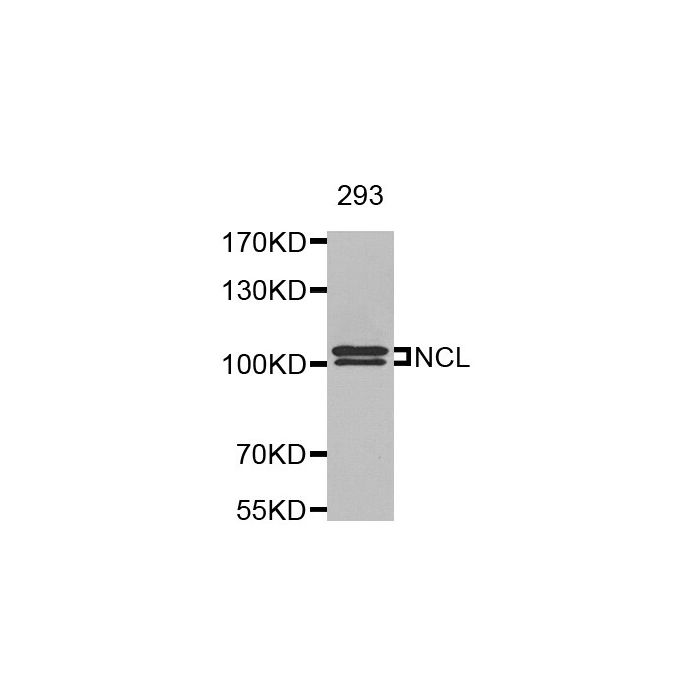
NCL polyclonal, anti-human, mouse, rat
€388.00
In stock
SKU
BS8090
Background:
C23 (nucleolin, NCL) is a eukaryotic nucleolar phosphoprotein that influences synthesis and maturation of ribosomes. C23 localizes to dense fibrillar regions of the nucleolus. It contains four RNA binding domains that interact with pre-rRNA during synthesis. C23 can influence RNA processing, ribosomal gene transcription and nucleolar targeting of ribosomal components. It is known to associate with a variety of proteins, including the nucleolar protein B23. Phosphorylation by Cdc2 and casein kinase II causes translocation of C23 from the nucleolus to the cytoplasm. Mitotic phosphorylated forms of Bcl-2 are present in nuclear structures in prophase Hela cells together with C23 and Ki-67. Retinoic acid-induced apoptosis leads to C23 down-regulation and Bcl-2 mRNA instability. C23 binds the human telomerase reverse transcriptase subunit (TERT) through interactions with its RNA binding domain 4 and carboxyl-terminal RGG domain, and this interaction is critical for the nucleolar localization of human TERT.
Alternative Name:
Nucleolin, Protein C23, NCL
Application Dilution: WB: 1:500~1:2000, IHC: 1:50~1:200
Specificity: NCL polyclonal antibody detects endogenous levels of NCL protein.
Immunogen:
Recombinant full length Human NCL.
MW: ~ 77 kDa
Swis Prot.: P19338
Purification & Purity:
The antibody was affinity-purified from rabbit antiserum by affinity-chromatography using epitope-specific immunogen and the purity is > 95% (by SDS-PAGE).
Format:
1mg/ml in PBS with 0.1% Sodium Azide, 50% Glycerol.
Storage:
Store at 4°C short term. Aliquot and store at -20°C long term. Avoid freeze-thaw cycles.
For research use only, not for use in diagnostic procedure.
C23 (nucleolin, NCL) is a eukaryotic nucleolar phosphoprotein that influences synthesis and maturation of ribosomes. C23 localizes to dense fibrillar regions of the nucleolus. It contains four RNA binding domains that interact with pre-rRNA during synthesis. C23 can influence RNA processing, ribosomal gene transcription and nucleolar targeting of ribosomal components. It is known to associate with a variety of proteins, including the nucleolar protein B23. Phosphorylation by Cdc2 and casein kinase II causes translocation of C23 from the nucleolus to the cytoplasm. Mitotic phosphorylated forms of Bcl-2 are present in nuclear structures in prophase Hela cells together with C23 and Ki-67. Retinoic acid-induced apoptosis leads to C23 down-regulation and Bcl-2 mRNA instability. C23 binds the human telomerase reverse transcriptase subunit (TERT) through interactions with its RNA binding domain 4 and carboxyl-terminal RGG domain, and this interaction is critical for the nucleolar localization of human TERT.
Alternative Name:
Nucleolin, Protein C23, NCL
Application Dilution: WB: 1:500~1:2000, IHC: 1:50~1:200
Specificity: NCL polyclonal antibody detects endogenous levels of NCL protein.
Immunogen:
Recombinant full length Human NCL.
MW: ~ 77 kDa
Swis Prot.: P19338
Purification & Purity:
The antibody was affinity-purified from rabbit antiserum by affinity-chromatography using epitope-specific immunogen and the purity is > 95% (by SDS-PAGE).
Format:
1mg/ml in PBS with 0.1% Sodium Azide, 50% Glycerol.
Storage:
Store at 4°C short term. Aliquot and store at -20°C long term. Avoid freeze-thaw cycles.
For research use only, not for use in diagnostic procedure.
| Is Featured? | No |
|---|
Write Your Own Review