
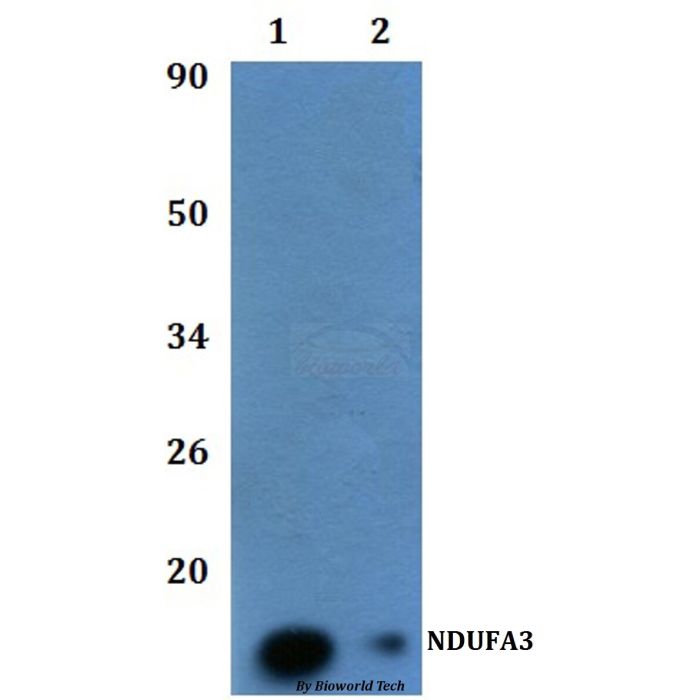
NDUFA3 polyclonal, anti-human, mouse
€305.00
In stock
SKU
BS61216
Background:
NDUFA3 (NADH dehydrogenase (ubiquinone) 1 alpha subcomplex, 3), also known as B9, is one of about 45 subunits comprising Complex I of the oxidative phosphorylation electron transport chain. Consisting of 84 amino acids and belonging to the Complex I NDUFA3 subunit family, NDUFA3 functions as an accessory subunit of the multi-protein mitochondrial membrane respiratory chain NADH dehydrogenase complex (known as Complex I). Complex I plays an important role in the transfer of electrons from NADH to the respiratory chain, a process that is essential for cellular respiration. The gene encoding NDUFA3 maps to human chromosome 19, which consists of over 63 million bases, houses approximately 1,400 genes and is recognized for having the greatest gene density of the human chromosomes. It is the genetic home for a number of immunoglobulin (Ig) superfamily members, including the killer cell and leukocyte Ig-like receptors, a number of ICAMs, the CEACAM and PSG family and Fc receptors (FcRs).
Alternative Name:
NADH dehydrogenase [ubiquinone] 1 alpha subcomplex subunit 3, Complex I-B9, CI-B9, NADH-ubiquinone oxidoreductase B9 subunit, NDUFA3
Application Dilution: WB: 1:500~1:1000
Specificity: NDUFA3 polyclonal antibody detects endogenous levels of NDUFA3 protein.
Immunogen:
A synthetic peptide corresponding to residues in Human NDUFA3.
MW: ~ 9 kDa
Swis Prot.: O95167
Purification & Purity:
The antibody was affinity-purified from rabbit antiserum by affinity-chromatography using epitope-specific immunogen and the purity is > 95% (by SDS-PAGE).
Format:
1 mg/ml in Phosphate buffered saline (PBS) with 0.05% sodium azide, approx. pH 7.3.
Storage:
Store at 4°C short term. Aliquot and store at -20°C long term. Avoid freeze-thaw cycles.
For research use only, not for use in diagnostic procedure.
NDUFA3 (NADH dehydrogenase (ubiquinone) 1 alpha subcomplex, 3), also known as B9, is one of about 45 subunits comprising Complex I of the oxidative phosphorylation electron transport chain. Consisting of 84 amino acids and belonging to the Complex I NDUFA3 subunit family, NDUFA3 functions as an accessory subunit of the multi-protein mitochondrial membrane respiratory chain NADH dehydrogenase complex (known as Complex I). Complex I plays an important role in the transfer of electrons from NADH to the respiratory chain, a process that is essential for cellular respiration. The gene encoding NDUFA3 maps to human chromosome 19, which consists of over 63 million bases, houses approximately 1,400 genes and is recognized for having the greatest gene density of the human chromosomes. It is the genetic home for a number of immunoglobulin (Ig) superfamily members, including the killer cell and leukocyte Ig-like receptors, a number of ICAMs, the CEACAM and PSG family and Fc receptors (FcRs).
Alternative Name:
NADH dehydrogenase [ubiquinone] 1 alpha subcomplex subunit 3, Complex I-B9, CI-B9, NADH-ubiquinone oxidoreductase B9 subunit, NDUFA3
Application Dilution: WB: 1:500~1:1000
Specificity: NDUFA3 polyclonal antibody detects endogenous levels of NDUFA3 protein.
Immunogen:
A synthetic peptide corresponding to residues in Human NDUFA3.
MW: ~ 9 kDa
Swis Prot.: O95167
Purification & Purity:
The antibody was affinity-purified from rabbit antiserum by affinity-chromatography using epitope-specific immunogen and the purity is > 95% (by SDS-PAGE).
Format:
1 mg/ml in Phosphate buffered saline (PBS) with 0.05% sodium azide, approx. pH 7.3.
Storage:
Store at 4°C short term. Aliquot and store at -20°C long term. Avoid freeze-thaw cycles.
For research use only, not for use in diagnostic procedure.
| Is Featured? | No |
|---|
Write Your Own Review