
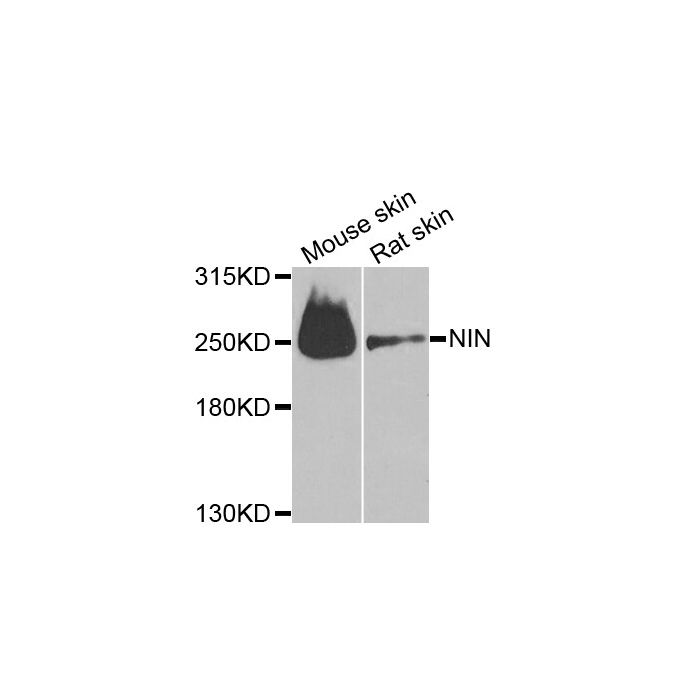
NIN polyclonal, anti-human, mouse, rat
€388.00
In stock
SKU
BS71124
Background:
This gene encodes one of the proteins important for centrosomal function. This protein is important for positioning and anchoring the microtubules minus-ends in epithelial cells. Localization of this protein to the centrosome requires three leucine zippers in the central coiled-coil domain. Multiple alternatively spliced transcript variants that encode different isoforms have been reported.
Alternative Name:
SCKL7,
Application Dilution: WB: 1:500 - 1:2000, IHC: 1:50 - 1:200
Specificity: NIN polyclonal antibody detects endogenous levels of NIN protein.
Immunogen:
Recombinant protein of human NIN.
MW: ~ 243 kDa
Swis Prot.: Q8N4C6
Purification & Purity:
The antibody was affinity-purified from rabbit antiserum by affinity-chromatography using epitope-specific immunogen and the purity is > 95% (by SDS-PAGE).
Format:
1mg/ml in PBS with 0.02% sodium azide, 50% glycerol, pH7.3.
Storage:
Store at 4°C short term. Aliquot and store at -20°C long term. Avoid freeze-thaw cycles.
For research use only, not for use in diagnostic procedure.
This gene encodes one of the proteins important for centrosomal function. This protein is important for positioning and anchoring the microtubules minus-ends in epithelial cells. Localization of this protein to the centrosome requires three leucine zippers in the central coiled-coil domain. Multiple alternatively spliced transcript variants that encode different isoforms have been reported.
Alternative Name:
SCKL7,
Application Dilution: WB: 1:500 - 1:2000, IHC: 1:50 - 1:200
Specificity: NIN polyclonal antibody detects endogenous levels of NIN protein.
Immunogen:
Recombinant protein of human NIN.
MW: ~ 243 kDa
Swis Prot.: Q8N4C6
Purification & Purity:
The antibody was affinity-purified from rabbit antiserum by affinity-chromatography using epitope-specific immunogen and the purity is > 95% (by SDS-PAGE).
Format:
1mg/ml in PBS with 0.02% sodium azide, 50% glycerol, pH7.3.
Storage:
Store at 4°C short term. Aliquot and store at -20°C long term. Avoid freeze-thaw cycles.
For research use only, not for use in diagnostic procedure.
| Is Featured? | No |
|---|
Write Your Own Review