
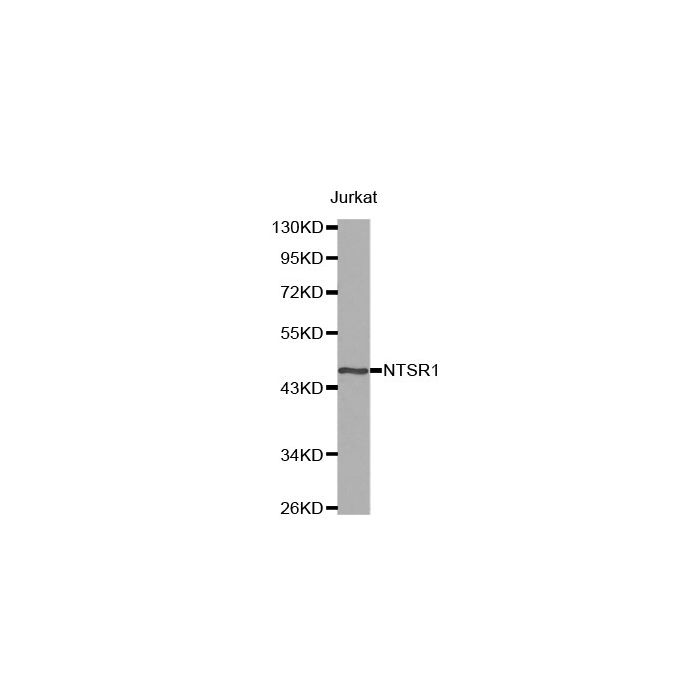
NTR1 polyclonal, anti-human, mouse
€388.00
In stock
SKU
BS7183
Background:
Neurotensin (NT) initiates an intracellular response by interacting with the G protein-coupled receptors NTR1 (NTS1 receptor, high affinity NTR) and NTR2 (NTS2 receptor, levocabastine-sensitive neurotensin receptor), and the type I receptor NTR3 (NTS3 receptor, sortilin-1, Gp95). NT has a wide distribution in regions of the brain and in peripheral tissues where NT receptors can contribute to hypotension, hyperglycemia, hypothermia, antinociception and regulation of intestinal motility and secretion. HL-60 cells express NTR1, which can couple to Gq, Gi/o, or Gs. Alternative splicing of rat NTR2 can generate a 5-transmembrane domain variant isoform that is co-expressed with the full-length NTR2 throughout the brain and spinal cord. NTR3 activation in the murine microglial cell line N11 induces MIP-2, MCP-1, IL-1β and TNFα in an ERK1/2 and Akt kinase-dependent manner.
Alternative Name:
NTSR1, NT-R-1, NTR, NTRH, NTRR
Application Dilution: WB: 1:500~1:2000
Specificity: NTR1 polyclonal antibody detects endogenous levels of NTR1 protein.
Immunogen:
Recombinant full length Human NTR1.
MW: ~36 kDa
Swis Prot.: P30989
Purification & Purity:
The antibody was affinity-purified from rabbit antiserum by affinity-chromatography using epitope-specific immunogen and the purity is > 95% (by SDS-PAGE).
Format:
1mg/ml in PBS with 0.1% Sodium Azide, 50% Glycerol.
Storage:
Store at 4°C short term. Aliquot and store at -20°C long term. Avoid freeze-thaw cycles.
For research use only, not for use in diagnostic procedure.
Neurotensin (NT) initiates an intracellular response by interacting with the G protein-coupled receptors NTR1 (NTS1 receptor, high affinity NTR) and NTR2 (NTS2 receptor, levocabastine-sensitive neurotensin receptor), and the type I receptor NTR3 (NTS3 receptor, sortilin-1, Gp95). NT has a wide distribution in regions of the brain and in peripheral tissues where NT receptors can contribute to hypotension, hyperglycemia, hypothermia, antinociception and regulation of intestinal motility and secretion. HL-60 cells express NTR1, which can couple to Gq, Gi/o, or Gs. Alternative splicing of rat NTR2 can generate a 5-transmembrane domain variant isoform that is co-expressed with the full-length NTR2 throughout the brain and spinal cord. NTR3 activation in the murine microglial cell line N11 induces MIP-2, MCP-1, IL-1β and TNFα in an ERK1/2 and Akt kinase-dependent manner.
Alternative Name:
NTSR1, NT-R-1, NTR, NTRH, NTRR
Application Dilution: WB: 1:500~1:2000
Specificity: NTR1 polyclonal antibody detects endogenous levels of NTR1 protein.
Immunogen:
Recombinant full length Human NTR1.
MW: ~36 kDa
Swis Prot.: P30989
Purification & Purity:
The antibody was affinity-purified from rabbit antiserum by affinity-chromatography using epitope-specific immunogen and the purity is > 95% (by SDS-PAGE).
Format:
1mg/ml in PBS with 0.1% Sodium Azide, 50% Glycerol.
Storage:
Store at 4°C short term. Aliquot and store at -20°C long term. Avoid freeze-thaw cycles.
For research use only, not for use in diagnostic procedure.
| Is Featured? | No |
|---|
Write Your Own Review