
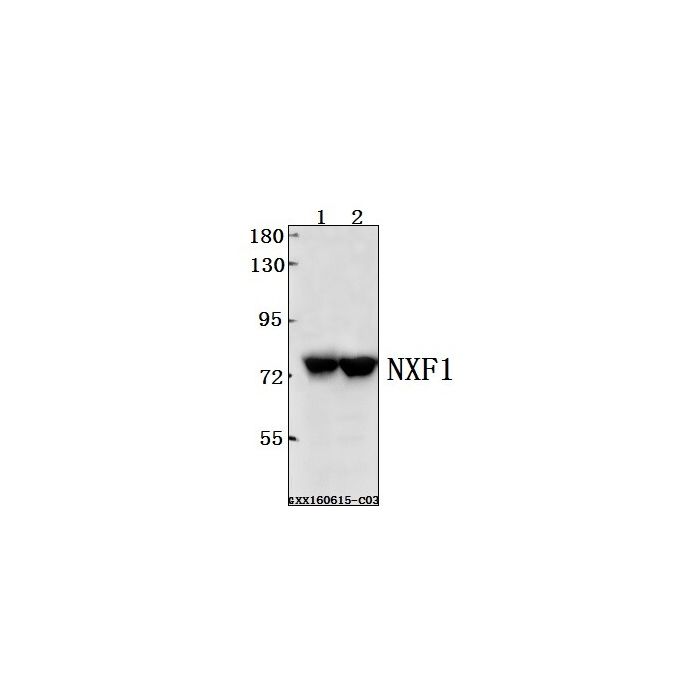
NXF1 polyclonal, anti-human
€305.00
In stock
SKU
BS61587
Background:
Involved in the nuclear export of mRNA species bearing retroviral constitutive transport elements (CTE) and in the export of mRNA from the nucleus to the cytoplasm. The NXF1-NXT1 heterodimer is involved in the export of HSP70 mRNA in conjunction with THOC4 and THOC5.
Alternative Name:
Nuclear RNA export factor 1, Tip-associated protein, Tip-associating protein, mRNA export factor TAP
Application Dilution: WB: 1:500~1:1000
Specificity: NXF1 polyclonal antibody detects endogenous levels of NXF1 protein.
Immunogen:
Synthetic peptide, corresponding to amino acids 1-45 of Human NXF1
MW: ~ 75 kDa
Swis Prot.: Q9UBU9
Purification & Purity:
The antibody was affinity-purified from rabbit antiserum by affinity-chromatography using epitope-specific immunogen and the purity is > 95% (by SDS-PAGE)
Format:
1 mg/ml in Phosphate buffered saline (PBS) with 0.05% sodium azide, approx. pH 7.3.
Storage:
Store at 4°C short term. Aliquot and store at -20°C long term. Avoid freeze-thaw cycles.
For research use only, not for use in diagnostic procedure.
Involved in the nuclear export of mRNA species bearing retroviral constitutive transport elements (CTE) and in the export of mRNA from the nucleus to the cytoplasm. The NXF1-NXT1 heterodimer is involved in the export of HSP70 mRNA in conjunction with THOC4 and THOC5.
Alternative Name:
Nuclear RNA export factor 1, Tip-associated protein, Tip-associating protein, mRNA export factor TAP
Application Dilution: WB: 1:500~1:1000
Specificity: NXF1 polyclonal antibody detects endogenous levels of NXF1 protein.
Immunogen:
Synthetic peptide, corresponding to amino acids 1-45 of Human NXF1
MW: ~ 75 kDa
Swis Prot.: Q9UBU9
Purification & Purity:
The antibody was affinity-purified from rabbit antiserum by affinity-chromatography using epitope-specific immunogen and the purity is > 95% (by SDS-PAGE)
Format:
1 mg/ml in Phosphate buffered saline (PBS) with 0.05% sodium azide, approx. pH 7.3.
Storage:
Store at 4°C short term. Aliquot and store at -20°C long term. Avoid freeze-thaw cycles.
For research use only, not for use in diagnostic procedure.
| Is Featured? | No |
|---|
Write Your Own Review