
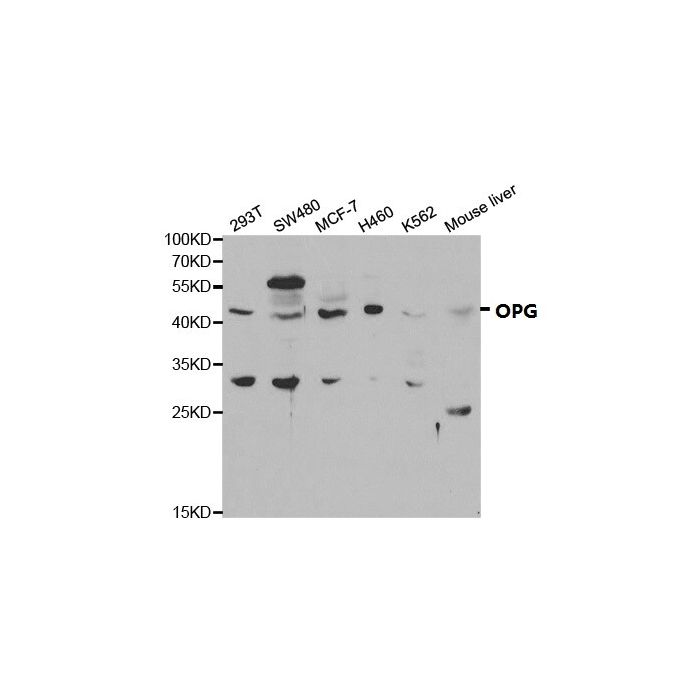
OPG polyclonal, anti-human, mouse, rat
€388.00
In stock
SKU
BS6684
Background:
The cytokine osteoprotegerin(OPG), also designated osteoclastogenesis inhibitory factor (OCIF), is known to inhibit osteoclast formation. A secreted glycoprotein, OPG is a member of the TNF receptor family that increases bone density and volume. OPG is thought to inhibit osteoclastogenesis by disrupting the cell-to-cell signaling between osteoblastic stromal cells and osteoclast progenitors. OPG is known to bind to TRAIL, a death domain-containing protein, and to inhibit TRAIL apoptosis in Jurkat cells. OPG also binds to osteoclast differentiation factor (ODF), also known as TRANCE/RANKL, a membrane-bound protein belonging to the TNF ligand family. Both TNFα and TNFβ upregulate OPG expression, while the bone resorbing agent prostaglandin E2 downregulates OPG.
Alternative Name:
Tumor necrosis factor receptor superfamily member 11B, Osteoclastogenesis inhibitory factor, Osteoprotegerin, TNFRSF11B, OCIF, OPG
Application Dilution: WB: 1:500~1:2000, IHC: 1:50~1:200
Specificity: OPG polyclonal antibody detects endogenous levels of Osteoprotegerin protein.
Immunogen:
Recombinant full length Human OPG.
MW: ~ 46 kDa
Swis Prot.: O00300
Purification & Purity:
The antibody was affinity-purified from rabbit antiserum by affinity-chromatography using epitope-specific immunogen and the purity is > 95% (by SDS-PAGE).
Format:
1mg/ml in PBS with 0.1% Sodium Azide, 50% Glycerol.
Storage:
Store at 4°C short term. Aliquot and store at -20°C long term. Avoid freeze-thaw cycles.
For research use only, not for use in diagnostic procedure.
The cytokine osteoprotegerin(OPG), also designated osteoclastogenesis inhibitory factor (OCIF), is known to inhibit osteoclast formation. A secreted glycoprotein, OPG is a member of the TNF receptor family that increases bone density and volume. OPG is thought to inhibit osteoclastogenesis by disrupting the cell-to-cell signaling between osteoblastic stromal cells and osteoclast progenitors. OPG is known to bind to TRAIL, a death domain-containing protein, and to inhibit TRAIL apoptosis in Jurkat cells. OPG also binds to osteoclast differentiation factor (ODF), also known as TRANCE/RANKL, a membrane-bound protein belonging to the TNF ligand family. Both TNFα and TNFβ upregulate OPG expression, while the bone resorbing agent prostaglandin E2 downregulates OPG.
Alternative Name:
Tumor necrosis factor receptor superfamily member 11B, Osteoclastogenesis inhibitory factor, Osteoprotegerin, TNFRSF11B, OCIF, OPG
Application Dilution: WB: 1:500~1:2000, IHC: 1:50~1:200
Specificity: OPG polyclonal antibody detects endogenous levels of Osteoprotegerin protein.
Immunogen:
Recombinant full length Human OPG.
MW: ~ 46 kDa
Swis Prot.: O00300
Purification & Purity:
The antibody was affinity-purified from rabbit antiserum by affinity-chromatography using epitope-specific immunogen and the purity is > 95% (by SDS-PAGE).
Format:
1mg/ml in PBS with 0.1% Sodium Azide, 50% Glycerol.
Storage:
Store at 4°C short term. Aliquot and store at -20°C long term. Avoid freeze-thaw cycles.
For research use only, not for use in diagnostic procedure.
| Is Featured? | No |
|---|
Write Your Own Review