
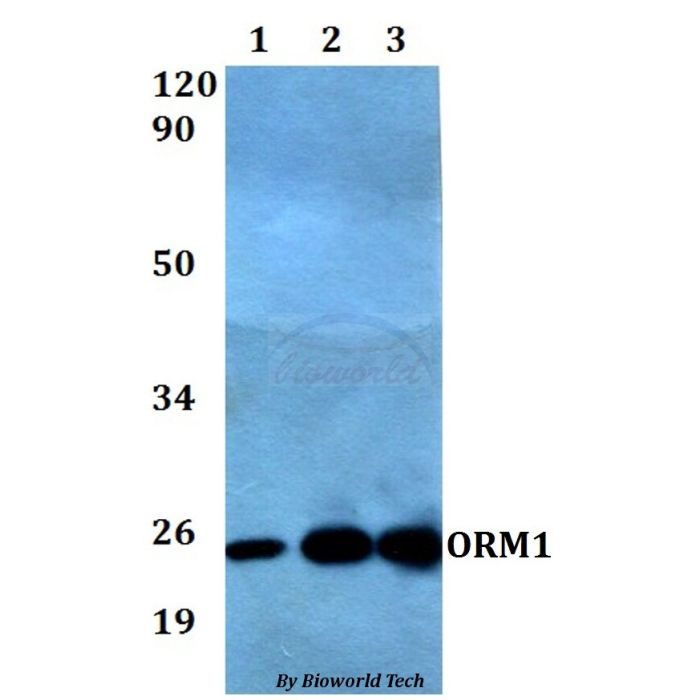
ORM1 polyclonal, anti-human, mouse, rat
€305.00
In stock
SKU
BS60547
Background:
Alpha 1 acid glycoprotein (AGP) is an acute phase plasma protein synthesized by the liver. It functions to regulate the interaction between blood cells and endothelial cells, and together with haptoglobin and C reactive protein, it also mediates the extravasation of cells during infection and inflammation. Expression of AGP is induced by acute-phase stimulatory agents such as bacterial lipopolysaccharides. AGP has a high affinity, low capacity binding for basic drugs at physiological pH. In human plasma, AGP is found at levels of 0.5-1.4 mg/ml. These levels are elevated during acute inflammation; therefore AGP protein levels can be used to diagnose inflammatory conditions. Multiple AGP genes exist, including AGP 1, AGP 2, AGP 3 and AGP 8. AGP 1 and AGP 2 contain five and six potential N-glycosylation sites, respectively. Abnormal expression of the APG 1 gene is linked to sarcoidosis and other immunogenetic diseases, while mutations in the APG 2 gene are associated with different types of carcinomas.
Alternative Name:
Alpha-1-acid glycoprotein 1, AGP 1, Orosomucoid-1, OMD 1, ORM1, AGP1
Application Dilution: WB: 1:500~1:1000
Specificity: ORM1 polyclonal antibody detects endogenous levels of ORM1 protein.
Immunogen:
A synthetic peptide corresponding to residues in Human ORM1
MW: ~ 24 kDa
Swis Prot.: P02763
Purification & Purity:
The antibody was affinity-purified from rabbit antiserum by affinity-chromatography using epitope-specific immunogen and the purity is > 95% (by SDS-PAGE).
Format:
1 mg/ml in Phosphate buffered saline (PBS) with 15 mM sodium azide, approx. pH 7.2.
Storage:
Store at 4°C short term. Aliquot and store at -20°C long term. Avoid freeze-thaw cycles.
For research use only, not for use in diagnostic procedure.
Alpha 1 acid glycoprotein (AGP) is an acute phase plasma protein synthesized by the liver. It functions to regulate the interaction between blood cells and endothelial cells, and together with haptoglobin and C reactive protein, it also mediates the extravasation of cells during infection and inflammation. Expression of AGP is induced by acute-phase stimulatory agents such as bacterial lipopolysaccharides. AGP has a high affinity, low capacity binding for basic drugs at physiological pH. In human plasma, AGP is found at levels of 0.5-1.4 mg/ml. These levels are elevated during acute inflammation; therefore AGP protein levels can be used to diagnose inflammatory conditions. Multiple AGP genes exist, including AGP 1, AGP 2, AGP 3 and AGP 8. AGP 1 and AGP 2 contain five and six potential N-glycosylation sites, respectively. Abnormal expression of the APG 1 gene is linked to sarcoidosis and other immunogenetic diseases, while mutations in the APG 2 gene are associated with different types of carcinomas.
Alternative Name:
Alpha-1-acid glycoprotein 1, AGP 1, Orosomucoid-1, OMD 1, ORM1, AGP1
Application Dilution: WB: 1:500~1:1000
Specificity: ORM1 polyclonal antibody detects endogenous levels of ORM1 protein.
Immunogen:
A synthetic peptide corresponding to residues in Human ORM1
MW: ~ 24 kDa
Swis Prot.: P02763
Purification & Purity:
The antibody was affinity-purified from rabbit antiserum by affinity-chromatography using epitope-specific immunogen and the purity is > 95% (by SDS-PAGE).
Format:
1 mg/ml in Phosphate buffered saline (PBS) with 15 mM sodium azide, approx. pH 7.2.
Storage:
Store at 4°C short term. Aliquot and store at -20°C long term. Avoid freeze-thaw cycles.
For research use only, not for use in diagnostic procedure.
| Is Featured? | No |
|---|
Write Your Own Review