
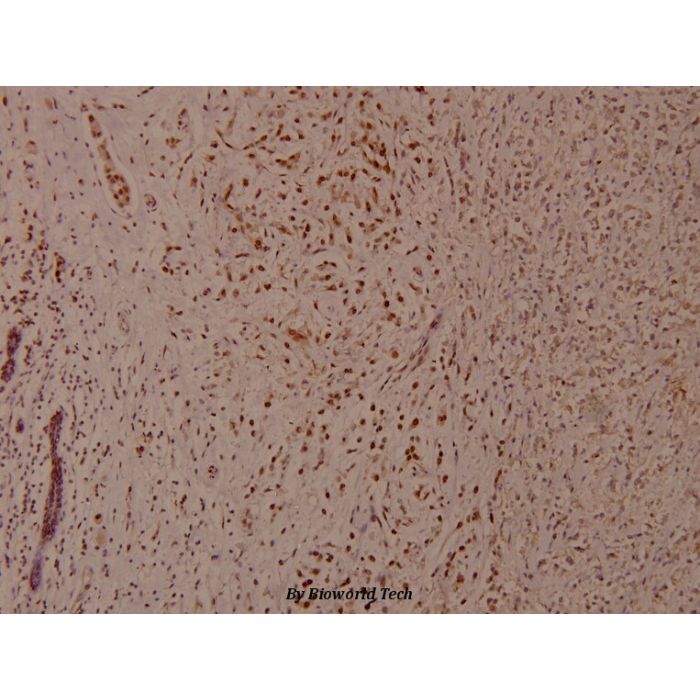
p53 (phospho-S37) polyclonal, anti-human, mouse, rat
€328.00
In stock
SKU
BS4836
Background:
p53, a DNA-binding, oligomerization domain and transcription activation domain-containing tumor suppressor, upregulates growth arrest and apoptosisrelated genes in response to stress signals, thereby influencing programmed cell death, cell differentiation and cell cycle control mechanisms. p53 localizes to the nucleus, yet can be chaperoned to the cytoplasm by the negative regulator MDM2, an E3 ubiquitin ligase that is upregulated in the presence of active p53, where MDM2 poly-ubiquitinates p53 for proteasome targeting. p53 fluctuates between latent and active (DNA-binding) conformations and is differentially activated through posttranslational modifications including phosphorylation and acetylation.
Alternative Name:
Cellular tumor antigen p53, Antigen NY-CO-13, Phosphoprotein p53, Tumor suppressor p53, TP53, P53
Application Dilution: IHC: 1:50~1:200
Specificity: p-p53 (S37) polyclonal antibody detects endogenous levels of p53 protein when phosphorylated at Ser37.
Immunogen:
Synthetic phosphopeptide derived from human p53 around the phosphorylation site of Serine 37.
MW: ~53,43 kDa
Swis Prot.: P04637
Purification & Purity:
The antibody was affinity-purified from rabbit antiserum by affinity-chromatography using epitope-specific immunogen and the purity is > 95% (by SDS-PAGE).
Format:
1 mg/ml in Phosphate buffered saline (PBS) with 0.05% sodium azide, approx. pH 7.2.
Storage:
Store at 4°C short term. Aliquot and store at -20°C long term. Avoid freeze-thaw cycles.
For research use only, not for use in diagnostic procedure.
p53, a DNA-binding, oligomerization domain and transcription activation domain-containing tumor suppressor, upregulates growth arrest and apoptosisrelated genes in response to stress signals, thereby influencing programmed cell death, cell differentiation and cell cycle control mechanisms. p53 localizes to the nucleus, yet can be chaperoned to the cytoplasm by the negative regulator MDM2, an E3 ubiquitin ligase that is upregulated in the presence of active p53, where MDM2 poly-ubiquitinates p53 for proteasome targeting. p53 fluctuates between latent and active (DNA-binding) conformations and is differentially activated through posttranslational modifications including phosphorylation and acetylation.
Alternative Name:
Cellular tumor antigen p53, Antigen NY-CO-13, Phosphoprotein p53, Tumor suppressor p53, TP53, P53
Application Dilution: IHC: 1:50~1:200
Specificity: p-p53 (S37) polyclonal antibody detects endogenous levels of p53 protein when phosphorylated at Ser37.
Immunogen:
Synthetic phosphopeptide derived from human p53 around the phosphorylation site of Serine 37.
MW: ~53,43 kDa
Swis Prot.: P04637
Purification & Purity:
The antibody was affinity-purified from rabbit antiserum by affinity-chromatography using epitope-specific immunogen and the purity is > 95% (by SDS-PAGE).
Format:
1 mg/ml in Phosphate buffered saline (PBS) with 0.05% sodium azide, approx. pH 7.2.
Storage:
Store at 4°C short term. Aliquot and store at -20°C long term. Avoid freeze-thaw cycles.
For research use only, not for use in diagnostic procedure.
| Is Featured? | No |
|---|
Write Your Own Review