
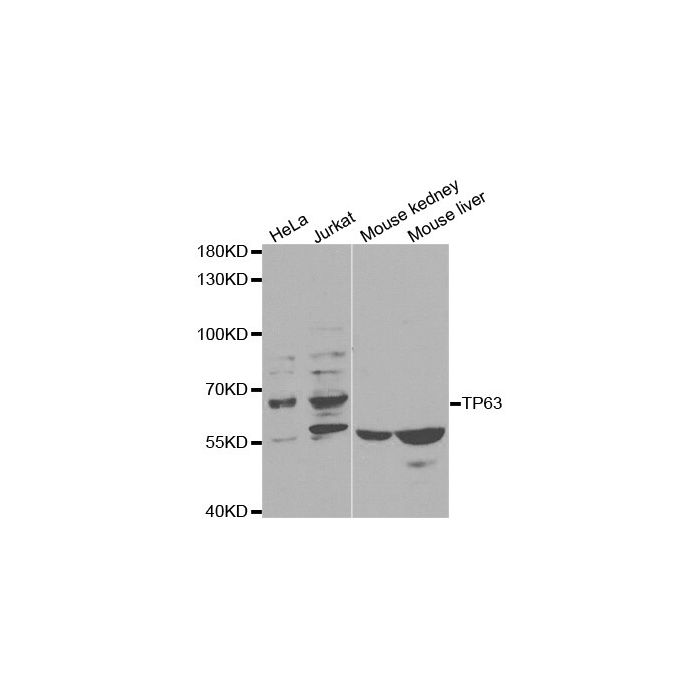
p63 / TP63 polyclonal, anti-human, mouse, rat
€388.00
In stock
SKU
BS6773
Background:
The p53 gene is a widely studied anti-oncogene, or tumor suppressor gene. The p53 gene product can act as a negative regulator of cell growth in response to DNA damage. p73 shares a high degree of homology with p53, and appears to have similar growth-inhibiting and apoptosis-promoting functions. However, unlike p53, the expression of p73 is not upregulated in response to DNA damage. p73 can, when overproduced, activate the p53- responsive gene p21. p63 has also been identified based on its similarities with p53. The p63 gene encodes multiple isotypes with variable functions. p63α (also designated p51B or KET), p63β and p63γ (also designated p51A), as well as corresponding TA* p63 isoforms, contain transactivation domains which have been shown to transactivate p53 reporter genes and induce apoptosis. p63 isoforms lack the transactivation domain and can act as dominant- negative reagents to inhibit transactivation by p53 and p63.
Alternative Name:
Tumor protein 63, Chronic ulcerative stomatitis protein, CUSP, Keratinocyte transcription factor KET, Transformation-related protein 63, TP63, Tumor protein p73-like, p73L, p40, p51, TP63, KET, P63, P73H, P73L, TP73L
Application Dilution: WB: 1:500 - 1:2000
Specificity: TP63 polyclonal antibody detects endogenous levels of TP63 protein.
Immunogen:
Recombinant full length Human p63 / TP63.
MW: ~ 77 kDa
Swis Prot.: Q9H3D4
Purification & Purity:
The antibody was affinity-purified from rabbit antiserum by affinity-chromatography using epitope-specific immunogen and the purity is > 95% (by SDS-PAGE).
Format:
1mg/ml in PBS with 0.1% Sodium Azide, 50% Glycerol.
Storage:
Store at 4°C short term. Aliquot and store at -20°C long term. Avoid freeze-thaw cycles.
For research use only, not for use in diagnostic procedure.
The p53 gene is a widely studied anti-oncogene, or tumor suppressor gene. The p53 gene product can act as a negative regulator of cell growth in response to DNA damage. p73 shares a high degree of homology with p53, and appears to have similar growth-inhibiting and apoptosis-promoting functions. However, unlike p53, the expression of p73 is not upregulated in response to DNA damage. p73 can, when overproduced, activate the p53- responsive gene p21. p63 has also been identified based on its similarities with p53. The p63 gene encodes multiple isotypes with variable functions. p63α (also designated p51B or KET), p63β and p63γ (also designated p51A), as well as corresponding TA* p63 isoforms, contain transactivation domains which have been shown to transactivate p53 reporter genes and induce apoptosis. p63 isoforms lack the transactivation domain and can act as dominant- negative reagents to inhibit transactivation by p53 and p63.
Alternative Name:
Tumor protein 63, Chronic ulcerative stomatitis protein, CUSP, Keratinocyte transcription factor KET, Transformation-related protein 63, TP63, Tumor protein p73-like, p73L, p40, p51, TP63, KET, P63, P73H, P73L, TP73L
Application Dilution: WB: 1:500 - 1:2000
Specificity: TP63 polyclonal antibody detects endogenous levels of TP63 protein.
Immunogen:
Recombinant full length Human p63 / TP63.
MW: ~ 77 kDa
Swis Prot.: Q9H3D4
Purification & Purity:
The antibody was affinity-purified from rabbit antiserum by affinity-chromatography using epitope-specific immunogen and the purity is > 95% (by SDS-PAGE).
Format:
1mg/ml in PBS with 0.1% Sodium Azide, 50% Glycerol.
Storage:
Store at 4°C short term. Aliquot and store at -20°C long term. Avoid freeze-thaw cycles.
For research use only, not for use in diagnostic procedure.
| Is Featured? | No |
|---|
Write Your Own Review