
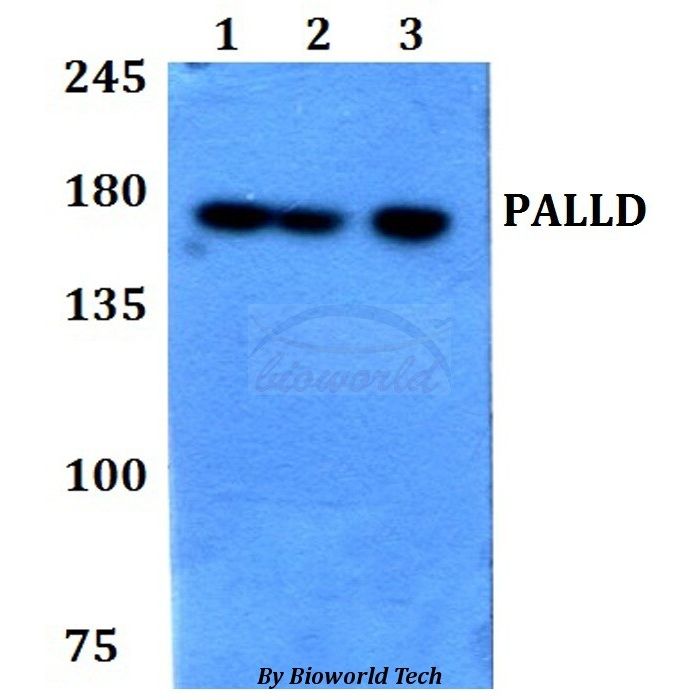
PALLD polyclonal, anti-human, mouse, rat
€305.00
In stock
SKU
BS60777
Background:
Palladin, also known as PALLD, PNCA1 or SIH002, is a 1,383 amino acid protein that localizes to both the cytoplasm and the cytoskeleton and contains five immunoglobulin (Ig)-like domains. Expressed as several alternatively spliced isoforms that are found in kidney, prostate, ovary and colon, palladin functions as a cytoskeletal protein that is required both for the organization of the Actin cytoskeleton, as well as for the establishment of proper cell motility, cell adhesion and cell-matrix interactions. Palladin interacts with Eps8, LASP-1 and VASP and may also play a role in cytoskeletal scaffolding and Actin remodeling. In response to DNA damage, palladin is subject to phosphorylation on select serine residues. Defects in the gene encoding palladin may increase genetic susceptibility to pancreatic cancer, strongly suggesting a role for palladin in tumorigenesis.
Alternative Name:
Palladin, SIH002, Sarcoma antigen NY-SAR-77, PALLD, KIAA0992, CGI-151
Application Dilution: WB: 1:500~1:1000
Specificity: PALLD polyclonal antibody detects endogenous levels of PALLD protein.
Immunogen:
A synthetic peptide corresponding to residues in Human PALLD
MW: ~ 151 kDa
Swis Prot.: Q8WX93
Purification & Purity:
The antibody was affinity-purified from rabbit antiserum by affinity-chromatography using epitope-specific immunogen and the purity is > 95% (by SDS-PAGE).
Format:
1 mg/ml in Phosphate buffered saline (PBS) with 15 mM sodium azide, approx. pH 7.2.
Storage:
Store at 4°C short term. Aliquot and store at -20°C long term. Avoid freeze-thaw cycles.
For research use only, not for use in diagnostic procedure.
Palladin, also known as PALLD, PNCA1 or SIH002, is a 1,383 amino acid protein that localizes to both the cytoplasm and the cytoskeleton and contains five immunoglobulin (Ig)-like domains. Expressed as several alternatively spliced isoforms that are found in kidney, prostate, ovary and colon, palladin functions as a cytoskeletal protein that is required both for the organization of the Actin cytoskeleton, as well as for the establishment of proper cell motility, cell adhesion and cell-matrix interactions. Palladin interacts with Eps8, LASP-1 and VASP and may also play a role in cytoskeletal scaffolding and Actin remodeling. In response to DNA damage, palladin is subject to phosphorylation on select serine residues. Defects in the gene encoding palladin may increase genetic susceptibility to pancreatic cancer, strongly suggesting a role for palladin in tumorigenesis.
Alternative Name:
Palladin, SIH002, Sarcoma antigen NY-SAR-77, PALLD, KIAA0992, CGI-151
Application Dilution: WB: 1:500~1:1000
Specificity: PALLD polyclonal antibody detects endogenous levels of PALLD protein.
Immunogen:
A synthetic peptide corresponding to residues in Human PALLD
MW: ~ 151 kDa
Swis Prot.: Q8WX93
Purification & Purity:
The antibody was affinity-purified from rabbit antiserum by affinity-chromatography using epitope-specific immunogen and the purity is > 95% (by SDS-PAGE).
Format:
1 mg/ml in Phosphate buffered saline (PBS) with 15 mM sodium azide, approx. pH 7.2.
Storage:
Store at 4°C short term. Aliquot and store at -20°C long term. Avoid freeze-thaw cycles.
For research use only, not for use in diagnostic procedure.
| Is Featured? | No |
|---|
Write Your Own Review