
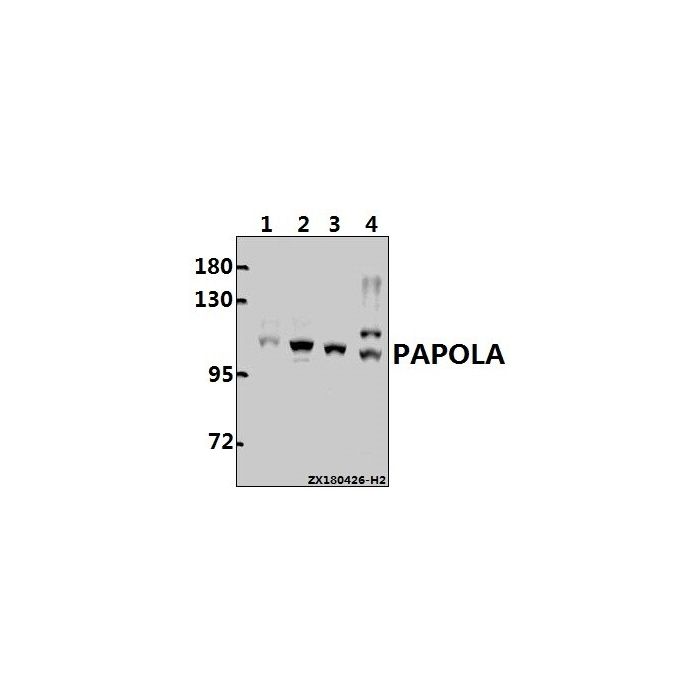
PAPOLA polyclonal, anti-human, mouse, rat
€305.00
In stock
SKU
BS61818
Background:
Polyadenylation of the 3' ends of eukaryotic mRNAs is a key event that takes place in the nucleus during maturation of mRNA. The reaction occurs in two distinct steps: endoribonucleolytic cleavage of the pre-RNA at the poly(A) site, followed by synthesis of the poly(A) tail at the 3' end of the up-stream cleavage product. The poly(A) polymerase (PAP) is required for the adenosine addition reaction. Western blot analysis reveals three PAPs, namely PAP-α, PAP-β and PAP-γ, demonstrating different molecular masses in HeLa cell extracts. The amino-terminal region of PAP is required for nonspecific polymerase activity, while both the amino and carboxy termini are required for specific polymerase activity. Additionally, PAP contains a functional ribonucleoprotein-type RNA binding domain (RBD) that is responsible for primer binding.
Alternative Name:
Poly(A) polymerase alpha, PAP-alpha, Polynucleotide adenylyltransferase alpha, PAPOLA, PAP
Application Dilution: WB: 1:500~1:1000
Specificity: PAPOLA pAb detects endogenous levels of PAPOLA protein.
Immunogen:
Synthetic peptide, corresponding to Human PAPOLA.
MW: ~ 100 kDa
Swis Prot.: P51003
Purification & Purity:
The antibody was affinity-purified from rabbit antiserum by affinity-chromatography using epitope-specific immunogen and the purity is > 95% (by SDS-PAGE).
Format:
1 mg/ml in Phosphate buffered saline (PBS) with 0.05% sodium azide, approx. pH 7.3.
Storage:
Store at 4°C short term. Aliquot and store at -20°C long term. Avoid freeze-thaw cycles.
For research use only, not for use in diagnostic procedure.
Polyadenylation of the 3' ends of eukaryotic mRNAs is a key event that takes place in the nucleus during maturation of mRNA. The reaction occurs in two distinct steps: endoribonucleolytic cleavage of the pre-RNA at the poly(A) site, followed by synthesis of the poly(A) tail at the 3' end of the up-stream cleavage product. The poly(A) polymerase (PAP) is required for the adenosine addition reaction. Western blot analysis reveals three PAPs, namely PAP-α, PAP-β and PAP-γ, demonstrating different molecular masses in HeLa cell extracts. The amino-terminal region of PAP is required for nonspecific polymerase activity, while both the amino and carboxy termini are required for specific polymerase activity. Additionally, PAP contains a functional ribonucleoprotein-type RNA binding domain (RBD) that is responsible for primer binding.
Alternative Name:
Poly(A) polymerase alpha, PAP-alpha, Polynucleotide adenylyltransferase alpha, PAPOLA, PAP
Application Dilution: WB: 1:500~1:1000
Specificity: PAPOLA pAb detects endogenous levels of PAPOLA protein.
Immunogen:
Synthetic peptide, corresponding to Human PAPOLA.
MW: ~ 100 kDa
Swis Prot.: P51003
Purification & Purity:
The antibody was affinity-purified from rabbit antiserum by affinity-chromatography using epitope-specific immunogen and the purity is > 95% (by SDS-PAGE).
Format:
1 mg/ml in Phosphate buffered saline (PBS) with 0.05% sodium azide, approx. pH 7.3.
Storage:
Store at 4°C short term. Aliquot and store at -20°C long term. Avoid freeze-thaw cycles.
For research use only, not for use in diagnostic procedure.
| Is Featured? | No |
|---|
Write Your Own Review