
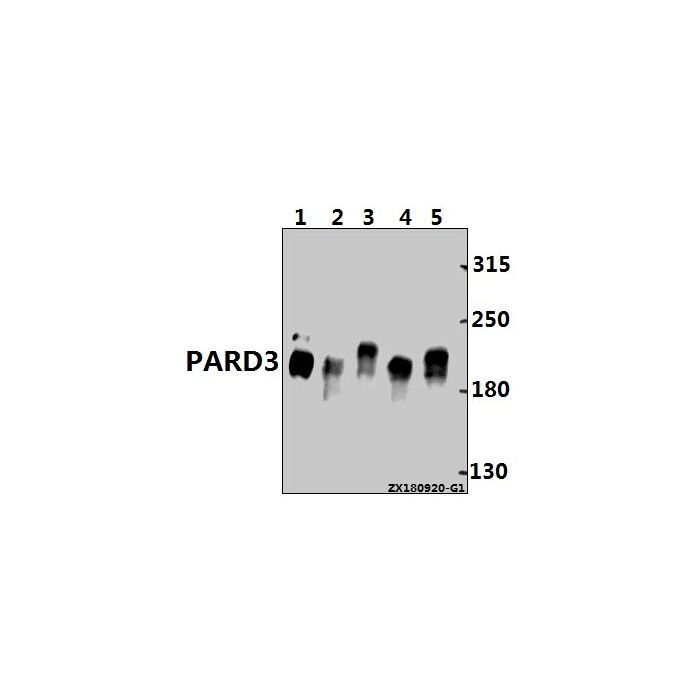
PARD3 (F1161) polyclonal, anti-human, mouse, rat
€305.00
In stock
SKU
BS2104
Catalog Number: BS2104
Size: 100 µl
Other Size: 50 µl
Isotype: rabbit IgG
Applications: WB
Questions? Contact us!
Size: 100 µl
Other Size: 50 µl
Isotype: rabbit IgG
Applications: WB
Questions? Contact us!
Background:
Cellular asymmetry is critical for the development of multicellular organisms. PARD (partitioning-defective) proteins play important roles in asymmetric cell division and polarized growth. PARD3A (partitioning-defective 3), also known as Baz, ASIP (atypical PKC isotype-specific-interacting protein), PAR3, PARD3, PAR3α, Bazooka, SE2-5T2, SE2-5L16 or SE2-5LT1, is a 1,356 amino acid protein that contains three PDZ domains and belongs to the PAR3 family of proteins. Expressed in a wide variety of tissues, PARD3A colocalizes with PARD6A/B and PKC ι at epithelial tight junctions and is believed to function as an adapter protein with an important role in the formation of normal tight junctions at epithelial cell-cell contacts. Due to alternative splicing events, PARD3A exists in at least ten isoforms, namely isoform A, isoform B, isoform C, isoform D, isoform E, isoform F, isoform Lb, isoform Sa, isoform Sb and isoform 10.
Alternative Name:
Partitioning defective 3 homolog, PAR-3, PARD-3, Atypical PKC isotype-specific-interacting protein, ASIP, CTCL tumor antigen se2-5, PAR3-alpha, PARD3, PAR3, PAR3A
Application Dilution:
WB: 1:500~1:1000
Specificity: PARD3 (F1161) polyclonal antibody detects endogenous levels of PARD3 protein.
Immunogen:
Synthetic peptide, corresponding to amino acids 1131-1191 of Human PARD3.
MW: ~ 181 kDa
Swiss-Prot: Q8TEW0
Purification & Purity:
The antibody was affinity-purified from rabbit antiserum by affinity-chromatography using epitope-specific immunogen and the purity is > 95% (by SDS-PAGE).
Format:
Rabbit IgG, 1mg/ml in PBS with 0.02% sodium azide, 50% glycerol, pH7.2
Storage:
Store at 4°C short term. Aliquot and store at -20°C long term. Avoid freeze-thaw cycles.
For research use only, not for use in diagnostic procedure.
Cellular asymmetry is critical for the development of multicellular organisms. PARD (partitioning-defective) proteins play important roles in asymmetric cell division and polarized growth. PARD3A (partitioning-defective 3), also known as Baz, ASIP (atypical PKC isotype-specific-interacting protein), PAR3, PARD3, PAR3α, Bazooka, SE2-5T2, SE2-5L16 or SE2-5LT1, is a 1,356 amino acid protein that contains three PDZ domains and belongs to the PAR3 family of proteins. Expressed in a wide variety of tissues, PARD3A colocalizes with PARD6A/B and PKC ι at epithelial tight junctions and is believed to function as an adapter protein with an important role in the formation of normal tight junctions at epithelial cell-cell contacts. Due to alternative splicing events, PARD3A exists in at least ten isoforms, namely isoform A, isoform B, isoform C, isoform D, isoform E, isoform F, isoform Lb, isoform Sa, isoform Sb and isoform 10.
Alternative Name:
Partitioning defective 3 homolog, PAR-3, PARD-3, Atypical PKC isotype-specific-interacting protein, ASIP, CTCL tumor antigen se2-5, PAR3-alpha, PARD3, PAR3, PAR3A
Application Dilution:
WB: 1:500~1:1000
Specificity: PARD3 (F1161) polyclonal antibody detects endogenous levels of PARD3 protein.
Immunogen:
Synthetic peptide, corresponding to amino acids 1131-1191 of Human PARD3.
MW: ~ 181 kDa
Swiss-Prot: Q8TEW0
Purification & Purity:
The antibody was affinity-purified from rabbit antiserum by affinity-chromatography using epitope-specific immunogen and the purity is > 95% (by SDS-PAGE).
Format:
Rabbit IgG, 1mg/ml in PBS with 0.02% sodium azide, 50% glycerol, pH7.2
Storage:
Store at 4°C short term. Aliquot and store at -20°C long term. Avoid freeze-thaw cycles.
For research use only, not for use in diagnostic procedure.
| Is Featured? | No |
|---|
Write Your Own Review