
PARP3 Polyclonal Antibody
€0.00
In stock
SKU
E-AB-40125
Catalog Number: E-AB-40125
Isotype: Rabbit IgG
Reactivity: human, mouse, rat
Applications: WB,IHC
Datasheet, Questions? Contact us!
Isotype: Rabbit IgG
Reactivity: human, mouse, rat
Applications: WB,IHC
Datasheet, Questions? Contact us!
Background:
Involved in the base excision repair (BER) pathway, by catalyzing the poly(ADP-ribosyl)ation of a limited number of acceptor proteins involved in chromatin architecture and in DNA metabolism. This modification follows DNA damages and appears as an obligatory step in a detection/signaling pathway leading to the reparation of DNA strand breaks. May link the DNA damage surveillance network to the mitotic fidelity checkpoint. Negatively influences the G1/S cell cycle progression without interfering with centrosome duplication. Binds DNA. May be involved in the regulation of PRC2 and PRC3 complex-dependent gene silencing.
Research Area: Cancer, Cell Biology, Epigenetics and Nuclear Signaling
Synonyms:
ADP ribosyltransferase (NAD+, poly (ADP ribose), ADP ribosyltransferase diphtheria toxin like 3, ADPRT-3, ADPRT3, ADPRTL2, ADPRTL3, ARTD3, hPARP 3, hPARP-3, hPARP3, IRT 1, IRT1, NAD(+) ADP ribosyltransferase 3, NAD(+) ADP-ribosyltransferase 3, NAD+ ADP ribosyltransferase 3, pADPRT 3, pADPRT-3, pADPRT3, PARP 3, PARP-3, PARP3, PARP3, Poly (ADP ribose) polymerase family, member 3, Poly (ADP ribose) synthetase 3, Poly [ADP-ribose] polymerase 3, Poly[ADP ribose] synthetase 3, Poly[ADP-ribose] synthase 3
Immunogen: Recombinant human PARP3 protein
Swissprot: Q9Y6F1
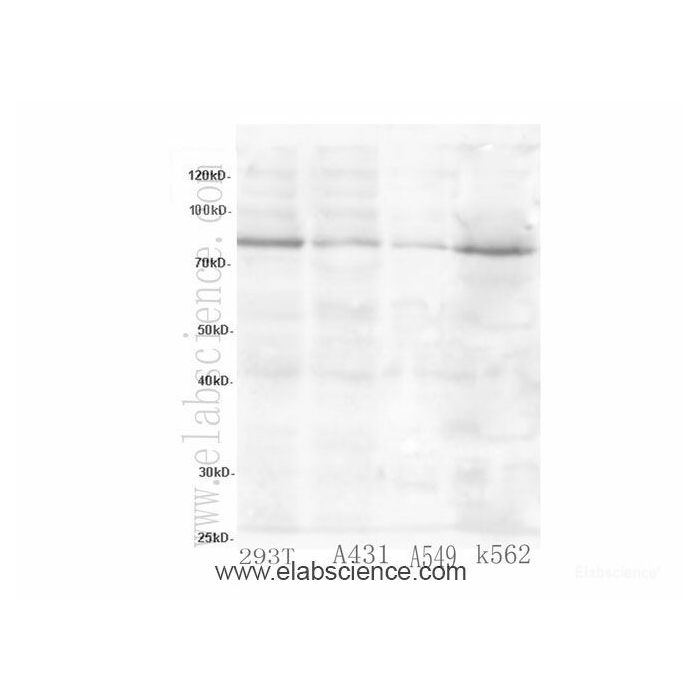
Calculated MW: 60 kDa
Observed MW: 60 kDa
Purification Method: Affinity purification
Buffer: PBS with 0.02% sodium azide and 50% glycerol pH 7.4.
Concentration: 2 mg/mL
Dilution: WB 1:500-1:1000,IHC 1:50-1:100
Storage:
Store at -20°C. Avoid freeze / thaw cycles.
| Is Featured? | No |
|---|
Write Your Own Review