
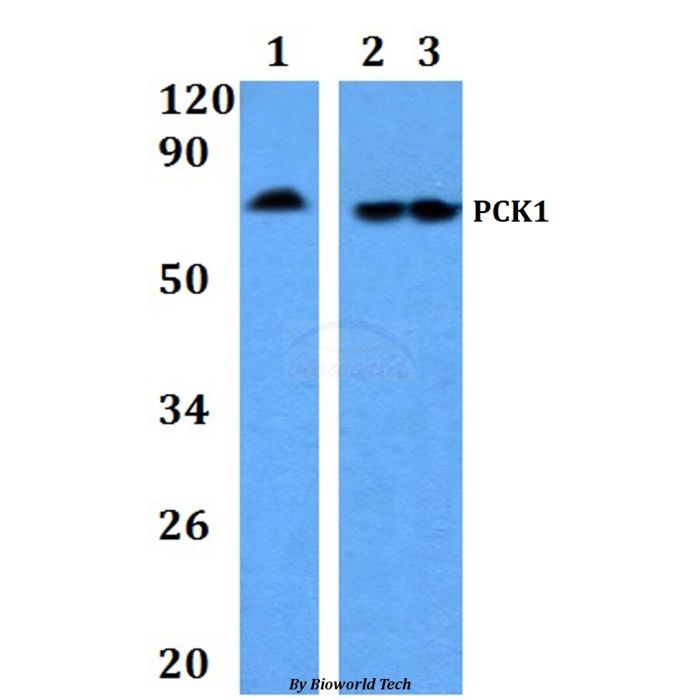
PCK1 polyclonal, anti-human, mouse, rat
€305.00
In stock
SKU
BS60887
Background:
Normal adjustment to changes in blood glucose levels depends on insulin signaling as well as enzymes involved in the regulation of gluconeogenesis. Pathological changes to this process are central to the type 2 diabetes phenotype. Phosphoenolpyruvate carboxykinase (PEPCK) plays an important role in this process by stimulating hepatic glucose production. PEPCK expression increases in response to glucagon and glucocorticoids, while insulin suppresses expression. Modulation of the signals governing PEPCK levels present a potential therapeutic approach to the treatment of insulin resistance and consequently obesity. The cytosolic form of PEPCK, known as PEPCK-C, and the mitochondrial form, known as PEPCK-M, are encoded by two different nuclear genes in mouse, human and chicken.
Alternative Name:
Phosphoenolpyruvate carboxykinase, cytosolic [GTP] (EC:4.1.1.32), PEPCK-C, PCK1, PEPCK1,
Application Dilution: WB: 1:500~1:1000
Specificity: PCK1 polyclonal antibody detects endogenous levels of PCK1 protein.
Immunogen:
A synthetic peptide corresponding to residues in Human PCK1.
MW: ~ 70 kDa
Swis Prot.: P35558
Purification & Purity:
The antibody was affinity-purified from rabbit antiserum by affinity-chromatography using epitope-specific immunogen and the purity is > 95% (by SDS-PAGE).
Format:
1 mg/ml in Phosphate buffered saline (PBS) with 0.05% sodium azide, approx. pH 7.3.
Storage:
Store at 4°C short term. Aliquot and store at -20°C long term. Avoid freeze-thaw cycles.
For research use only, not for use in diagnostic procedure.
Normal adjustment to changes in blood glucose levels depends on insulin signaling as well as enzymes involved in the regulation of gluconeogenesis. Pathological changes to this process are central to the type 2 diabetes phenotype. Phosphoenolpyruvate carboxykinase (PEPCK) plays an important role in this process by stimulating hepatic glucose production. PEPCK expression increases in response to glucagon and glucocorticoids, while insulin suppresses expression. Modulation of the signals governing PEPCK levels present a potential therapeutic approach to the treatment of insulin resistance and consequently obesity. The cytosolic form of PEPCK, known as PEPCK-C, and the mitochondrial form, known as PEPCK-M, are encoded by two different nuclear genes in mouse, human and chicken.
Alternative Name:
Phosphoenolpyruvate carboxykinase, cytosolic [GTP] (EC:4.1.1.32), PEPCK-C, PCK1, PEPCK1,
Application Dilution: WB: 1:500~1:1000
Specificity: PCK1 polyclonal antibody detects endogenous levels of PCK1 protein.
Immunogen:
A synthetic peptide corresponding to residues in Human PCK1.
MW: ~ 70 kDa
Swis Prot.: P35558
Purification & Purity:
The antibody was affinity-purified from rabbit antiserum by affinity-chromatography using epitope-specific immunogen and the purity is > 95% (by SDS-PAGE).
Format:
1 mg/ml in Phosphate buffered saline (PBS) with 0.05% sodium azide, approx. pH 7.3.
Storage:
Store at 4°C short term. Aliquot and store at -20°C long term. Avoid freeze-thaw cycles.
For research use only, not for use in diagnostic procedure.
| Is Featured? | No |
|---|
Write Your Own Review