
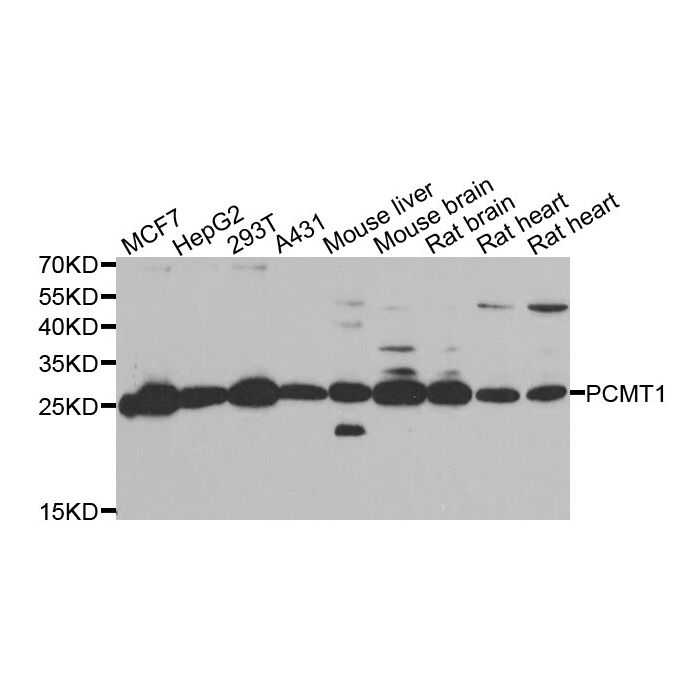
PCMT1 polyclonal, anti-human, mouse, rat
€388.00
In stock
SKU
BS8353
Background:
PCMT1 (protein-L-isoaspartate (D-aspartate) O-methyltransferase), also known as PIMT, is a member of the L-isoaspartyl/D-aspartyl protein methyltransferase family and is highly expressed in brain. Functioning as a monomer, PCMT localizes to the cytoplasm and participates in the degradation and/or repair of damaged proteins. More specifically, PCMT1 recognizes isomerized Asp or Asn residues in peptides and proteins and catalyzes the conversion of abnormal L-isoaspartyl and D-aspartyl residues to methyl esters that may then spontaneously hydrolyze to re-form normal aspartyl residues. In congruence with this reaction, PCMT1 converts the methyl donor S-adenosylmethionine (AdoMet) to S-andenosylhomocysteine (AdoHcy). In mice lacking PCMT1, damaged proteins accumulate in a variety of tissues and the ratio between AdoMet and AdoHcy is increased in brain tissue. The phenotypic result is progressive epilepsy and death at an early age.
Alternative Name:
Protein-L-isoaspartate(D-aspartate) O-methyltransferase, PIMT, L-isoaspartyl protein carboxyl, methyltransferase, Protein L-isoaspartyl/D-aspartyl, methyltransferase, Protein-beta-aspartate methyltransferase, PCMT1
Application Dilution: WB: 1:500 - 1:2000, IF: 1:50 - 1:100, IP: 1:50 - 1:200
Specificity: PCMT1 polyclonal antibody detects endogenous levels of PCMT1 protein.
Immunogen:
Recombinant full length Human PCMT1.
MW: ~ 25 kDa
Swis Prot.: P22061
Purification & Purity:
The antibody was affinity-purified from rabbit antiserum by affinity-chromatography using epitope-specific immunogen and the purity is > 95% (by SDS-PAGE).
Format:
1mg/ml in PBS with 0.1% Sodium Azide, 50% Glycerol.
Storage:
Store at 4°C short term. Aliquot and store at -20°C long term. Avoid freeze-thaw cycles.
For research use only, not for use in diagnostic procedure.
PCMT1 (protein-L-isoaspartate (D-aspartate) O-methyltransferase), also known as PIMT, is a member of the L-isoaspartyl/D-aspartyl protein methyltransferase family and is highly expressed in brain. Functioning as a monomer, PCMT localizes to the cytoplasm and participates in the degradation and/or repair of damaged proteins. More specifically, PCMT1 recognizes isomerized Asp or Asn residues in peptides and proteins and catalyzes the conversion of abnormal L-isoaspartyl and D-aspartyl residues to methyl esters that may then spontaneously hydrolyze to re-form normal aspartyl residues. In congruence with this reaction, PCMT1 converts the methyl donor S-adenosylmethionine (AdoMet) to S-andenosylhomocysteine (AdoHcy). In mice lacking PCMT1, damaged proteins accumulate in a variety of tissues and the ratio between AdoMet and AdoHcy is increased in brain tissue. The phenotypic result is progressive epilepsy and death at an early age.
Alternative Name:
Protein-L-isoaspartate(D-aspartate) O-methyltransferase, PIMT, L-isoaspartyl protein carboxyl, methyltransferase, Protein L-isoaspartyl/D-aspartyl, methyltransferase, Protein-beta-aspartate methyltransferase, PCMT1
Application Dilution: WB: 1:500 - 1:2000, IF: 1:50 - 1:100, IP: 1:50 - 1:200
Specificity: PCMT1 polyclonal antibody detects endogenous levels of PCMT1 protein.
Immunogen:
Recombinant full length Human PCMT1.
MW: ~ 25 kDa
Swis Prot.: P22061
Purification & Purity:
The antibody was affinity-purified from rabbit antiserum by affinity-chromatography using epitope-specific immunogen and the purity is > 95% (by SDS-PAGE).
Format:
1mg/ml in PBS with 0.1% Sodium Azide, 50% Glycerol.
Storage:
Store at 4°C short term. Aliquot and store at -20°C long term. Avoid freeze-thaw cycles.
For research use only, not for use in diagnostic procedure.
| Is Featured? | No |
|---|
Write Your Own Review