
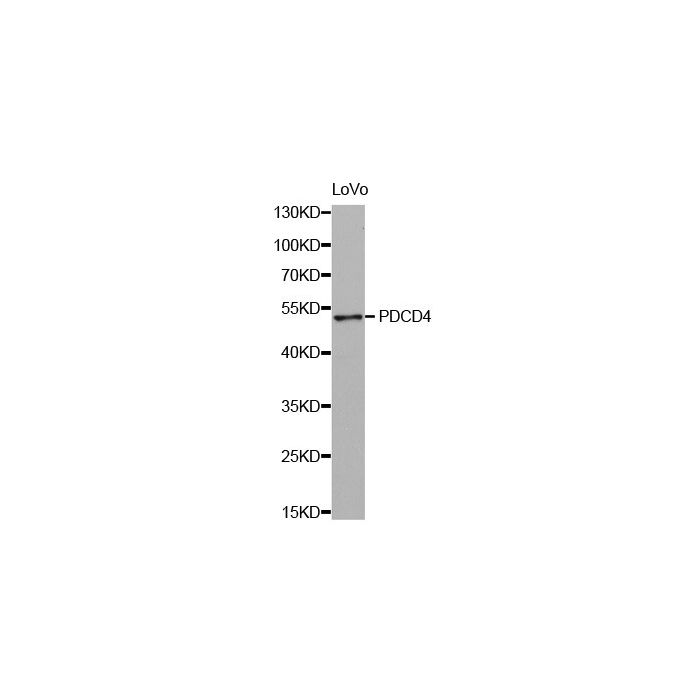
PDCD4 polyclonal, anti-human, mouse, rat
€388.00
In stock
SKU
BS7192
Background:
The transformation suppressor gene Pdcd-4 (programmed cell death gene 4) inhibits the tumor-promoter mediated transformation of mouse keratinocytes and is a potential tumor suppressor gene in the development of human lung cancer. Biochemical analysis suggests that the Pdcd-4 protein is involved in protein translation as well as in nuclear events. Pdcd-4 directly interacts with the RNA helicase eIF4A and inhibits protein synthesis by interfering with the assembly of the cap-dependent translation initiation complex. Pdcd-4 also suppresses the transactivation of AP-1 responsive promoters by c-Jun, suggesting that the transformation-suppressor activity of Pdcd-4 might be due, at least in part, to the inhibition of c-Jun activity. In addition to affecting c-Jun phosphorylation, Pdcd-4 blocks the recruitment of the co-activator p300 by c-Jun.
Alternative Name:
Programmed cell death protein 4, Neoplastic transformation inhibitor protein, Nuclear antigen H731-like, Protein 197/15a, PDCD4, H731
Application Dilution: WB: 1:500 - 1:1000, IHC: 1:50 - 1:100, IP: 1:20 - 1:50, FC: 1:20 - 1:50
Specificity: PDCD4 polyclonal antibody detects endogenous levels of PDCD4 protein.
Immunogen:
Recombinant full length Human PDCD4.
MW: ~ 51 kDa
Swis Prot.: Q53EL6
Purification & Purity:
The antibody was affinity-purified from rabbit antiserum by affinity-chromatography using epitope-specific immunogen and the purity is > 95% (by SDS-PAGE).
Format:
1mg/ml in PBS with 0.1% Sodium Azide, 50% Glycerol.
Storage:
Store at 4°C short term. Aliquot and store at -20°C long term. Avoid freeze-thaw cycles.
For research use only, not for use in diagnostic procedure.
The transformation suppressor gene Pdcd-4 (programmed cell death gene 4) inhibits the tumor-promoter mediated transformation of mouse keratinocytes and is a potential tumor suppressor gene in the development of human lung cancer. Biochemical analysis suggests that the Pdcd-4 protein is involved in protein translation as well as in nuclear events. Pdcd-4 directly interacts with the RNA helicase eIF4A and inhibits protein synthesis by interfering with the assembly of the cap-dependent translation initiation complex. Pdcd-4 also suppresses the transactivation of AP-1 responsive promoters by c-Jun, suggesting that the transformation-suppressor activity of Pdcd-4 might be due, at least in part, to the inhibition of c-Jun activity. In addition to affecting c-Jun phosphorylation, Pdcd-4 blocks the recruitment of the co-activator p300 by c-Jun.
Alternative Name:
Programmed cell death protein 4, Neoplastic transformation inhibitor protein, Nuclear antigen H731-like, Protein 197/15a, PDCD4, H731
Application Dilution: WB: 1:500 - 1:1000, IHC: 1:50 - 1:100, IP: 1:20 - 1:50, FC: 1:20 - 1:50
Specificity: PDCD4 polyclonal antibody detects endogenous levels of PDCD4 protein.
Immunogen:
Recombinant full length Human PDCD4.
MW: ~ 51 kDa
Swis Prot.: Q53EL6
Purification & Purity:
The antibody was affinity-purified from rabbit antiserum by affinity-chromatography using epitope-specific immunogen and the purity is > 95% (by SDS-PAGE).
Format:
1mg/ml in PBS with 0.1% Sodium Azide, 50% Glycerol.
Storage:
Store at 4°C short term. Aliquot and store at -20°C long term. Avoid freeze-thaw cycles.
For research use only, not for use in diagnostic procedure.
| Is Featured? | No |
|---|
Write Your Own Review