
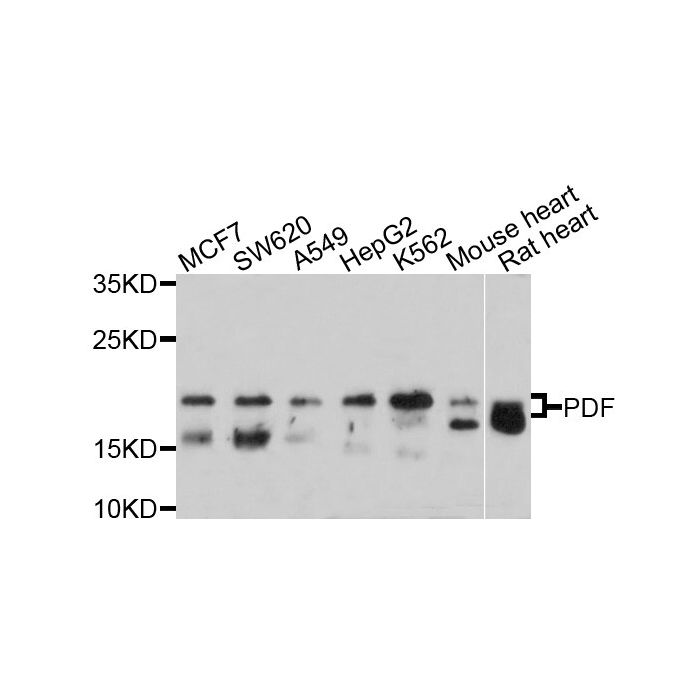
PDF polyclonal, anti-human, mouse, rat
€388.00
In stock
SKU
BS71659
Background:
Protein synthesis proceeds after formylation of methionine by methionyl-tRNA formyl transferase (FMT) and transfer of the charged initiator f-met tRNA to the ribosome. In eubacteria and eukaryotic organelles the product of this gene, peptide deformylase (PDF), removes the formyl group from the initiating methionine of nascent peptides. In eubacteria, deformylation of nascent peptides is required for subsequent cleavage of initiating methionines by methionine aminopeptidase. The discovery that a natural inhibitor of PDF, actinonin, acts as an antimicrobial agent in some bacteria has spurred intensive research into the design of bacterial-specific PDF inhibitors. In human cells, only mitochondrial proteins have N-formylation of initiating methionines. Protein inhibitors of PDF or siRNAs of PDF block the growth of cancer cell lines but have no effect on normal cell growth. In humans, PDF function may therefore be restricted to rapidly growing cells.
Alternative Name:
Polypeptide deformylase, PDF1A
Application Dilution: WB : 1:500 - 1:2000
Specificity: PDF polyclonal antibody detects endogenous levels of PDF protein.
Immunogen:
Recombinant protein of human PDF
MW: Predicted band size: 27 kDa, Observed band size: Refer to Figures
Swis Prot.: Q9HBH1
Purification & Purity:
The antibody was affinity-purified from rabbit antiserum by affinity-chromatography using epitope-specific immunogen and the purity is > 95% (by SDS-PAGE).
Format:
1mg/ml in PBS with 0.02% sodium azide, 50% glycerol, pH7.3.
Storage:
Store at 4°C short term. Aliquot and store at -20°C long term. Avoid freeze-thaw cycles.
For research use only, not for use in diagnostic procedure.
Protein synthesis proceeds after formylation of methionine by methionyl-tRNA formyl transferase (FMT) and transfer of the charged initiator f-met tRNA to the ribosome. In eubacteria and eukaryotic organelles the product of this gene, peptide deformylase (PDF), removes the formyl group from the initiating methionine of nascent peptides. In eubacteria, deformylation of nascent peptides is required for subsequent cleavage of initiating methionines by methionine aminopeptidase. The discovery that a natural inhibitor of PDF, actinonin, acts as an antimicrobial agent in some bacteria has spurred intensive research into the design of bacterial-specific PDF inhibitors. In human cells, only mitochondrial proteins have N-formylation of initiating methionines. Protein inhibitors of PDF or siRNAs of PDF block the growth of cancer cell lines but have no effect on normal cell growth. In humans, PDF function may therefore be restricted to rapidly growing cells.
Alternative Name:
Polypeptide deformylase, PDF1A
Application Dilution: WB : 1:500 - 1:2000
Specificity: PDF polyclonal antibody detects endogenous levels of PDF protein.
Immunogen:
Recombinant protein of human PDF
MW: Predicted band size: 27 kDa, Observed band size: Refer to Figures
Swis Prot.: Q9HBH1
Purification & Purity:
The antibody was affinity-purified from rabbit antiserum by affinity-chromatography using epitope-specific immunogen and the purity is > 95% (by SDS-PAGE).
Format:
1mg/ml in PBS with 0.02% sodium azide, 50% glycerol, pH7.3.
Storage:
Store at 4°C short term. Aliquot and store at -20°C long term. Avoid freeze-thaw cycles.
For research use only, not for use in diagnostic procedure.
| Is Featured? | No |
|---|
Write Your Own Review