
PEA15 polyclonal, anti-human, mouse, rat
€305.00
In stock
SKU
BS61435
Background:
PEA-15 (Phosphoprotein Enriched in Astrocytes) exists in an non-phosphorylated form (N), and two phosphorylated forms, Pa and Pb. PEA-15 is an endogenous substrate for PKC, which mediates the transition from Pa to Pb. The level of PEA-15 phosphorylation changes upon depolymerization or stabilization of tubulins, indicating that PEA-15 colocalizes with microtubules. The first 80 amino acids of PEA-15 correspond to the death effector domain (DED), which is a domain found in proteins that regulate apoptotic signaling pathways. The DED domain is necessary for PEA-15 to block Ras suppression. Although PEA-15 is predominantly expressed in the central nervous system, low levels of PEA-15 are expressed in liver and kidney, and higher levels in muscle. PEA-15 is also referred to as PED, Phosphoprotein Enriched in Diabetes, for its elevated expression in type 2 diabetic patients.
Alternative Name:
Astrocytic phosphoprotein PEA-15, 15 kDa phosphoprotein enriched in astrocytes, Phosphoprotein enriched in diabetes, PED, PEA15
Application Dilution: WB: 1:500~1:1000
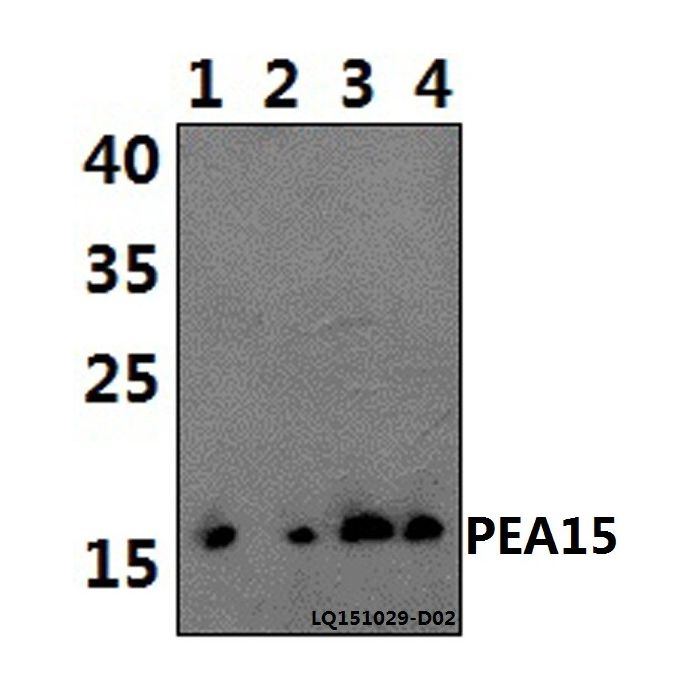
Specificity: PEA15 polyclonal antibody detects endogenous levels of PEA15 protein.
Immunogen:
Synthetic peptide, corresponding to amino acids 85-130 of Human PEA15.
MW: ~ 15 kDa
Swis Prot.: Q15121
Purification & Purity:
The antibody was affinity-purified from rabbit antiserum by affinity-chromatography using epitope-specific immunogen and the purity is > 95% (by SDS-PAGE).
Format:
1 mg/ml in Phosphate buffered saline (PBS) with 0.05% sodium azide, approx. pH 7.3.
Storage:
Store at 4°C short term. Aliquot and store at -20°C long term. Avoid freeze-thaw cycles.
For research use only, not for use in diagnostic procedure.
PEA-15 (Phosphoprotein Enriched in Astrocytes) exists in an non-phosphorylated form (N), and two phosphorylated forms, Pa and Pb. PEA-15 is an endogenous substrate for PKC, which mediates the transition from Pa to Pb. The level of PEA-15 phosphorylation changes upon depolymerization or stabilization of tubulins, indicating that PEA-15 colocalizes with microtubules. The first 80 amino acids of PEA-15 correspond to the death effector domain (DED), which is a domain found in proteins that regulate apoptotic signaling pathways. The DED domain is necessary for PEA-15 to block Ras suppression. Although PEA-15 is predominantly expressed in the central nervous system, low levels of PEA-15 are expressed in liver and kidney, and higher levels in muscle. PEA-15 is also referred to as PED, Phosphoprotein Enriched in Diabetes, for its elevated expression in type 2 diabetic patients.
Alternative Name:
Astrocytic phosphoprotein PEA-15, 15 kDa phosphoprotein enriched in astrocytes, Phosphoprotein enriched in diabetes, PED, PEA15
Application Dilution: WB: 1:500~1:1000
Specificity: PEA15 polyclonal antibody detects endogenous levels of PEA15 protein.
Immunogen:
Synthetic peptide, corresponding to amino acids 85-130 of Human PEA15.
MW: ~ 15 kDa
Swis Prot.: Q15121
Purification & Purity:
The antibody was affinity-purified from rabbit antiserum by affinity-chromatography using epitope-specific immunogen and the purity is > 95% (by SDS-PAGE).
Format:
1 mg/ml in Phosphate buffered saline (PBS) with 0.05% sodium azide, approx. pH 7.3.
Storage:
Store at 4°C short term. Aliquot and store at -20°C long term. Avoid freeze-thaw cycles.
For research use only, not for use in diagnostic procedure.
| Is Featured? | No |
|---|
Write Your Own Review