
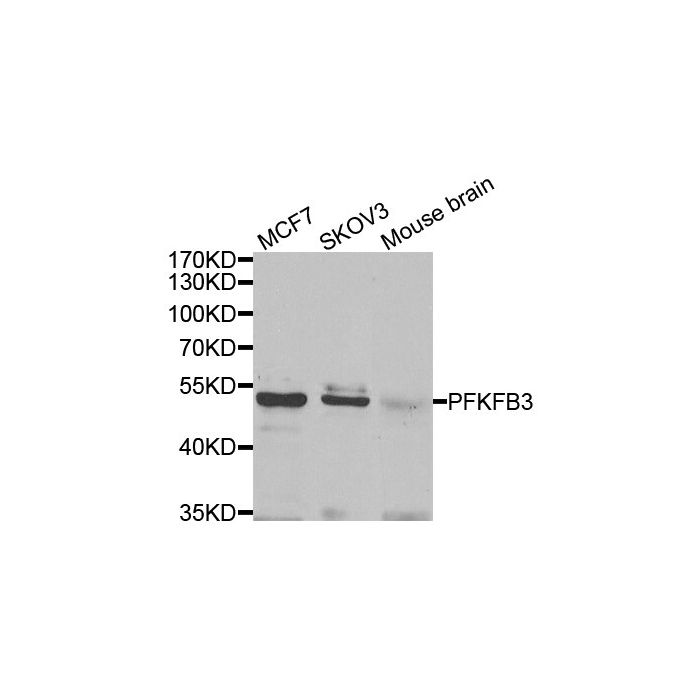
PFKFB3 polyclonal, anti-human, mouse
€388.00
In stock
SKU
BS8601
Background:
Phosphofructosekinase-2 (PFK-2) belongs to the phosphoglycerate mutase family and is required for the activation of cellular glycolysis. Within the glycolysis pathway, PFK-2 regulates the synthesis and degradation of fructose 2,6-bisphosphate (F2,6BP) by enzymatically catalyzing the phosphorylation of fructose-6-phosphate to form F2,6BP. F2,6BP functions as a potent activator for 6-phosphofructo-1-kinase that can then activate the glycolysis pathway. Various tissue-specific isoforms of PFK-2 are expressed, including the PFK-2 specific to the brain (br), the liver (liv) and the placenta (pl), and they are also differentially regulated and function as homodimers. A unique isoform, iPFK-2, is induced following proinflammatory stimuli, and it is also constituitively expressed in a variety of carcinoma cell lines, where it leads to an accumation of intracellular F2,6BP. In addition, the expression of iPFK-2 correlates to increases in DNA sysnthesis, suggesting that iPFK-2 may contribute to cellular transformation of cells and enhanced cellular proliferation.
Alternative Name:
6-phosphofructo-2-kinase/fructose-2, 6-bisphosphatase 3, 6PF-2-K/Fru-2, 6-P2ase 3, PFK/FBPase 3, 6PF-2-K/Fru-2, 6-P2ase brain/placenta-type isozyme, Renal carcinoma antigen NY-REN-56, iPFK-2
Application Dilution: WB: 1:500 - 1:2000, IF: 1:50 - 1:100
Specificity: PFKFB3 polyclonal antibody detects endogenous levels of PFKFB3 protein.
Immunogen:
Recombinant full length Human PFKFB3.
MW: ~ 59kDa
Swis Prot.: Q16875
Purification & Purity:
The antibody was affinity-purified from rabbit antiserum by affinity-chromatography using epitope-specific immunogen and the purity is > 95% (by SDS-PAGE).
Format:
1mg/ml in PBS with 0.1% Sodium Azide, 50% Glycerol.
Storage:
Store at 4°C short term. Aliquot and store at -20°C long term. Avoid freeze-thaw cycles.
For research use only, not for use in diagnostic procedure.
Phosphofructosekinase-2 (PFK-2) belongs to the phosphoglycerate mutase family and is required for the activation of cellular glycolysis. Within the glycolysis pathway, PFK-2 regulates the synthesis and degradation of fructose 2,6-bisphosphate (F2,6BP) by enzymatically catalyzing the phosphorylation of fructose-6-phosphate to form F2,6BP. F2,6BP functions as a potent activator for 6-phosphofructo-1-kinase that can then activate the glycolysis pathway. Various tissue-specific isoforms of PFK-2 are expressed, including the PFK-2 specific to the brain (br), the liver (liv) and the placenta (pl), and they are also differentially regulated and function as homodimers. A unique isoform, iPFK-2, is induced following proinflammatory stimuli, and it is also constituitively expressed in a variety of carcinoma cell lines, where it leads to an accumation of intracellular F2,6BP. In addition, the expression of iPFK-2 correlates to increases in DNA sysnthesis, suggesting that iPFK-2 may contribute to cellular transformation of cells and enhanced cellular proliferation.
Alternative Name:
6-phosphofructo-2-kinase/fructose-2, 6-bisphosphatase 3, 6PF-2-K/Fru-2, 6-P2ase 3, PFK/FBPase 3, 6PF-2-K/Fru-2, 6-P2ase brain/placenta-type isozyme, Renal carcinoma antigen NY-REN-56, iPFK-2
Application Dilution: WB: 1:500 - 1:2000, IF: 1:50 - 1:100
Specificity: PFKFB3 polyclonal antibody detects endogenous levels of PFKFB3 protein.
Immunogen:
Recombinant full length Human PFKFB3.
MW: ~ 59kDa
Swis Prot.: Q16875
Purification & Purity:
The antibody was affinity-purified from rabbit antiserum by affinity-chromatography using epitope-specific immunogen and the purity is > 95% (by SDS-PAGE).
Format:
1mg/ml in PBS with 0.1% Sodium Azide, 50% Glycerol.
Storage:
Store at 4°C short term. Aliquot and store at -20°C long term. Avoid freeze-thaw cycles.
For research use only, not for use in diagnostic procedure.
| Is Featured? | No |
|---|
Write Your Own Review