
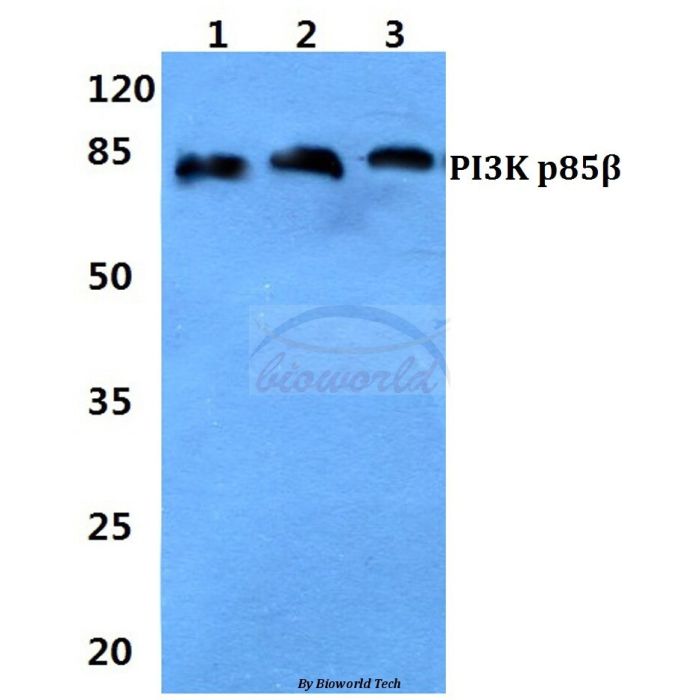
PI3K p85β polyclonal, anti-human, mouse, rat
€305.00
In stock
SKU
BS60314
Background:
Phosphatidylinositol 3-kinase (PI 3-kinase) is composed of p85 and p110 subunits. p85 lacks PI 3-kinase activity and acts as an adapter, coupling p110 to activated protein tyrosine kinase. Two forms of p85 have been described (p85α and p85β), each possessing one SH3 and two SH2 domains. Various p110 isoforms have been identified. p110α and p110β interact with p85α, and p110α has also been shown to interact with p85β in vitro. p110δ expression is restricted to white blood cells. It has been shown to bind p85α and p85β, but it apparently does not phosphorylate these subunits. p110δ seems to have the capacity to autophosphorylate. p110γ does not interact with the p85 subunits. It has been shown to be activated by α and βγ heterotrimeric G proteins.
Alternative Name:
Phosphatidylinositol 3-kinase regulatory subunit beta, PI3-kinase regulatory subunit beta, PI3K regulatory subunit beta, PtdIns-3-kinase regulatory subunit beta, Phosphatidylinositol 3-kinase 85 kDa regulatory subunit beta, PI3-kinase subunit p85-beta, PtdIns-3-kinase regulatory subunit p85-beta, PIK3R2
Application Dilution: WB: 1:500~1:1000
Specificity: PI 3-kinase p85β polyclonal antibody detects endogenous levels of PI 3-kinase p85β protein.
Immunogen:
A synthetic peptide corresponding to residues in Human PI3K p85β.
MW: ~ 85 kDa
Swis Prot.: O00459
Purification & Purity:
The antibody was affinity-purified from rabbit antiserum by affinity-chromatography using epitope-specific immunogen and the purity is > 95% (by SDS-PAGE).
Format:
1 mg/ml in Phosphate buffered saline (PBS) with 0.05% sodium azide, approx. pH 7.2.
Storage:
Store at 4°C short term. Aliquot and store at -20°C long term. Avoid freeze-thaw cycles.
For research use only, not for use in diagnostic procedure.
Phosphatidylinositol 3-kinase (PI 3-kinase) is composed of p85 and p110 subunits. p85 lacks PI 3-kinase activity and acts as an adapter, coupling p110 to activated protein tyrosine kinase. Two forms of p85 have been described (p85α and p85β), each possessing one SH3 and two SH2 domains. Various p110 isoforms have been identified. p110α and p110β interact with p85α, and p110α has also been shown to interact with p85β in vitro. p110δ expression is restricted to white blood cells. It has been shown to bind p85α and p85β, but it apparently does not phosphorylate these subunits. p110δ seems to have the capacity to autophosphorylate. p110γ does not interact with the p85 subunits. It has been shown to be activated by α and βγ heterotrimeric G proteins.
Alternative Name:
Phosphatidylinositol 3-kinase regulatory subunit beta, PI3-kinase regulatory subunit beta, PI3K regulatory subunit beta, PtdIns-3-kinase regulatory subunit beta, Phosphatidylinositol 3-kinase 85 kDa regulatory subunit beta, PI3-kinase subunit p85-beta, PtdIns-3-kinase regulatory subunit p85-beta, PIK3R2
Application Dilution: WB: 1:500~1:1000
Specificity: PI 3-kinase p85β polyclonal antibody detects endogenous levels of PI 3-kinase p85β protein.
Immunogen:
A synthetic peptide corresponding to residues in Human PI3K p85β.
MW: ~ 85 kDa
Swis Prot.: O00459
Purification & Purity:
The antibody was affinity-purified from rabbit antiserum by affinity-chromatography using epitope-specific immunogen and the purity is > 95% (by SDS-PAGE).
Format:
1 mg/ml in Phosphate buffered saline (PBS) with 0.05% sodium azide, approx. pH 7.2.
Storage:
Store at 4°C short term. Aliquot and store at -20°C long term. Avoid freeze-thaw cycles.
For research use only, not for use in diagnostic procedure.
| Is Featured? | No |
|---|
Write Your Own Review