
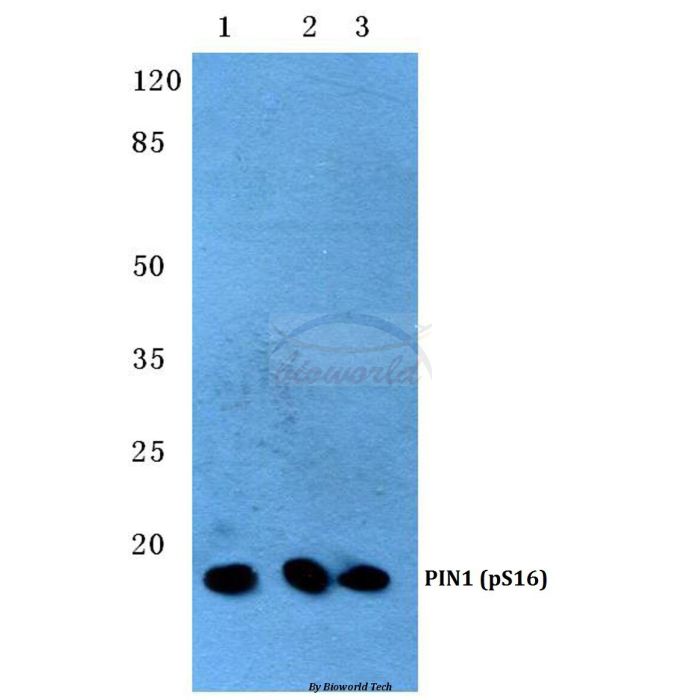
PIN1 (phospho-S16) polyclonal, anti-human, mouse, rat
€328.00
In stock
SKU
BS4860
Background:
NIMA was originally shown in Aspergillus nidulans to be necessary for entry into mitosis. NIMA-related mammalian proteins have since been identified as Nek1, Nek2 and Nek3. High expression of Nek1 is seen in male and female germ cell lines of mouse. Nek2 is the closest known mammalian relative to NIMA. Like NIMA, Nek2 expression peaks at the G2 to M phase transition. Pin1 was originally identified as a NIMA-interacting protein. Pin1 is a peptidyl-prolyl cis/trans isomerase (PPIase), which specifically binds to phosphoserine-proline or phosphothreonine-proline bonds in mitotic phosphoproteins. While previously identified PPIases have been shown to be involved in protein folding, assembly and transport, Pin1 is the first PPIase to be identified as a required protein for cell viability.
Alternative Name:
Peptidyl-prolyl cis-trans isomerase NIMA-interacting 1, Peptidyl-prolyl cis-trans isomerase Pin1, PPIase Pin1, Rotamase Pin1, PIN1
Application Dilution: WB: 1:500~1:1000, IHC: 1:50~1:200
Specificity: PIN1 polyclonal antibody detects endogenous levels of PIN1 protein.
Immunogen:
Synthetic phosphopeptide derived from human PIN1 around the phosphorylation site of Serine 16.
MW: ~ 18 kDa
Swis Prot.: Q13526
Purification & Purity:
The antibody was affinity-purified from rabbit antiserum by affinity-chromatography using epitope-specific immunogen and the purity is > 95% (by SDS-PAGE).
Format:
1mg/ml in PBS with 0.1% Sodium Azide, 50% Glycerol.
Storage:
Store at 4°C short term. Aliquot and store at -20°C long term. Avoid freeze-thaw cycles.
For research use only, not for use in diagnostic procedure.
NIMA was originally shown in Aspergillus nidulans to be necessary for entry into mitosis. NIMA-related mammalian proteins have since been identified as Nek1, Nek2 and Nek3. High expression of Nek1 is seen in male and female germ cell lines of mouse. Nek2 is the closest known mammalian relative to NIMA. Like NIMA, Nek2 expression peaks at the G2 to M phase transition. Pin1 was originally identified as a NIMA-interacting protein. Pin1 is a peptidyl-prolyl cis/trans isomerase (PPIase), which specifically binds to phosphoserine-proline or phosphothreonine-proline bonds in mitotic phosphoproteins. While previously identified PPIases have been shown to be involved in protein folding, assembly and transport, Pin1 is the first PPIase to be identified as a required protein for cell viability.
Alternative Name:
Peptidyl-prolyl cis-trans isomerase NIMA-interacting 1, Peptidyl-prolyl cis-trans isomerase Pin1, PPIase Pin1, Rotamase Pin1, PIN1
Application Dilution: WB: 1:500~1:1000, IHC: 1:50~1:200
Specificity: PIN1 polyclonal antibody detects endogenous levels of PIN1 protein.
Immunogen:
Synthetic phosphopeptide derived from human PIN1 around the phosphorylation site of Serine 16.
MW: ~ 18 kDa
Swis Prot.: Q13526
Purification & Purity:
The antibody was affinity-purified from rabbit antiserum by affinity-chromatography using epitope-specific immunogen and the purity is > 95% (by SDS-PAGE).
Format:
1mg/ml in PBS with 0.1% Sodium Azide, 50% Glycerol.
Storage:
Store at 4°C short term. Aliquot and store at -20°C long term. Avoid freeze-thaw cycles.
For research use only, not for use in diagnostic procedure.
| Is Featured? | No |
|---|
Write Your Own Review