
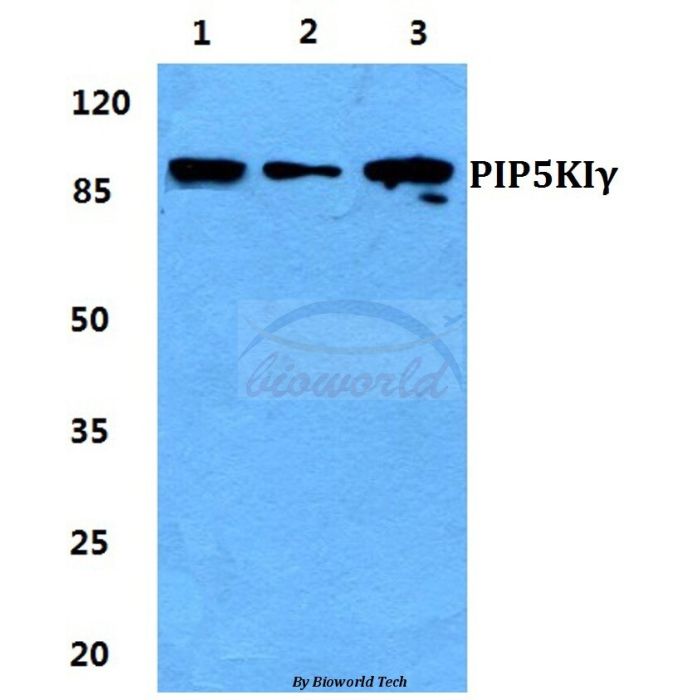
PIP5KIγ polyclonal, anti-human, mouse, rat
€305.00
In stock
SKU
BS5857
Background:
Phosphatidylinositol-4-phosphate-5-kinase (PIPK) synthesizes phosphatidylinositol-4,5-bisphosphate, which regulates various processes including cell proliferation, survival, membrane trafficking and cytoskeletal organization. The PIPK family is divided into type I, type II and type III. Each type of the PIPK family phosphorylates distinct substrates. They contain an activation loop, which determines their enzymatic specificity and subcellular targeting. The phosphatidylinositol-4-phosphate-5-kinase type I consists of three members, PIPK I α, β and γ, which are characterized by phosphorylating PI4P on the 5-hydroxyl. PIPK I α, designated PIPK I β in mouse, is expressed in brain tissue. PIPK I β, designated PIPK I α in mouse, is also called STM7. PIPK I γ has two variants produced by alternative splicing which are expressed in lung, brain and kidneys.
Alternative Name:
Phosphatidylinositol 4-phosphate 5-kinase type-1 gamma, PIP5K1-gamma, PtdIns(4)P-5-kinase 1 gamma, Phosphatidylinositol 4-phosphate 5-kinase type I gamma, PIP5KIgamma, PIP5K1C, KIAA0589, PIP5KI γ, PIP5KI-γ
Application Dilution: WB: 1:500~1:1000
Specificity: PIP5KIγ polyclonal antibody detects endogenous levels of PIP5KIγ protein.
Immunogen:
Synthetic peptide, corresponding to amino acids 346-391 of Human PIP5KIγ.
MW: ~ 73, 87 kDa
Swis Prot.: O60331
Purification & Purity:
The antibody was affinity-purified from rabbit antiserum by affinity-chromatography using epitope-specific immunogen and the purity is > 95% (by SDS-PAGE).
Format:
1mg/ml in PBS with 0.1% Sodium Azide, 50% Glycerol.
Storage:
Store at 4°C short term. Aliquot and store at -20°C long term. Avoid freeze-thaw cycles.
For research use only, not for use in diagnostic procedure.
Phosphatidylinositol-4-phosphate-5-kinase (PIPK) synthesizes phosphatidylinositol-4,5-bisphosphate, which regulates various processes including cell proliferation, survival, membrane trafficking and cytoskeletal organization. The PIPK family is divided into type I, type II and type III. Each type of the PIPK family phosphorylates distinct substrates. They contain an activation loop, which determines their enzymatic specificity and subcellular targeting. The phosphatidylinositol-4-phosphate-5-kinase type I consists of three members, PIPK I α, β and γ, which are characterized by phosphorylating PI4P on the 5-hydroxyl. PIPK I α, designated PIPK I β in mouse, is expressed in brain tissue. PIPK I β, designated PIPK I α in mouse, is also called STM7. PIPK I γ has two variants produced by alternative splicing which are expressed in lung, brain and kidneys.
Alternative Name:
Phosphatidylinositol 4-phosphate 5-kinase type-1 gamma, PIP5K1-gamma, PtdIns(4)P-5-kinase 1 gamma, Phosphatidylinositol 4-phosphate 5-kinase type I gamma, PIP5KIgamma, PIP5K1C, KIAA0589, PIP5KI γ, PIP5KI-γ
Application Dilution: WB: 1:500~1:1000
Specificity: PIP5KIγ polyclonal antibody detects endogenous levels of PIP5KIγ protein.
Immunogen:
Synthetic peptide, corresponding to amino acids 346-391 of Human PIP5KIγ.
MW: ~ 73, 87 kDa
Swis Prot.: O60331
Purification & Purity:
The antibody was affinity-purified from rabbit antiserum by affinity-chromatography using epitope-specific immunogen and the purity is > 95% (by SDS-PAGE).
Format:
1mg/ml in PBS with 0.1% Sodium Azide, 50% Glycerol.
Storage:
Store at 4°C short term. Aliquot and store at -20°C long term. Avoid freeze-thaw cycles.
For research use only, not for use in diagnostic procedure.
| Is Featured? | No |
|---|
Write Your Own Review