
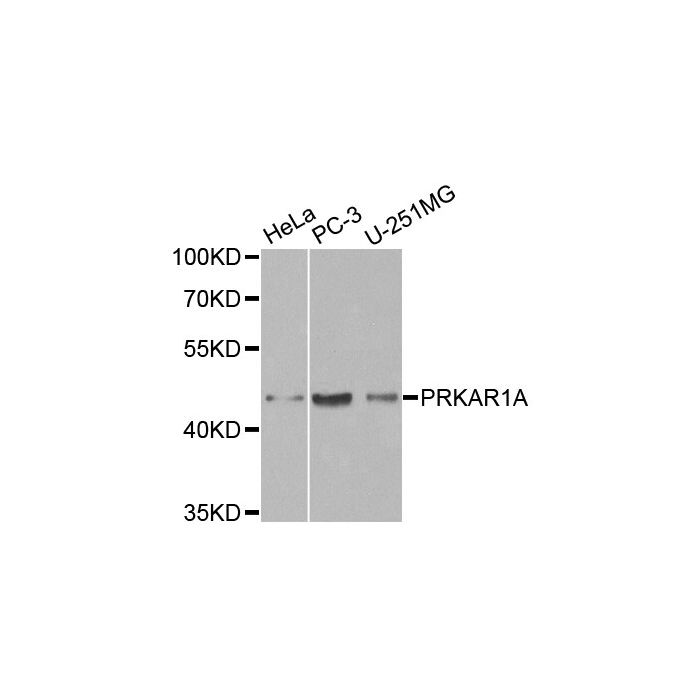
PKA Iα reg polyclonal, anti-human
€388.00
In stock
SKU
BS6217
Background:
The second messenger cyclic AMP (cAMP) mediates diverse cellular responses to external signals such as proliferation, ion transport, regulation of metabolism and gene transcription by activation of the cAMP-dependent protein kinase (cAPK or PKA). Activation of PKA occurs when cAMP binds to the two regulatory subunits of the tetrameric PKA holoenzyme, resulting in release of active catalytic subunits. Four different PKA regulatory subunits have been identified, designated Ia, Ib, IIa and IIb. The PKA Ia reg protein is a tissue-specific extinguisher that downregulates the expression of seven liver genes in hepatoma x fibroblast hybrids. Functional null mutations in the gene that codes for PKA Ia reg cause Carney complex (CNC). CNC is an autosomal dominant multiple neoplasia syndrome. CNC is associated with a variety of characterized symptoms such as cardiac and other myxomas, spotty skin pigmentation, endocrine tumors and psammomatous melanotic schwannomas.
Alternative Name:
AMP-dependent protein kinase type I-alpha regulatory subunit,Tissue-specific extinguisher 1,TSE1,PKR1, PRKAR1, TSE1,PRKAR1A
Application Dilution: WB: 1:500 - 1:2000, IHC: 1:50 - 1:200
Specificity: PKA Iα reg polyclonal antibody detects endogenous levels of PKA Iα reg protein.
Immunogen:
Recombinant full length Human PKA Iα reg.
MW: ~ 43 kDa
Swis Prot.: P10644
Purification & Purity:
The antibody was affinity-purified from rabbit antiserum by affinity-chromatography using epitope-specific immunogen and the purity is > 95% (by SDS-PAGE).
Format:
1mg/ml in PBS with 0.1% Sodium Azide, 50% Glycerol.
Storage:
Store at 4°C short term. Aliquot and store at -20°C long term. Avoid freeze-thaw cycles.
For research use only, not for use in diagnostic procedure.
The second messenger cyclic AMP (cAMP) mediates diverse cellular responses to external signals such as proliferation, ion transport, regulation of metabolism and gene transcription by activation of the cAMP-dependent protein kinase (cAPK or PKA). Activation of PKA occurs when cAMP binds to the two regulatory subunits of the tetrameric PKA holoenzyme, resulting in release of active catalytic subunits. Four different PKA regulatory subunits have been identified, designated Ia, Ib, IIa and IIb. The PKA Ia reg protein is a tissue-specific extinguisher that downregulates the expression of seven liver genes in hepatoma x fibroblast hybrids. Functional null mutations in the gene that codes for PKA Ia reg cause Carney complex (CNC). CNC is an autosomal dominant multiple neoplasia syndrome. CNC is associated with a variety of characterized symptoms such as cardiac and other myxomas, spotty skin pigmentation, endocrine tumors and psammomatous melanotic schwannomas.
Alternative Name:
AMP-dependent protein kinase type I-alpha regulatory subunit,Tissue-specific extinguisher 1,TSE1,PKR1, PRKAR1, TSE1,PRKAR1A
Application Dilution: WB: 1:500 - 1:2000, IHC: 1:50 - 1:200
Specificity: PKA Iα reg polyclonal antibody detects endogenous levels of PKA Iα reg protein.
Immunogen:
Recombinant full length Human PKA Iα reg.
MW: ~ 43 kDa
Swis Prot.: P10644
Purification & Purity:
The antibody was affinity-purified from rabbit antiserum by affinity-chromatography using epitope-specific immunogen and the purity is > 95% (by SDS-PAGE).
Format:
1mg/ml in PBS with 0.1% Sodium Azide, 50% Glycerol.
Storage:
Store at 4°C short term. Aliquot and store at -20°C long term. Avoid freeze-thaw cycles.
For research use only, not for use in diagnostic procedure.
| Is Featured? | No |
|---|
Write Your Own Review