
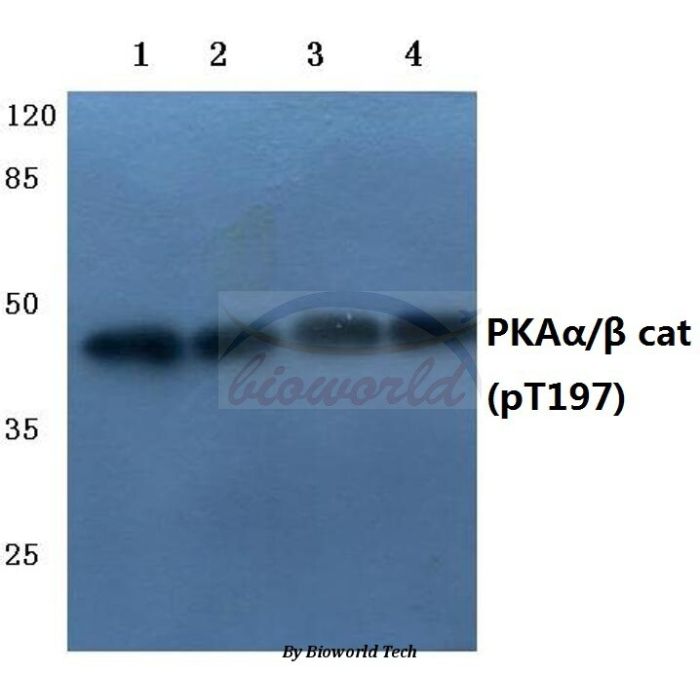
PKAα/β cat (phospho-T197) polyclonal, anti-human, mouse, rat
€328.00
In stock
SKU
BS4345
Background:
PRKACA and PRKACB are members of the Ser/Thr protein kinase family and are a catalytic subunit of cAMP-dependent protein kinase. cAMP is a signaling molecule important for a variety of cellular functions. cAMP exerts its effects by activating the cAMP-dependent protein kinase, which transduces the signal through phosphorylation of different target proteins. The inactive kinase holoenzyme is a tetramer composed of two regulatory and two catalytic subunits. cAMP causes the dissociation of the inactive holoenzyme into a dimer of regulatory subunits bound to four cAMP and two free monomeric catalytic subunits.
Alternative Name:
cAMP-dependent protein kinase catalytic subunit alpha, PKA C-alpha, PRKACA, PKACA, PKA Ca, cAMP-dependent protein kinase catalytic subunit beta, PKA C-beta, PRKACB, PKACB, PKA Cb,
Application Dilution: WB: 1:500~1:1000, IHC: 1:50~1:200
Specificity: p-PKAα/β cat (T197) polyclonal antibody detects endogenous levels of PKAα/βcat protein when phosphorylated at Thr197.
Immunogen:
Synthetic phosphopeptide derived from human PKAα around the phosphorylation site of Threonine 197.
MW: ~ 42 kDa
Swis Prot.: P17612/P22694
Purification & Purity:
The antibody was affinity-purified from rabbit antiserum by affinity-chromatography using epitope-specific immunogen and the purity is > 95% (by SDS-PAGE).
Format:
1 mg/ml in Phosphate buffered saline (PBS) with 15 mM sodium azide, approx. pH 7.2.
Storage:
Store at 4°C short term. Aliquot and store at -20°C long term. Avoid freeze-thaw cycles.
For research use only, not for use in diagnostic procedure.
PRKACA and PRKACB are members of the Ser/Thr protein kinase family and are a catalytic subunit of cAMP-dependent protein kinase. cAMP is a signaling molecule important for a variety of cellular functions. cAMP exerts its effects by activating the cAMP-dependent protein kinase, which transduces the signal through phosphorylation of different target proteins. The inactive kinase holoenzyme is a tetramer composed of two regulatory and two catalytic subunits. cAMP causes the dissociation of the inactive holoenzyme into a dimer of regulatory subunits bound to four cAMP and two free monomeric catalytic subunits.
Alternative Name:
cAMP-dependent protein kinase catalytic subunit alpha, PKA C-alpha, PRKACA, PKACA, PKA Ca, cAMP-dependent protein kinase catalytic subunit beta, PKA C-beta, PRKACB, PKACB, PKA Cb,
Application Dilution: WB: 1:500~1:1000, IHC: 1:50~1:200
Specificity: p-PKAα/β cat (T197) polyclonal antibody detects endogenous levels of PKAα/βcat protein when phosphorylated at Thr197.
Immunogen:
Synthetic phosphopeptide derived from human PKAα around the phosphorylation site of Threonine 197.
MW: ~ 42 kDa
Swis Prot.: P17612/P22694
Purification & Purity:
The antibody was affinity-purified from rabbit antiserum by affinity-chromatography using epitope-specific immunogen and the purity is > 95% (by SDS-PAGE).
Format:
1 mg/ml in Phosphate buffered saline (PBS) with 15 mM sodium azide, approx. pH 7.2.
Storage:
Store at 4°C short term. Aliquot and store at -20°C long term. Avoid freeze-thaw cycles.
For research use only, not for use in diagnostic procedure.
| Is Featured? | No |
|---|
Write Your Own Review