
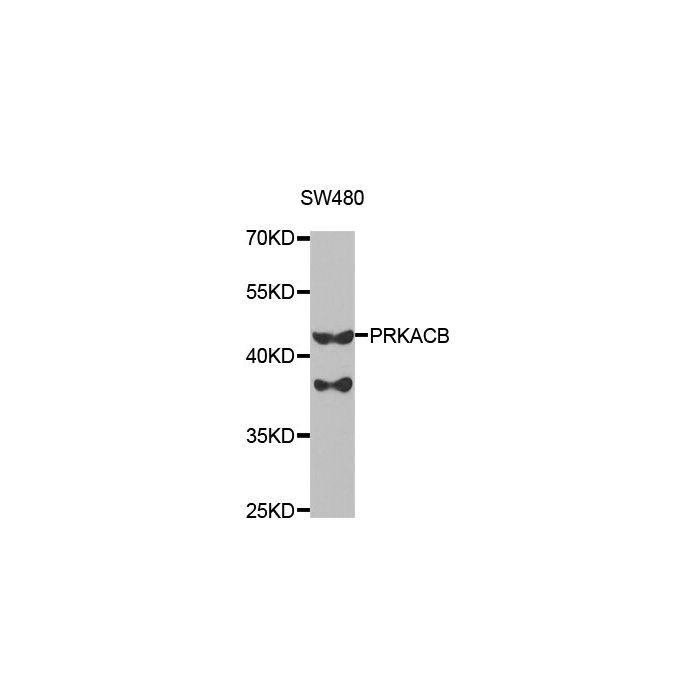
PKAβ cat polyclonal, anti-human, mouse
€388.00
In stock
SKU
BS8469
Background:
Activation of PKA occurs when cAMP binds to the two regulatory subunits of the tetrameric PKA holoenzyme resulting in release of active catalytic subunits. Three catalytic (C) subunits have been identified, designated Cα, Cβ and Cγ, that each represent specific gene products. Cα and Cβ are closely related (93% amino acid sequence similarity), whereas Cγ displays 83% and 79% similarity to Cα and Cβ, respectively. Activation of transcription upon elevation of cAMP levels results from translocation of PKA to the nucleus where it phosphorylates the transcription factor cAMP response element binding protein (CREB) on serine 133 which in turn leads to TFIIB binding to TATA-box-binding protein TBP1, thus linking phospho-CREB to the Pol II transcription initiation complex.
Alternative Name:
cAMP-dependent protein kinase catalytic subunit beta, PRKACB, PKA C beta, PKA C-beta, PKACB, PKA Cβ
Application Dilution: WB: 1:500~1:2000, IHC: 1:50~1:200, IF: 1:50~1:200
Specificity: PKAβ cat polyclonal antibody detects endogenous levels of PKAβ cat protein.
Immunogen:
Recombinant full length Human PKAβ cat.
MW: ~ 40kDa
Swis Prot.: P22694
Purification & Purity:
The antibody was affinity-purified from rabbit antiserum by affinity-chromatography using epitope-specific immunogen and the purity is > 95% (by SDS-PAGE).
Format:
1mg/ml in PBS with 0.1% Sodium Azide, 50% Glycerol.
Storage:
Store at 4°C short term. Aliquot and store at -20°C long term. Avoid freeze-thaw cycles.
For research use only, not for use in diagnostic procedure.
Activation of PKA occurs when cAMP binds to the two regulatory subunits of the tetrameric PKA holoenzyme resulting in release of active catalytic subunits. Three catalytic (C) subunits have been identified, designated Cα, Cβ and Cγ, that each represent specific gene products. Cα and Cβ are closely related (93% amino acid sequence similarity), whereas Cγ displays 83% and 79% similarity to Cα and Cβ, respectively. Activation of transcription upon elevation of cAMP levels results from translocation of PKA to the nucleus where it phosphorylates the transcription factor cAMP response element binding protein (CREB) on serine 133 which in turn leads to TFIIB binding to TATA-box-binding protein TBP1, thus linking phospho-CREB to the Pol II transcription initiation complex.
Alternative Name:
cAMP-dependent protein kinase catalytic subunit beta, PRKACB, PKA C beta, PKA C-beta, PKACB, PKA Cβ
Application Dilution: WB: 1:500~1:2000, IHC: 1:50~1:200, IF: 1:50~1:200
Specificity: PKAβ cat polyclonal antibody detects endogenous levels of PKAβ cat protein.
Immunogen:
Recombinant full length Human PKAβ cat.
MW: ~ 40kDa
Swis Prot.: P22694
Purification & Purity:
The antibody was affinity-purified from rabbit antiserum by affinity-chromatography using epitope-specific immunogen and the purity is > 95% (by SDS-PAGE).
Format:
1mg/ml in PBS with 0.1% Sodium Azide, 50% Glycerol.
Storage:
Store at 4°C short term. Aliquot and store at -20°C long term. Avoid freeze-thaw cycles.
For research use only, not for use in diagnostic procedure.
| Is Featured? | No |
|---|
Write Your Own Review