
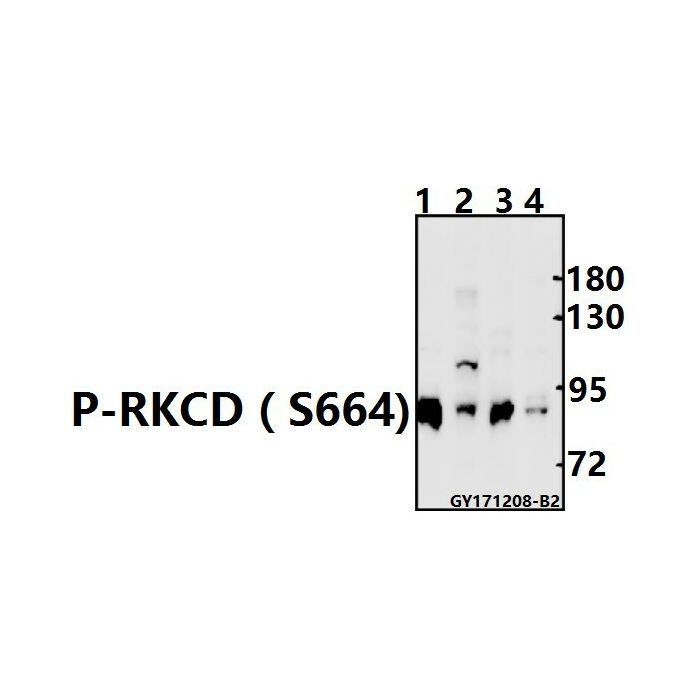
PKC δ/RKCD (phospho-S664) polyclonal, anti-human, mouse, rat
€328.00
In stock
SKU
BS64162
Background:
Protein kinase C (PKC) family members influence a variety of cellular functions, including cell growth, cell differentiation, hormone secretion and membrane function. PKC isoforms are calcium and phospholipid-dependent serine/threonine protein kinases. Diacylglycerols (DAG) and tumor promoting phorbol esters bind to and activate PKC. PKC δ phosphorylation on Thr 507 mediates inhibition of JAK2 and Stat3 function. PKC δ phosphorylates and associates with Stat3 on Ser 727 following induction by IL-6 to negatively regulate the DNA binding and transcriptional activity of Stat3. The Tyr 525, 523 and 565 residues in the catalytic domain are crucial for activation of PKC δ. The Tyr 52, 155 and 187 residues of PKC δ reside within a regulatory domain. The residue Ser 643 appears to be an autophosphorylation site.
Alternative Name:
Protein kinase C delta type, Tyrosine-protein kinase PRKCD, nPKC-delta, Sphingosine-dependent protein kinase-1, SDK1, PRKCD
Application Dilution: WB: 1:500~1:1000
Specificity: p-RKCD (S664) pAb detects endogenous levels of p-RKCD (S664) protein only when phosphorylated at Ser664.
Immunogen:
Synthetic phosphopeptide derived from human PKCD around the phosphorylation site of Serine 664
MW: ~ 78 kDa
Swis Prot.: Q05655
Purification & Purity:
The antibody was affinity-purified from rabbit antiserum by affinity-chromatography using epitope-specific immunogen and the purity is > 95% (by SDS-PAGE).
Format:
1 mg/ml in Phosphate buffered saline (PBS) with 0.05% sodium azide, approx. pH 7.3.
Storage:
Store at 4°C short term. Aliquot and store at -20°C long term. Avoid freeze-thaw cycles.
For research use only, not for use in diagnostic procedure.
Protein kinase C (PKC) family members influence a variety of cellular functions, including cell growth, cell differentiation, hormone secretion and membrane function. PKC isoforms are calcium and phospholipid-dependent serine/threonine protein kinases. Diacylglycerols (DAG) and tumor promoting phorbol esters bind to and activate PKC. PKC δ phosphorylation on Thr 507 mediates inhibition of JAK2 and Stat3 function. PKC δ phosphorylates and associates with Stat3 on Ser 727 following induction by IL-6 to negatively regulate the DNA binding and transcriptional activity of Stat3. The Tyr 525, 523 and 565 residues in the catalytic domain are crucial for activation of PKC δ. The Tyr 52, 155 and 187 residues of PKC δ reside within a regulatory domain. The residue Ser 643 appears to be an autophosphorylation site.
Alternative Name:
Protein kinase C delta type, Tyrosine-protein kinase PRKCD, nPKC-delta, Sphingosine-dependent protein kinase-1, SDK1, PRKCD
Application Dilution: WB: 1:500~1:1000
Specificity: p-RKCD (S664) pAb detects endogenous levels of p-RKCD (S664) protein only when phosphorylated at Ser664.
Immunogen:
Synthetic phosphopeptide derived from human PKCD around the phosphorylation site of Serine 664
MW: ~ 78 kDa
Swis Prot.: Q05655
Purification & Purity:
The antibody was affinity-purified from rabbit antiserum by affinity-chromatography using epitope-specific immunogen and the purity is > 95% (by SDS-PAGE).
Format:
1 mg/ml in Phosphate buffered saline (PBS) with 0.05% sodium azide, approx. pH 7.3.
Storage:
Store at 4°C short term. Aliquot and store at -20°C long term. Avoid freeze-thaw cycles.
For research use only, not for use in diagnostic procedure.
| Is Featured? | No |
|---|
Write Your Own Review