
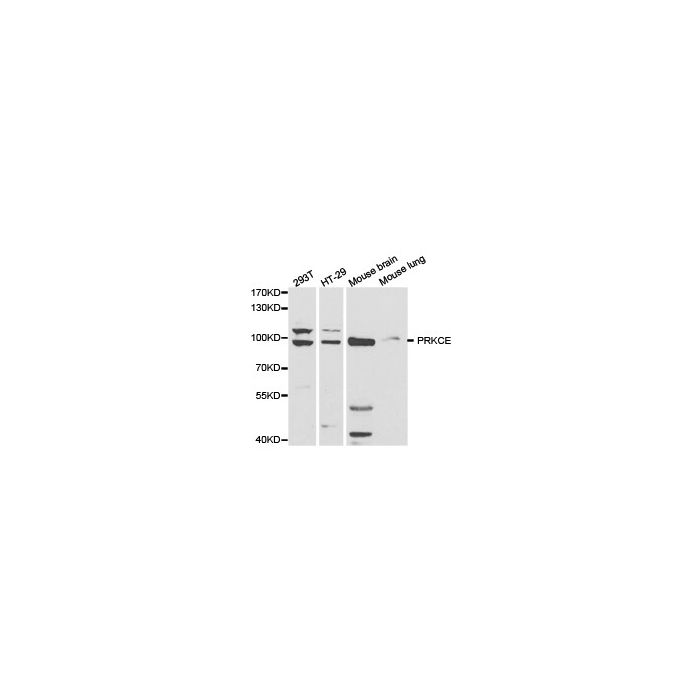
PKC ε/ PRKCE polyclonal, anti-human, mouse, rat
€388.00
In stock
SKU
BS6704
Background:
Members of the protein kinase C (PKC) family play a key regulatory role in a variety of cellular functions including cell growth and differentiation, gene expression, hormone secretion and membrane function. PKCs were originally identified as serine/threonine protein kinases whose activity was dependent on calcium and phospholipids. Diacylglycerols (DAG) and tumor promoting phorbol esters bind to and activate PKC. PKCs can be subdivided into many different isoforms (α, βI, βII, γ, ∂, é, Ω, h, †, λ/î, µ and n). Patterns of expression for each PKC isoform differ among tissues and PKC family members exhibit clear differences in their cofactor dependencies. For instance, the kinase activities of PKC ∂ and é are independent of Ca++. On the other hand, most of the other PKC members possess phorbol ester-binding activities and kinase activities.
Alternative Name:
Protein kinase C epsilon type, nPKC-epsilon, PRKCE, PKCE
Application Dilution: WB: 1:500~1:2000, IHC/ICC: 1:50~1:200
Specificity: PRKCE polyclonal antibody detects endogenous levels of PRKCE protein.
Immunogen:
Recombinant full length Human PKC ε.
MW: ~ 83 kDa
Swis Prot.: Q02156
Purification & Purity:
The antibody was affinity-purified from rabbit antiserum by affinity-chromatography using epitope-specific immunogen and the purity is > 95% (by SDS-PAGE).
Format:
1mg/ml in PBS with 0.1% Sodium Azide, 50% Glycerol.
Storage:
Store at 4°C short term. Aliquot and store at -20°C long term. Avoid freeze-thaw cycles.
For research use only, not for use in diagnostic procedure.
Members of the protein kinase C (PKC) family play a key regulatory role in a variety of cellular functions including cell growth and differentiation, gene expression, hormone secretion and membrane function. PKCs were originally identified as serine/threonine protein kinases whose activity was dependent on calcium and phospholipids. Diacylglycerols (DAG) and tumor promoting phorbol esters bind to and activate PKC. PKCs can be subdivided into many different isoforms (α, βI, βII, γ, ∂, é, Ω, h, †, λ/î, µ and n). Patterns of expression for each PKC isoform differ among tissues and PKC family members exhibit clear differences in their cofactor dependencies. For instance, the kinase activities of PKC ∂ and é are independent of Ca++. On the other hand, most of the other PKC members possess phorbol ester-binding activities and kinase activities.
Alternative Name:
Protein kinase C epsilon type, nPKC-epsilon, PRKCE, PKCE
Application Dilution: WB: 1:500~1:2000, IHC/ICC: 1:50~1:200
Specificity: PRKCE polyclonal antibody detects endogenous levels of PRKCE protein.
Immunogen:
Recombinant full length Human PKC ε.
MW: ~ 83 kDa
Swis Prot.: Q02156
Purification & Purity:
The antibody was affinity-purified from rabbit antiserum by affinity-chromatography using epitope-specific immunogen and the purity is > 95% (by SDS-PAGE).
Format:
1mg/ml in PBS with 0.1% Sodium Azide, 50% Glycerol.
Storage:
Store at 4°C short term. Aliquot and store at -20°C long term. Avoid freeze-thaw cycles.
For research use only, not for use in diagnostic procedure.
| Is Featured? | No |
|---|
Write Your Own Review