
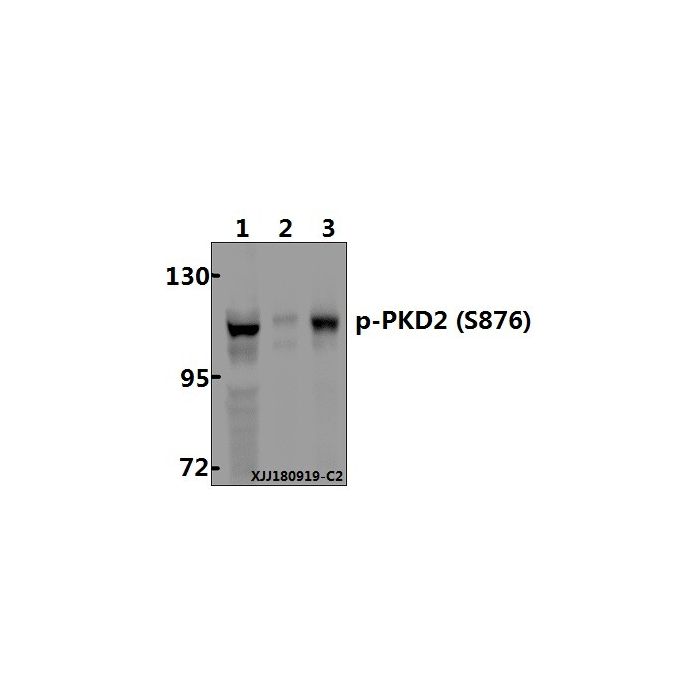
PKD2 (phospho-S876) polyclonal, anti-human
€328.00
In stock
SKU
BS4351
Catalog Number: BS4351
Size: 100 µl
Other Size: 50 µl
Isotype: rabbit IgG
Applications: WB
Questions? Contact us!
Size: 100 µl
Other Size: 50 µl
Isotype: rabbit IgG
Applications: WB
Questions? Contact us!
Background:
Protein kinase D2 (PKD2) is one of three members of the protein kinase D family, including PKD1/PKCμ and PKD3/PKCν, that belong to the calcium/calmodulin superfamily of serine/threonine protein kinases. PKDs contain a conserved, carboxy-terminal catalytic domain, an amino-terminal regulatory region hallmarked by a PH domain that coordinates subcellular localization, and two zinc-finger/C1 lipid-binding domains that mediate activation of the enzyme in response to diacylglycerol (DAG) or phorbol ester. In addition to lipid-mediated activation, PKD catalytic activity can also be stimulated via phosphorylation of critical serine residues within the activation loop of the enzyme. Novel PKCs, such as PKCη and PKCε, have been shown to phosphorylate PKD1 at Ser744 and Ser748 (Ser706 and Ser710 in human PKD2), resulting in alleviation of autoinhibition of the enzyme mediated by PH domain interactions with the catalytic domain. Phosphorylation and activation of PKD isoforms has also been described for other upstream kinases. For example, casein kinase 2 (CK2) has been shown to phosphorylate PKD2 at Ser244, which promotes nuclear accumulation of PKD2, phosphorylation of HDAC7, and expression of Nur77. Although only a handfull of PKD2 effectors have been identified, PKD2 has been implicated in regulating an array of cellular events, including cell survival, development, growth, migration, and transformation. PKD2-mediated phosphorylation of at least one known substrate, phosphatidylinositol 4-kinase type IIIβ (PI4KIIIβ), also implicates PKD2 in the formation and regulation of exocytotic transport vesicles from the trans Golgi network.
Alternative Name:
Serine/threonine-protein kinase D2, nPKC-D2, PRKD2, PKD2, HSPC187,
Application Dilution:
WB: 1:500~1:1000
Specificity: PKD2 (phospho-S876) polyclonal antibody detects endogenous levels of PKD2 protein only when phosphorylated at Ser876.
Immunogen:
Synthetic phosphopeptide derived from human PKD2 around the phosphorylation site of Serine 876
MW: ~ 105 kDa
Swiss-Prot: Q9BZL6
Purification & Purity:
The antibody was affinity-purified from rabbit antiserum by affinity-chromatography using epitope-specific immunogen and the purity is > 95% (by SDS-PAGE).
Format:
Rabbit IgG, 1mg/ml in PBS with 0.02% sodium azide, 50% glycerol, pH7.2
Storage:
Store at 4°C short term. Aliquot and store at -20°C long term. Avoid freeze-thaw cycles.
For research use only, not for use in diagnostic procedure.
Protein kinase D2 (PKD2) is one of three members of the protein kinase D family, including PKD1/PKCμ and PKD3/PKCν, that belong to the calcium/calmodulin superfamily of serine/threonine protein kinases. PKDs contain a conserved, carboxy-terminal catalytic domain, an amino-terminal regulatory region hallmarked by a PH domain that coordinates subcellular localization, and two zinc-finger/C1 lipid-binding domains that mediate activation of the enzyme in response to diacylglycerol (DAG) or phorbol ester. In addition to lipid-mediated activation, PKD catalytic activity can also be stimulated via phosphorylation of critical serine residues within the activation loop of the enzyme. Novel PKCs, such as PKCη and PKCε, have been shown to phosphorylate PKD1 at Ser744 and Ser748 (Ser706 and Ser710 in human PKD2), resulting in alleviation of autoinhibition of the enzyme mediated by PH domain interactions with the catalytic domain. Phosphorylation and activation of PKD isoforms has also been described for other upstream kinases. For example, casein kinase 2 (CK2) has been shown to phosphorylate PKD2 at Ser244, which promotes nuclear accumulation of PKD2, phosphorylation of HDAC7, and expression of Nur77. Although only a handfull of PKD2 effectors have been identified, PKD2 has been implicated in regulating an array of cellular events, including cell survival, development, growth, migration, and transformation. PKD2-mediated phosphorylation of at least one known substrate, phosphatidylinositol 4-kinase type IIIβ (PI4KIIIβ), also implicates PKD2 in the formation and regulation of exocytotic transport vesicles from the trans Golgi network.
Alternative Name:
Serine/threonine-protein kinase D2, nPKC-D2, PRKD2, PKD2, HSPC187,
Application Dilution:
WB: 1:500~1:1000
Specificity: PKD2 (phospho-S876) polyclonal antibody detects endogenous levels of PKD2 protein only when phosphorylated at Ser876.
Immunogen:
Synthetic phosphopeptide derived from human PKD2 around the phosphorylation site of Serine 876
MW: ~ 105 kDa
Swiss-Prot: Q9BZL6
Purification & Purity:
The antibody was affinity-purified from rabbit antiserum by affinity-chromatography using epitope-specific immunogen and the purity is > 95% (by SDS-PAGE).
Format:
Rabbit IgG, 1mg/ml in PBS with 0.02% sodium azide, 50% glycerol, pH7.2
Storage:
Store at 4°C short term. Aliquot and store at -20°C long term. Avoid freeze-thaw cycles.
For research use only, not for use in diagnostic procedure.
| Is Featured? | No |
|---|
Write Your Own Review