
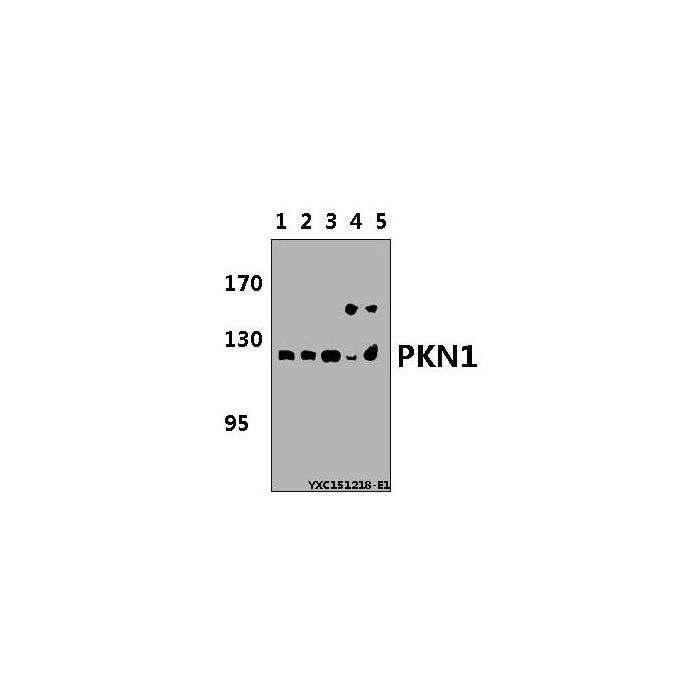
PKN1 polyclonal, anti-human, mouse, rat
€305.00
In stock
SKU
BS5859
Background:
Protein kinase N (PKN) is a fatty acid-activated serine/threonine kinase whose catalytic domain exhibits homology with that of the PKC family. PKN associates with Rho via its amino terminus, is activated in a GTP-dependent manner and phosphorylates the head-rod domain of neurofilament protein. A second protein, rhophilin, exhibits 40% sequence identity with the amino terminal Rho binding domain. The enzymatic activity of rhophilin has not been demonstrated and it is possible that it acts through the recruitment of cytoskeletal components that initiate a kinase signaling cascade. Citron interacts specifically with active Rho and Rac1 but not Cdc42. Citron exhibits a distinctive protein organization and little homology with the Rho binding domains of PKN and rhophilin.
Alternative Name:
Serine/threonine-protein kinase N1, Protease-activated kinase 1, PAK-1, Protein kinase C-like 1, Protein kinase C-like PKN, Protein kinase PKN-alpha, Protein-kinase C-related kinase 1, Serine-threonine protein kinase N, PAK1, PKN, PRK1, PRKCL1
Application Dilution: WB: 1:500~1:1000, ICC: 1:50~1:200
Specificity: PKN1 polyclonal antibody detects endogenous levels of PKN1 protein.
Immunogen:
Synthetic peptide, corresponding to amino acids 294-339 of Human PKN1.
MW: ~ 103, 120 kDa
Swis Prot.: Q16512
Purification & Purity:
The antibody was affinity-purified from rabbit antiserum by affinity-chromatography using epitope-specific immunogen and the purity is > 95% (by SDS-PAGE).
Format:
1 mg/ml in Phosphate buffered saline (PBS) with 0.05% sodium azide, approx. pH 7.2.
Storage:
Store at 4°C short term. Aliquot and store at -20°C long term. Avoid freeze-thaw cycles.
For research use only, not for use in diagnostic procedure.
Protein kinase N (PKN) is a fatty acid-activated serine/threonine kinase whose catalytic domain exhibits homology with that of the PKC family. PKN associates with Rho via its amino terminus, is activated in a GTP-dependent manner and phosphorylates the head-rod domain of neurofilament protein. A second protein, rhophilin, exhibits 40% sequence identity with the amino terminal Rho binding domain. The enzymatic activity of rhophilin has not been demonstrated and it is possible that it acts through the recruitment of cytoskeletal components that initiate a kinase signaling cascade. Citron interacts specifically with active Rho and Rac1 but not Cdc42. Citron exhibits a distinctive protein organization and little homology with the Rho binding domains of PKN and rhophilin.
Alternative Name:
Serine/threonine-protein kinase N1, Protease-activated kinase 1, PAK-1, Protein kinase C-like 1, Protein kinase C-like PKN, Protein kinase PKN-alpha, Protein-kinase C-related kinase 1, Serine-threonine protein kinase N, PAK1, PKN, PRK1, PRKCL1
Application Dilution: WB: 1:500~1:1000, ICC: 1:50~1:200
Specificity: PKN1 polyclonal antibody detects endogenous levels of PKN1 protein.
Immunogen:
Synthetic peptide, corresponding to amino acids 294-339 of Human PKN1.
MW: ~ 103, 120 kDa
Swis Prot.: Q16512
Purification & Purity:
The antibody was affinity-purified from rabbit antiserum by affinity-chromatography using epitope-specific immunogen and the purity is > 95% (by SDS-PAGE).
Format:
1 mg/ml in Phosphate buffered saline (PBS) with 0.05% sodium azide, approx. pH 7.2.
Storage:
Store at 4°C short term. Aliquot and store at -20°C long term. Avoid freeze-thaw cycles.
For research use only, not for use in diagnostic procedure.
| Is Featured? | No |
|---|
Write Your Own Review