
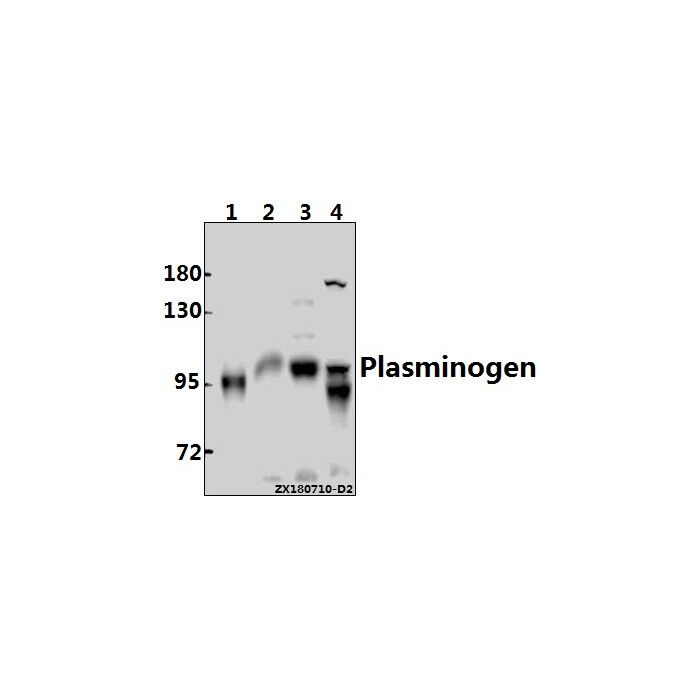
Plasminogen (Y233) polyclonal, anti-human, mouse, rat
€305.00
In stock
SKU
BS9229
Background:
Cleavage of the serine proteinase plasminogen to form plasmin is the central event in the dissolution of blood clots by the fibrinolytic system. Within the fibrinolytic cascade, the serine proteinases urokinase-type plasminogen activator (uPA) and tissue-type plasminogen activator (tPA) activate the proenzyme plasminogen by cleaving plasminogen to form the fibrinolytically active enzyme plasmin. The enzyme plasmin consists of a heavy chain of 561 amino acids, which originates from the N-terminus of plasminogen, and a light chain of 230 amino acid residues, which is derived from the C-terminus of plasminogen. Plasmin is a proangiogenic proteinase that is capable of degrading a variety of extracellular matrix proteins and that facilitates endothelial cell migration and angiogenesis. In the presence of free sulfhydryl donors (FSD), plasmin undergoes auto-proteolysis and is converted to the enzyme angiostatin, which blocks angiogenesis and neovascularization and can inhibit the growth of primary and metastatic tumors.
Alternative Name:
Plasminogen, Plasmin heavy chain A, Activation peptide, Angiostatin, Plasmin heavy chain A, short form, PLG
Application Dilution: WB: 1:500~1:1000
Specificity: Plasminogen (Y233) polyclonal antibody detects endogenous levels of Plasminogen protein.
Immunogen:
Synthetic peptide, corresponding to amino acids 201-250 of Human Plasminogen.
MW: ~ 100 kDa
Swis Prot.: P00747
Purification & Purity:
The antibody was affinity-purified from rabbit antiserum by affinity-chromatography using epitope-specific immunogen and the purity is > 95% (by SDS-PAGE).
Format:
1 mg/ml in Phosphate buffered saline (PBS) with 0.05% sodium azide, approx. pH 7.2.
Storage:
Store at 4°C short term. Aliquot and store at -20°C long term. Avoid freeze-thaw cycles.
For research use only, not for use in diagnostic procedure.
Cleavage of the serine proteinase plasminogen to form plasmin is the central event in the dissolution of blood clots by the fibrinolytic system. Within the fibrinolytic cascade, the serine proteinases urokinase-type plasminogen activator (uPA) and tissue-type plasminogen activator (tPA) activate the proenzyme plasminogen by cleaving plasminogen to form the fibrinolytically active enzyme plasmin. The enzyme plasmin consists of a heavy chain of 561 amino acids, which originates from the N-terminus of plasminogen, and a light chain of 230 amino acid residues, which is derived from the C-terminus of plasminogen. Plasmin is a proangiogenic proteinase that is capable of degrading a variety of extracellular matrix proteins and that facilitates endothelial cell migration and angiogenesis. In the presence of free sulfhydryl donors (FSD), plasmin undergoes auto-proteolysis and is converted to the enzyme angiostatin, which blocks angiogenesis and neovascularization and can inhibit the growth of primary and metastatic tumors.
Alternative Name:
Plasminogen, Plasmin heavy chain A, Activation peptide, Angiostatin, Plasmin heavy chain A, short form, PLG
Application Dilution: WB: 1:500~1:1000
Specificity: Plasminogen (Y233) polyclonal antibody detects endogenous levels of Plasminogen protein.
Immunogen:
Synthetic peptide, corresponding to amino acids 201-250 of Human Plasminogen.
MW: ~ 100 kDa
Swis Prot.: P00747
Purification & Purity:
The antibody was affinity-purified from rabbit antiserum by affinity-chromatography using epitope-specific immunogen and the purity is > 95% (by SDS-PAGE).
Format:
1 mg/ml in Phosphate buffered saline (PBS) with 0.05% sodium azide, approx. pH 7.2.
Storage:
Store at 4°C short term. Aliquot and store at -20°C long term. Avoid freeze-thaw cycles.
For research use only, not for use in diagnostic procedure.
| Is Featured? | No |
|---|
Write Your Own Review